45 Humanitarian and civil society organisations warn that Israel’s assault on Gaza City amounts to a death sentence.
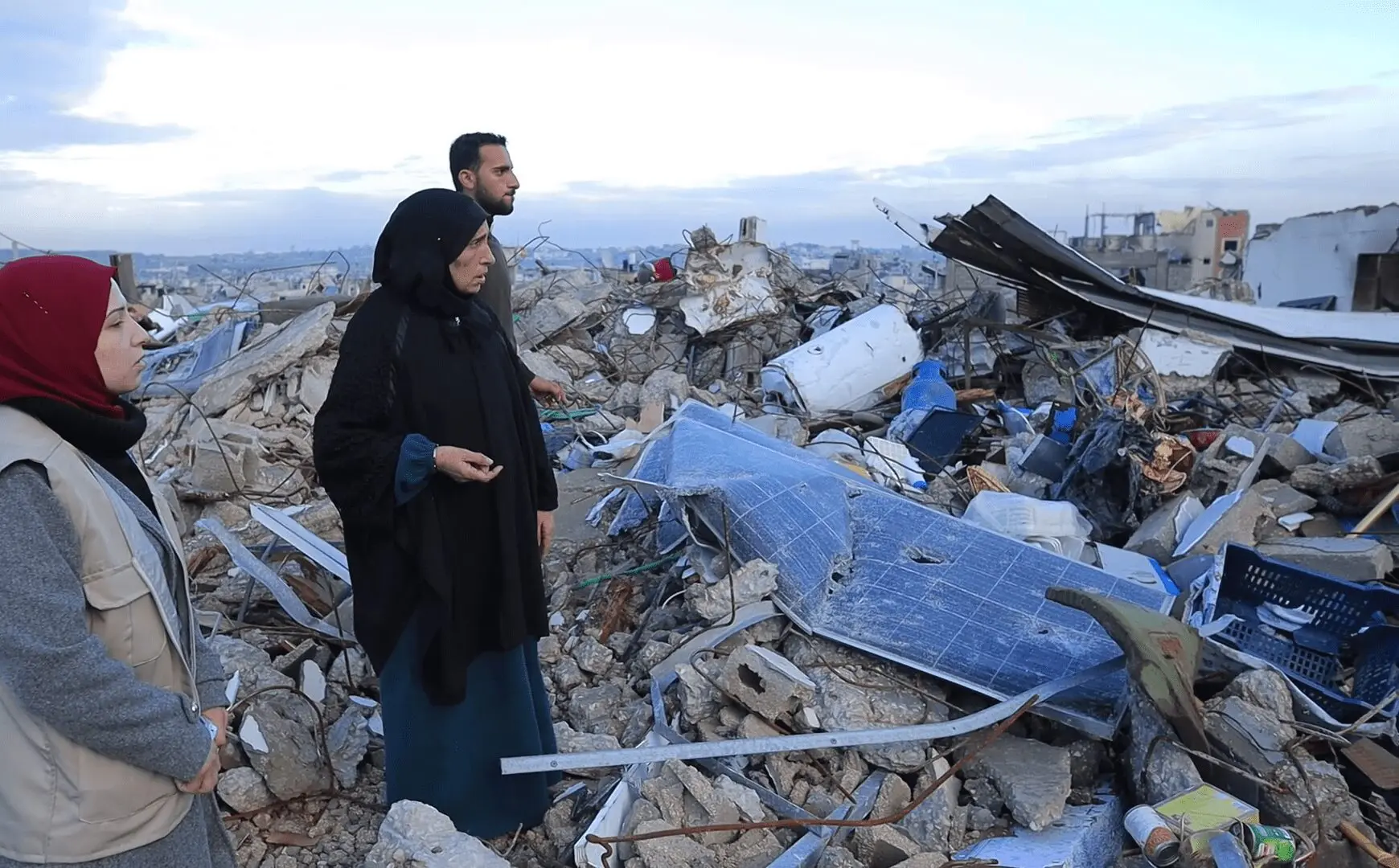
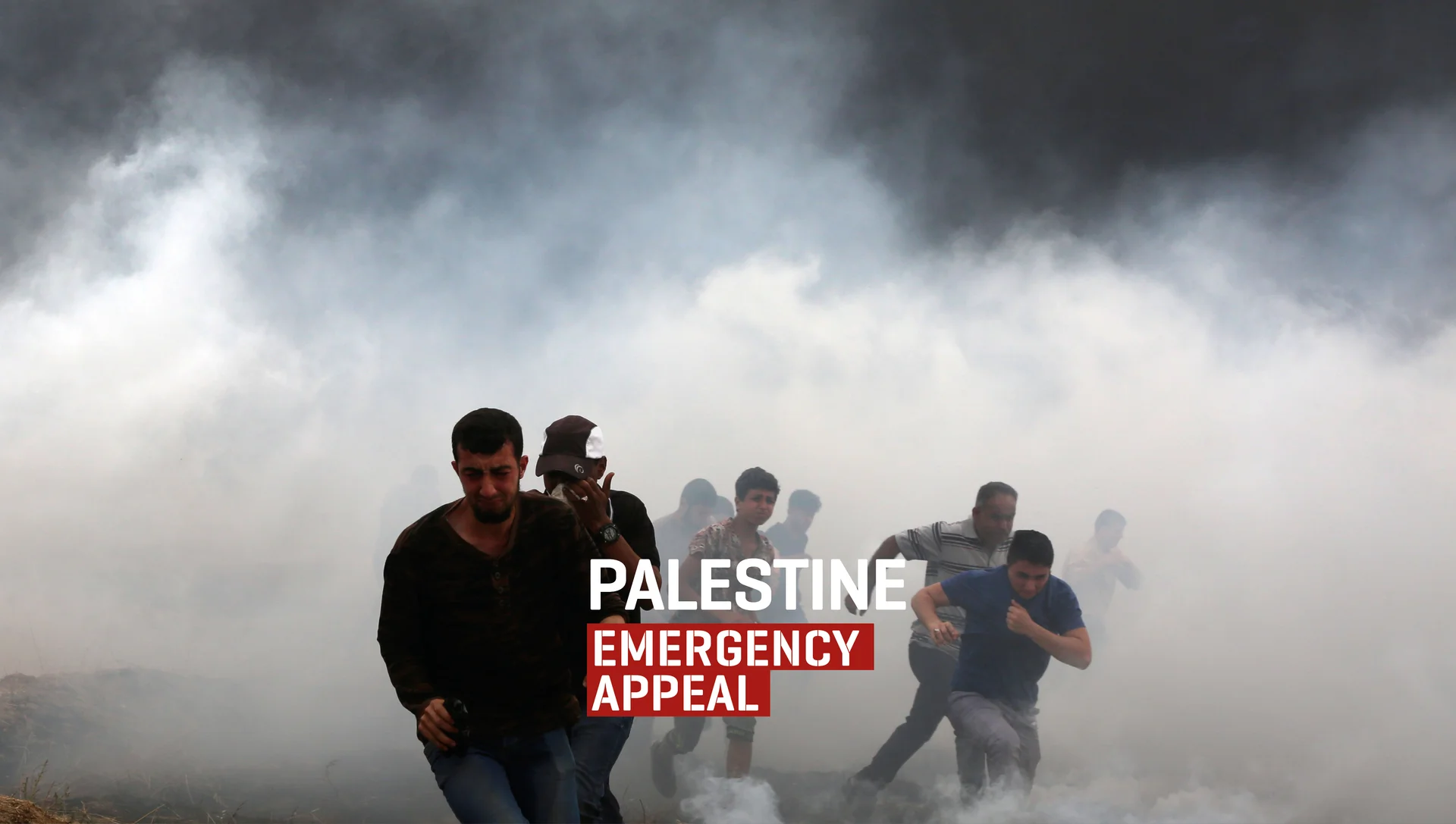
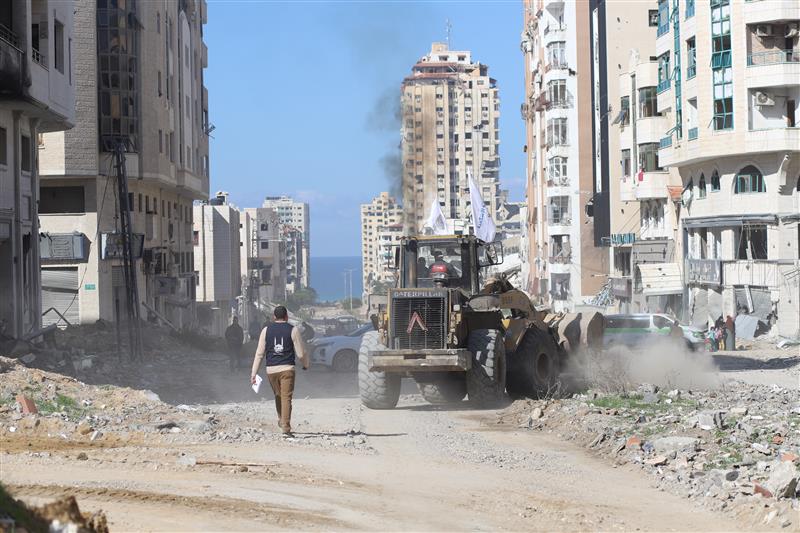
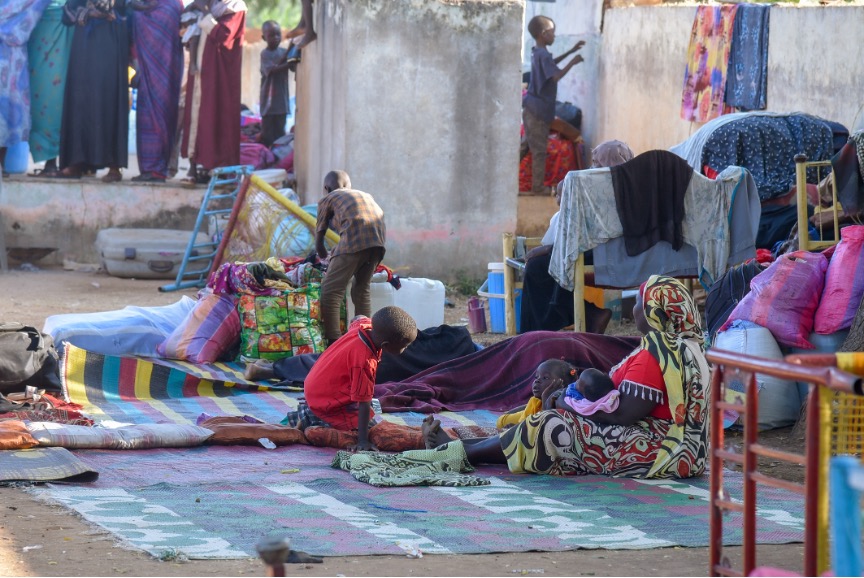
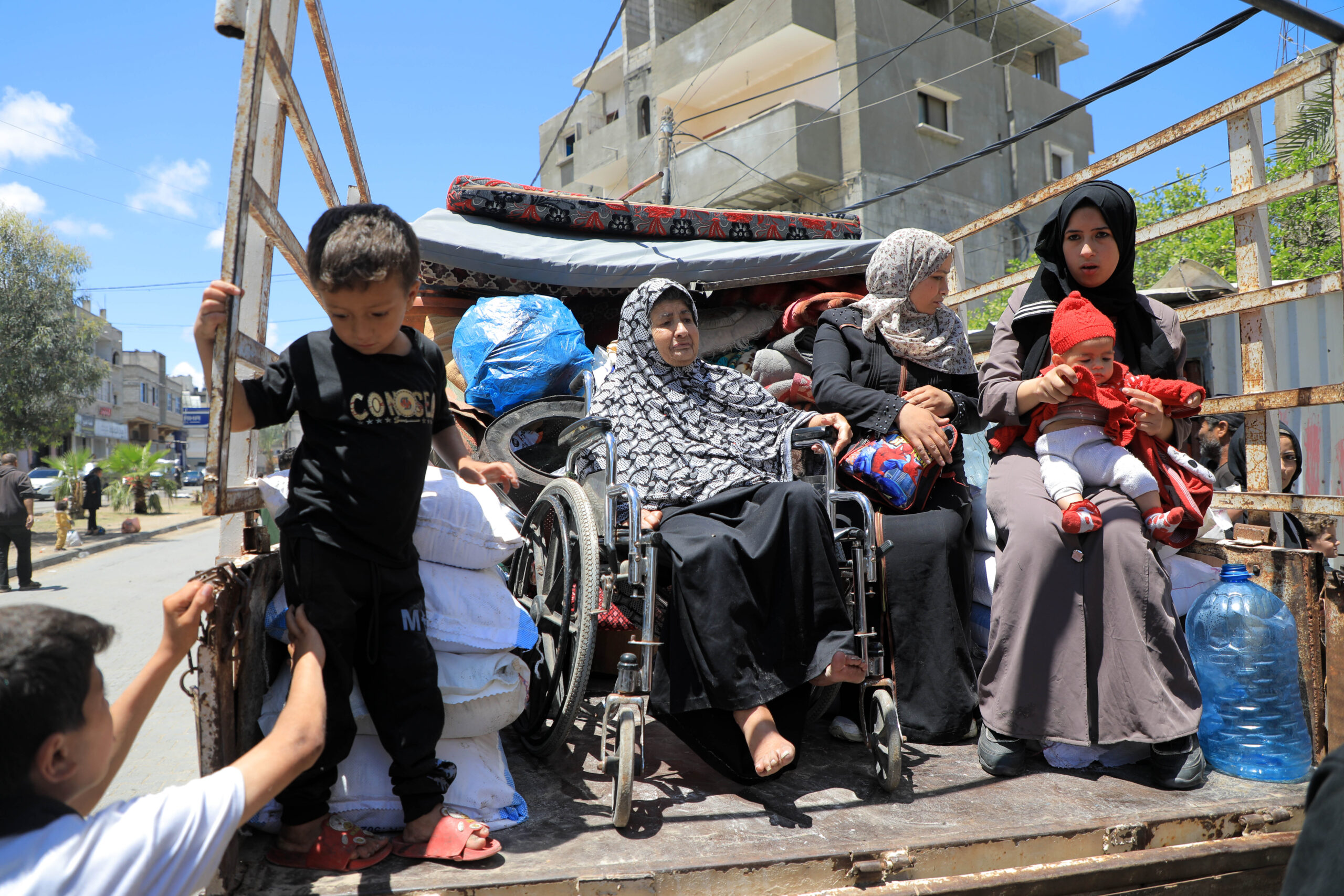
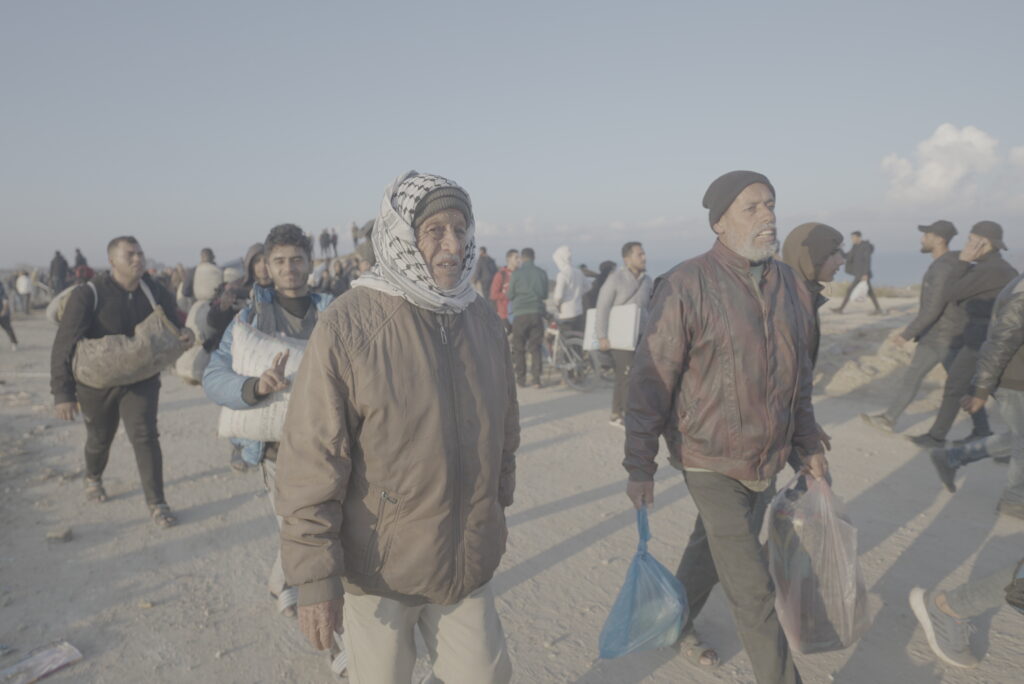
Intensified Israeli military attacks on Gaza City and forced displacement orders for the entire city are leaving families with an impossible dilemma: flee and risk death on the road and in overcrowded displacement areas, or stay and face relentless bombardment in their shelters. Starvation and siege await them regardless.
“Our only demand is life,” said Ayman (name changed), a father sheltering with his family in Gaza City. “We are humans, just like you. We want to live with dignity and safety, not to die from hunger or bombs.”
Nearly one million Palestinians, starved, grieving, and displaced many times over, remain in Gaza City. If Israel’s operation in Gaza City continues, hospitals will be cut off and attacked, shelters and schools bombed, aid convoys blocked, and those too weak, old, or sick to flee will be left to die. “We are tired of running from one place to another,” said Abeer (name changed), a humanitarian worker.
At the same time, Israel is deliberately obstructing humanitarian operations. Aid trucks continue to be denied, and international NGOs are left in limbo by an opaque registration regime, even as famine deepens.
The International Court of Justice has recognised that Palestinians in Gaza have a right to be protected from genocide. Each act of forced displacement and each surge of hunger makes that danger more certain, and the world cannot claim it did not see this coming.
Let our goods enter. Let us work. Stop this assault.
Signed by 45 Humanitarian and Civil Society Organisations
1. ActionAid
2. Action For Humanity
3. American Friends Service Committee
4. Anera
5. Asamblea de Cooperación por la Paz
6. A New Policy
7. Caritas Internationalis
8. Caritas Jerusalem
9. Christian Aid
10. Churches for Middle East Peace
11. CISS – Cooperazione Internazionale Sud Sud
12. Danish Refugee Council
13. Danske Hus i Palæstina
14. Embrace the Middle East
15. Evangelical Lutheran Church in America
16. HelpAge International
17. Humanity & Inclusion – Handicap International
18. Humanity First UK
19. Insecurity Insight
20. INSO
21. Islamic Relief
22. Japan International Volunteer Center (JVC)
23. Médecins Du Monde France (MdM France )
24. Médecins du Monde Switzerland (MdM Switzerland)
25. MedGlobal
26. Medico International
27. Médicos del Mundo (Spain)
28. Mennonite Central Committee
29. National Justice and Peace Network England and Wales
Sumud, or steadfastness, is a word that has become synonymous with the people of Palestine. As they face ongoing occupation and mounting adversity, their collective resilience and perseverance of their cultural identity deeply embody the concept of sumud.
What is Sumud?
Sumud (صمود) is an Arabic word meaning steadfastness or perseverance. It is a term that embodies the concept of everyday resistance. One of non-violent, collective resilience, and maintaining dignity, identity, and connection despite ongoing oppression.
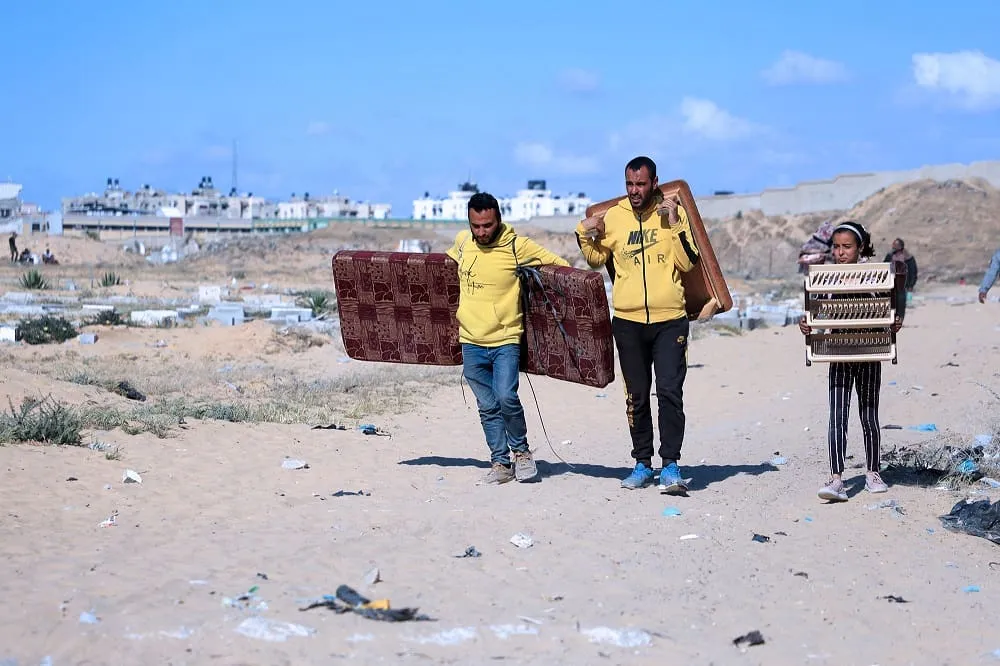
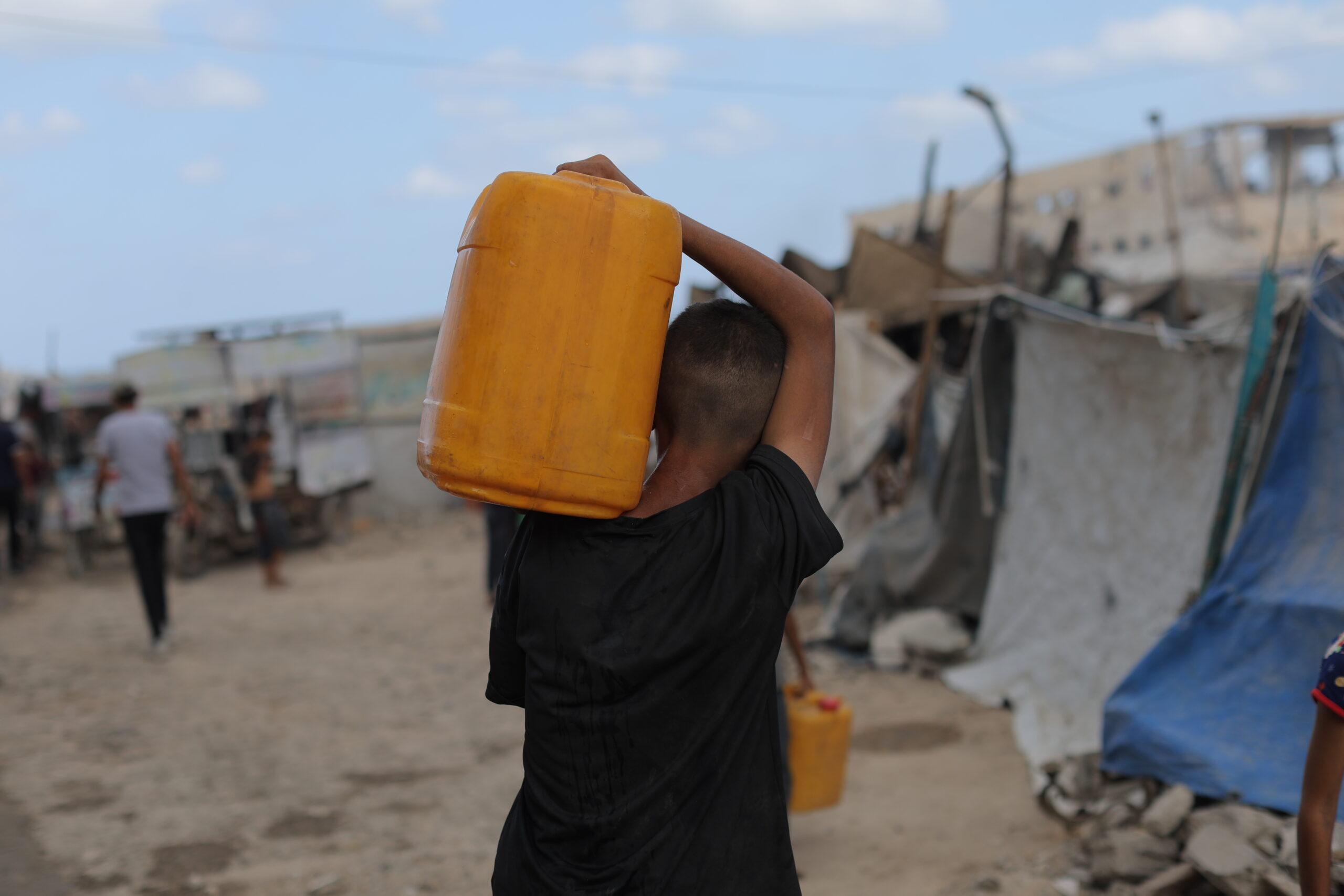
Photo: Displaced Palestinian carrying water to their makeshift shelter
In turn, Palestinians use sumud to interpret, cope and respond to ongoing injustice and traumatic experiences. For them, it is both a value and an action. Sumud strengthens their sense of purpose and meaning. It manifests through individual and collective action. Actions that protect family and community survival, wellbeing, dignity, Palestinian identity and culture, and a determination to remain on the land.
History of Steadfastness in Palestine
From when their homeland was seized by occupying forces in 1948, Palestinians have continually show resilience, both actively and passively.
The establishment of Israel led to the Nakba (catastrophe). This was a massive destruction that the terrorist Zionist movement committed on Palestinian lands. With more than 530 Palestinian cities and villages entirely demolished, and hundreds of thousands of Palestinians killed and expelled from their homes.
In 1967, the Naksa (setback in English) occurred, and Palestinians lost new parts of their lands – the West Bank, Gaza Strip and East Jerusalem. Other Arab countries also came under direct Israeli occupation, such as Sinai and the Golan Heights. The Nakba and Naksa taught the Palestinians sumud, and that leaving their lands was not a viable alternative for their future.
Palestine and Sumud Today
Today, as Palestinians remain targeted by occupying forces in every aspect of life, sumud has become a way of resistance.
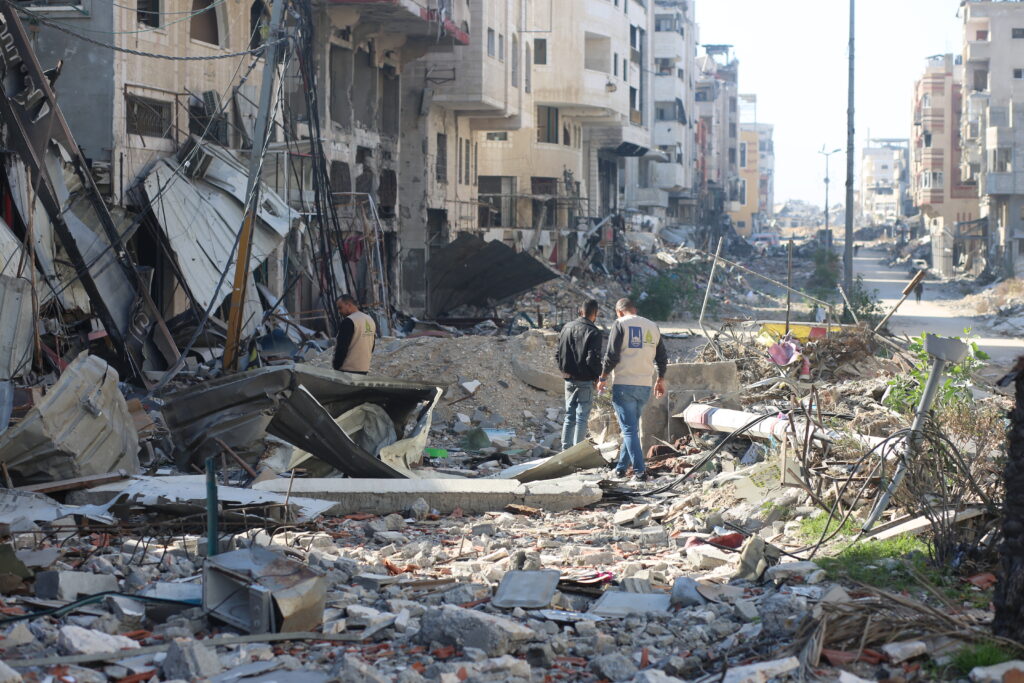
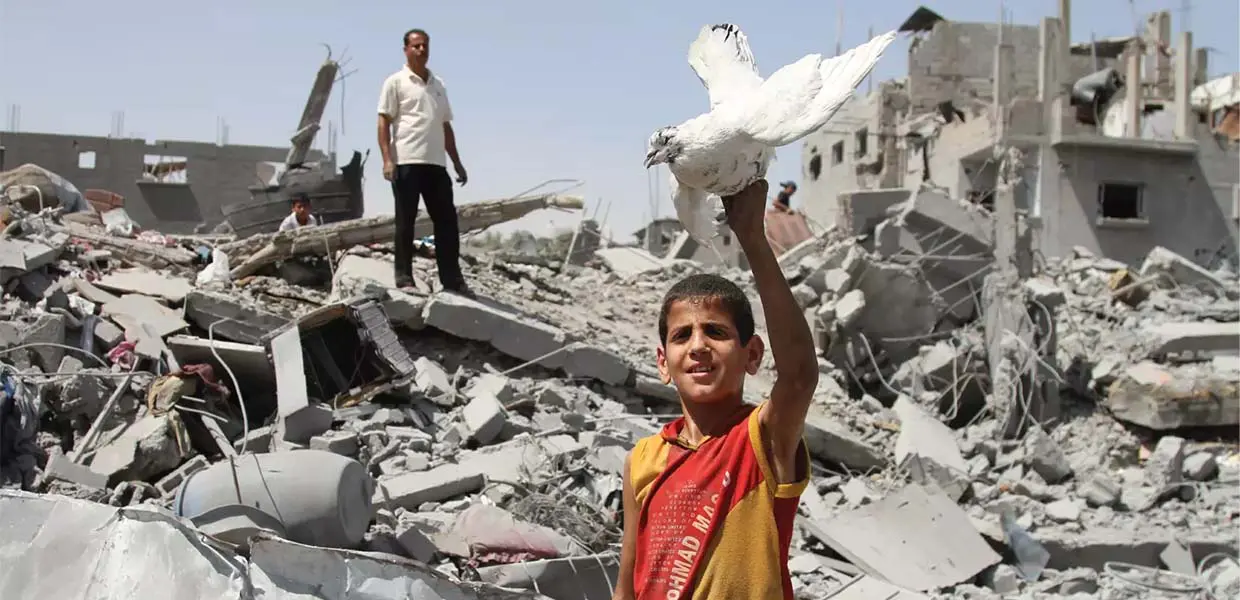
To Palestinians, sumud is when bombs destroy your house. But you still stand up on the rubble of the house and say that this is my homeland, and it will be so forever. Sumud when the Israeli settlers burn the olive trees. But you still plant new ones. Because the more the Zionists destroy, the more the Palestinian people rebuild.
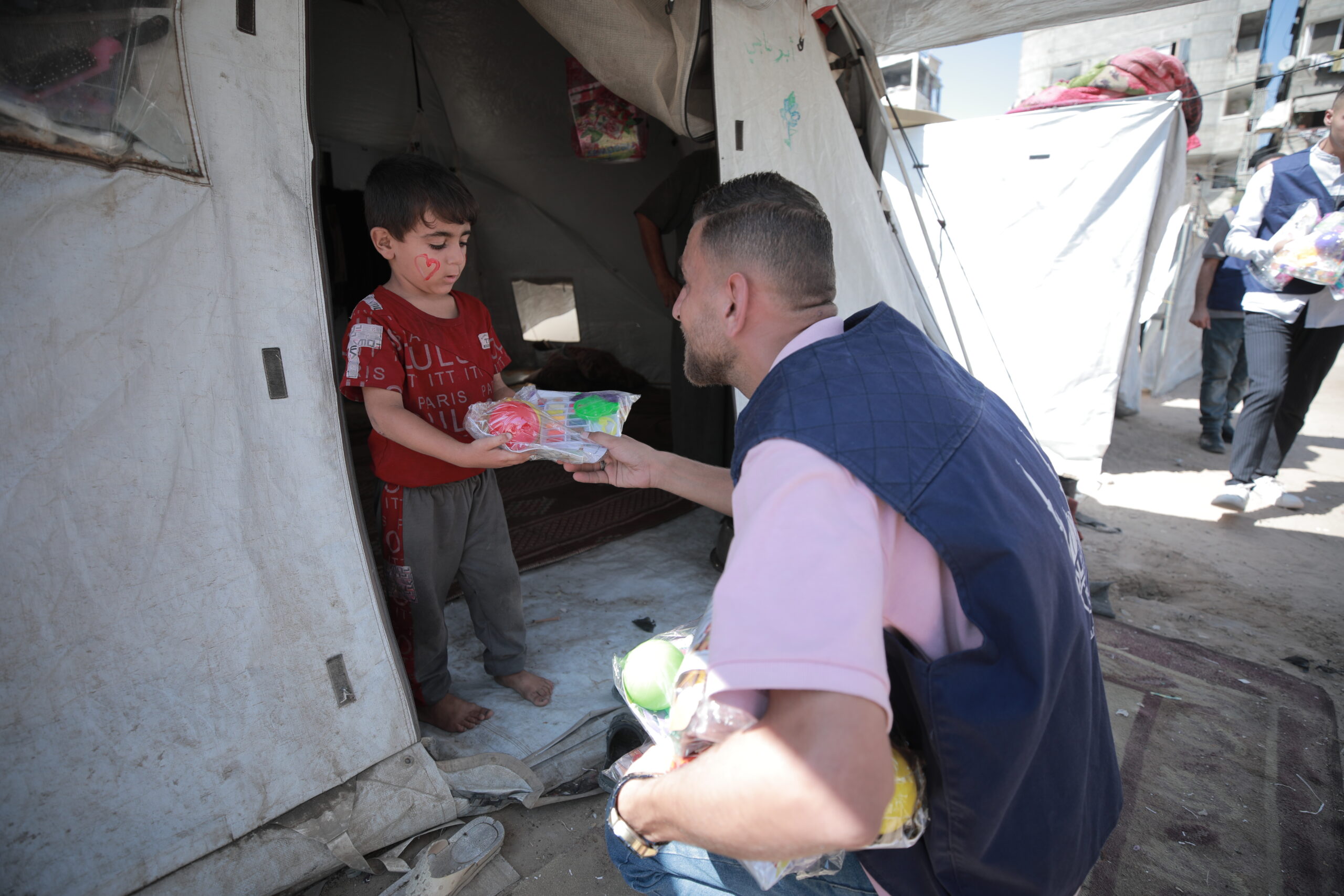
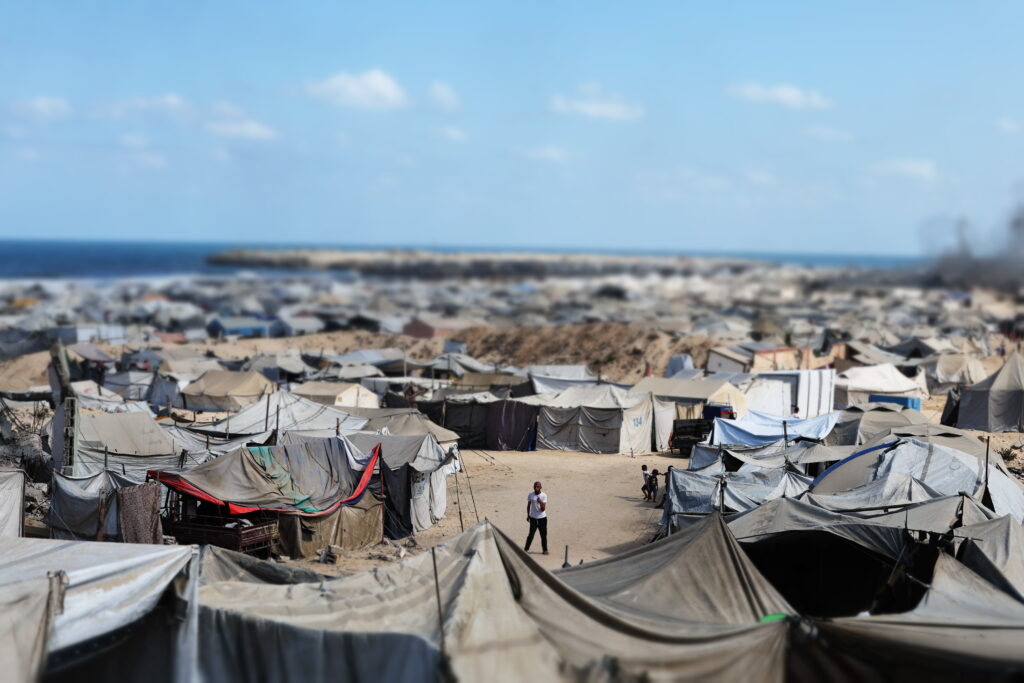
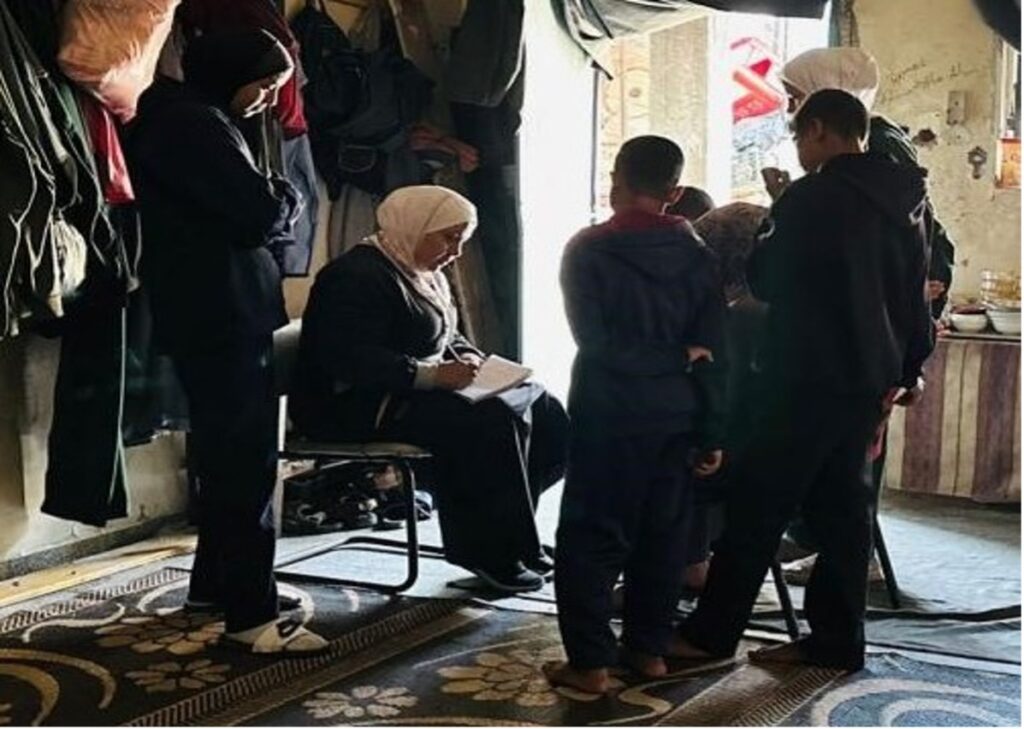
Photo: Displaced persons camp in Gaza
Because sumud is the action of standing against all kinds of injustice and discrimination and the protection of the Palestinian identity, culture, tradition, and custom. It is the way Palestinians maintain their homeland as well as the continuation of the struggle against the Israeli occupation.
Where the occupying regime tries to devastate and destroy the Palestinian people, sumud gives Palestinians hope and determination. Sumud focuses on preserving the self in the present to open up new horizons, perspectives, and desires in the future for self-determination, liberty, and equality.
Struggle and Sumud
Both struggle and Sumud, in Palestinian culture, have become intertwined. Struggle, or resistance, for Palestinians is their physical actions against the Israeli occupation. Sumud is the structure and framework in which these actions are organised. It is their determination and confidence not to lose again. To prevent another Nakba and Naksa. It is a style of life and ethical responsibility in which an individual sacrifices themselves tirelessly.
In other words, Sumud is to give up what you love and embrace patience for the coming pain. That this is all for the sake of the homeland as well as for others.
This is why Sumud, for Palestinians, is a core cultural and national concept. One that means more than steadfastness, but staying strong in all possible ways. Even in the face of unimaginable cruelty and injustice.
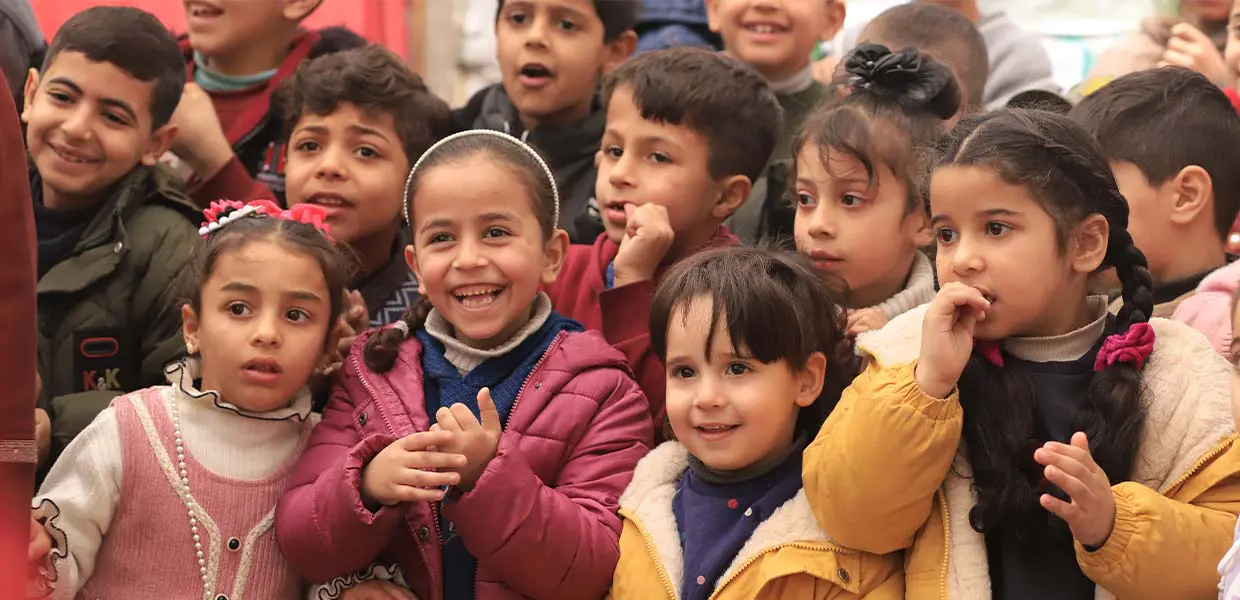
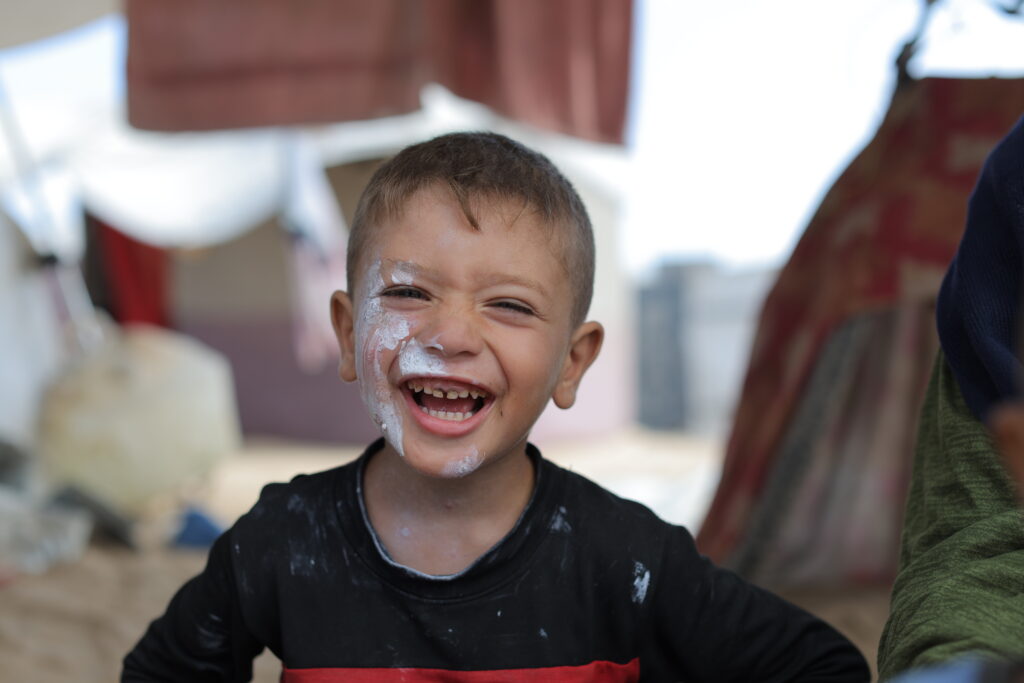
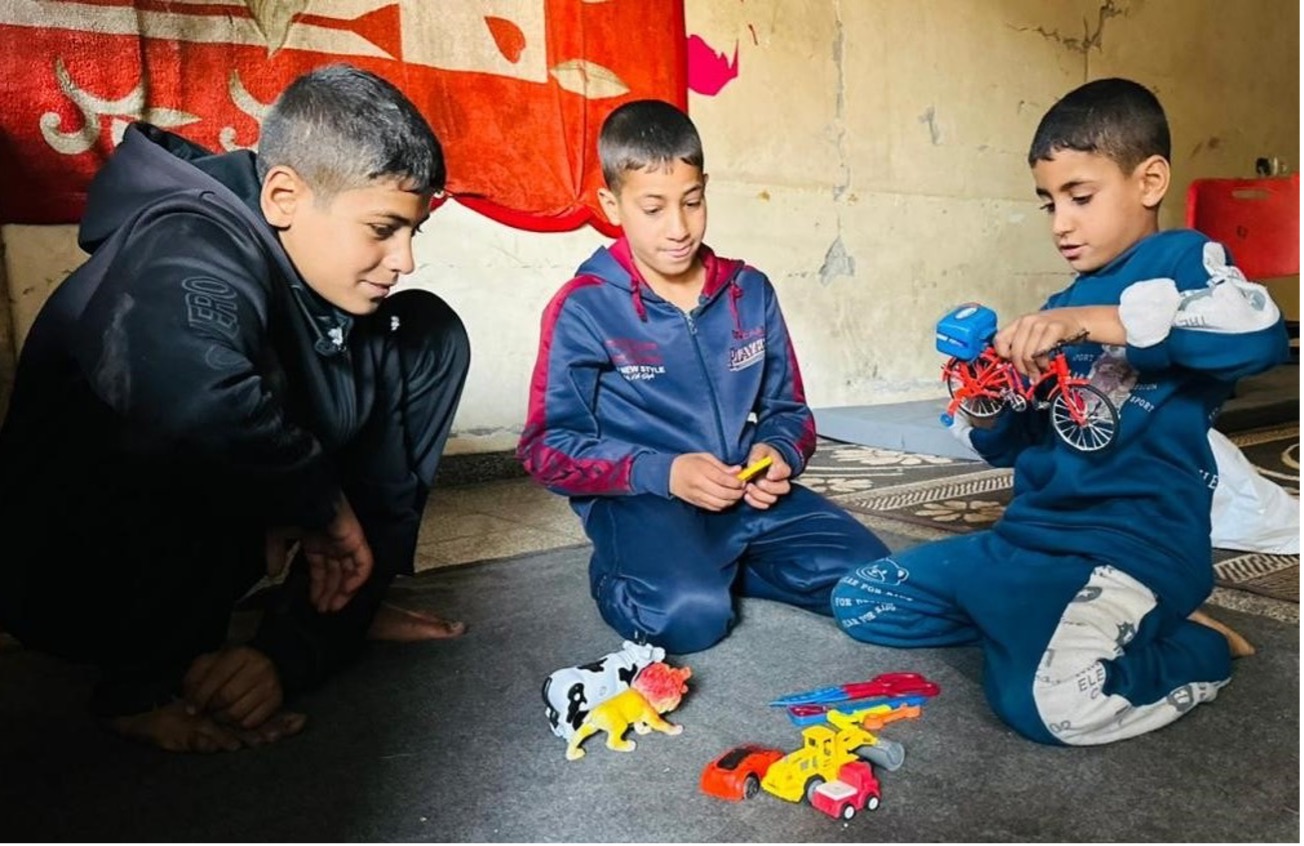
Photo: Displaced Palestinian boy smiling
It presents a form of social solidarity and coherence against injustice and oppression. One that can be a model for emancipation for other nations that suffer persecution in the world. A symbol of resistance against colonisation, hegemony and suppression, and as a means to achieve self‑determination, freedom and justice.
In a time when the Israeli regime restricts every single aspect of Palestinian freedom and liberty, Sumud presents a solution as a way of surviving in the struggle against Israeli colonisation and hegemony. Both in the way individuals stand up as one person against the whole Israeli apartheid, sacrificing themselves for the sake of others. As well as collective organised resistance and fighting Israeli injustice. The profound term has deep and well-established roots for Palestinians and their land, reflecting their strength and perseverance as a nation and culture.
Today’s official confirmation of famine in Gaza brings shame on the entire world. Every day, our team there sees more people starving to death and children turning into living skeletons before our eyes. Many more will die unless the world acts now.
The famine is no accident – Israel is intentionally starving Palestinians to death. It is entirely man-made, caused by Israel’s cruel and illegal blockade and the complicity of world leaders who have failed to stop the daily war crimes. Never before has a famine – the most extreme and rarest form of starvation – been so widely predicted and so easily preventable, yet repeated warnings have been ignored.
Israel has destroyed Gaza’s ability to feed itself, then blocked lifesaving aid from entering and gunned down starving people trying to get food for their children. It has destroyed Gaza’s health system, denying malnourished people treatment. Truckloads of food, medicine, and other vital aid are just a few miles from starving people, but are barred from reaching them. Even as horrific images of emaciated children touch hearts around the world, Israel has further accelerated its attacks on civilians, continued to restrict aid, and stepped up its efforts to shut down and militarise the humanitarian response. Young children are the most vulnerable to starvation, but even aid workers and medics are now wasting away.
In the face of relentless violence and suffering, Palestinians in Gaza have shown incredible courage and resilience, but there is a limit to what humans can endure.
There can be no more excuses. World leaders must finally act to save lives and prevent genocide. The only way to stop this famine from spreading further across Gaza and killing even more people is to demand a ceasefire and pressure Israel to fully reopen all land crossings so that Gaza can be flooded with sufficient supplies. A small, temporary increase is not enough – it must be large-scale, sustained, and delivered through the UN-led system that Israel is trying to shut down.
More paltry words of condemnation will not make any difference now. To save lives, governments must apply meaningful economic and diplomatic pressure, such as ending all arms sales, suspending trade agreements, and banning trade and investment with illegal Israeli settlements.
Despite claims by Israeli authorities that there is no limit on humanitarian aid entering Gaza, most major international NGOs have been unable to deliver a single truck of lifesaving supplies since 2 March.
Instead of clearing the growing backlog of goods, Israeli authorities have rejected requests from dozens of NGOs to bring in lifesaving goods, citing that these organisations are “not authorised to deliver aid.” In July alone, over 60 requests were denied under this justification.
This obstruction has left millions of dollars’ worth of food, medicine, water, and shelter items stranded in warehouses across Jordan and Egypt, while Palestinians are being starved.
“Anera has over $7 million worth of lifesaving supplies blocked from entering Gaza – including 744 pallets of rice, enough for six million meals, blocked in Ashdod just kilometres away,” said Sean Carroll, President and CEO of Anera.
Many of the NGOs now told they are not “authorised” to deliver aid have worked in Gaza for decades, are trusted by communities and experienced in delivering aid safely. Their exclusion has left hospitals without basic supplies, children, people with disabilities, and older people dying from hunger and preventable illnesses, and aid workers themselves going to work hungry.
The obstruction is tied to new INGO registration rules introduced in March. Under these new rules, registration can be denied on the basis of vague and politicised criteria, such as alleged “delegitimisation” of the state of Israel. INGOs warned that the process was designed to control independent organisations, silence advocacy, and censor humanitarian reporting. This new bureaucratic obstruction is inconsistent with established international law as it entrenches Israel’s control and annexation of the occupied Palestinian territory.
Unless INGOs submit to the full registration requirements, including the mandatory submission of details of private donors, complete Palestinian staff lists and other sensitive information about personnel for so-called “security” vetting to Israeli authorities, many could be forced to halt operations in Gaza and the West Bank, including East Jerusalem, and remove all international staff within 60 days. Some organisations have even been issued a seven-day ultimatum to provide Palestinian staff lists.
NGOs have made clear that sharing such data is unlawful (including under relevant data protection laws), unsafe, and incompatible with humanitarian principles. In the deadliest context for aid workers worldwide, where 98 per cent of those humanitarians killed were Palestinian, NGOs have no guarantees that handing over such information would not put staff at further risk, or be used to advance the government of Israel’s stated military and political aims.
Today, INGOs’ fears have proven true: the registration system is now being used to further block aid and deny food and medicine amid the worst-case scenario of famine.
“Since the full siege was imposed on 2 March, CARE has not been able to deliver any of our $1.5 million worth of pre-positioned supplies into Gaza,” said Jolien Veldwijk, Country Director of CARE. “This includes critical shipments of food parcels, medical supplies, hygiene kits, dignity kits, and maternal and infant care items. Our mandate is to save lives, but due to the registration restrictions, civilians are being left without the food, medicine, and protection they urgently need.”
“Oxfam has over $2.5 million worth of goods that have been rejected from entering Gaza by Israel, especially WASH and hygiene items as well as food,” said Bushra Khalidi, Oxfam Policy Lead. “This registration process signals to INGOs that their ability to operate may come at the cost of their independence and ability to speak out.”
These restrictions are part of a broader strategy that includes the so-called “GHF” scheme – a militarised distribution mechanism promoted as a humanitarian solution. In reality, it is a deadly tool of control, with at least 859 Palestinians killed around “GHF” sites since it began operating.
“The militarised food distribution scheme has weaponised starvation and curated suffering. Distributions at GHF sites have resulted in extreme levels of violence and killings, primarily of young Palestinian men, but also of women and children, who have gone to the sites in the hope of receiving food,” according to Aitor Zabalgogeazkoa, MSF emergency coordinator in Gaza.
Both the “GHF” scheme and the INGO registration process aim to block impartial aid, exclude Palestinian actors, and replace trusted humanitarian organisations with mechanisms that serve political and military objectives. They come as the government of Israel escalates its military offensive and deepens its occupation in Gaza, making clear these measures are part of a broader strategy to entrench control and erase Palestinian presence.
“At this point, everyone knows what the correct, humane answer is, and it’s not a floating pier, airdrops or the “GHF.” The answer, to save lives, save humanity and save yourselves from complicity in engineered mass starvation, is to open all the borders, at all hours, to the thousands of trucks, millions of meals and medical supplies, ready and waiting nearby,” said Sean Carroll of Anera.
We call on all states and donors to:
Press Israel to end the weaponisation of aid, including through bureaucratic obstruction, such as the INGO registration procedures.
Insist that INGOs are not forced to share sensitive personal information, in violation of the General Data Protection Regulation (GDPR), or compromise staff safety or independence as a condition for delivering aid.
Demand the immediate and unconditional opening of all land crossings and conditions for the delivery of lifesaving humanitarian aid.
Editor’s note
The occupied Palestinian territory is the deadliest setting for aid workers worldwide, with Palestinian staff accounting for 98% of aid worker fatalities: 509 out of 517 killings that took place between 2023-2025, according to the Aid Worker Security Database.
On 6 May, 55 organisations warned that Israel’s new INGO registration measures are a grave threat to humanitarian operations and international law.
On 1 July, 200+ organisations called for immediate action to end the deadly Israeli distribution scheme, including the so-called “GHF” in Gaza, revert to the existing UN-led coordination mechanisms, and lift the Israeli government’s blockade on aid and commercial supplies.
On 23 July, 100+ organisations warned that, as mass starvation spreads across Gaza, our colleagues and those we serve are wasting away.
On 29 July, the Integrated Food Security Phase Classification (IPC) wrote that the worst-case scenario of famine is currently playing out in the Gaza Strip.
Israel has consistently denied restricting the amount of aid allowed into Gaza, including throughout July 2025, when most of the denials discussed in this statement were issued.
On 31 July, OHCHR wrote that since 27 May, at least 1,373 Palestinians have been killed while seeking food; 859 in the vicinity of the “GHF” sites and 514 along the routes of food convoys. Most of these killings were committed by the Israeli forces.
On 4 August, a Palestinian nurse in Gaza was killed when an airdrop struck him.
On 5 August, it was reported that Israeli authorities are planning for the full occupation of the Gaza Strip.
On 6 August, UN agencies and NGOs warned that without immediate action, most international NGO partners could be de-registered by Israel in the coming weeks.
On 6 August, the Dutch Data Protection Authority (DPA) concluded that Israel’s information requests under the INGO registration process risk violating the General Data Protection Regulation (GDPR). The DPA advised that INGOs should not comply with these requests, and that the only solution is for Israel to amend its requirements and for the relevant ministries to issue a formal protest.
On 7 August, MSF released a report stating food distributions in Gaza run by the so-called “GHF” are sites of “orchestrated killing and dehumanisation” that must be shut down.”
On 10 August, Save the Children reported the deaths of 100 children due to starvation in Gaza since October 2023.
On 12 August, a group of UN Special Rapporteurs on human rights published a letter to the Israeli government, stating deep concern that the INGO registration measures “weaken the ability of INGOs to operate independently and impartially and to carry out their humanitarian and human rights work without interference or fear of reprisal” and that “that the obligation to report on INGO personnel, in the context of occupation, armed conflict and serious violations of international law, could raise serious protection and reprisal concerns.”
Signatories:
Action Against Hunger (ACF)
A New Policy
ACT Alliance
Action For Humanity
ActionAid Denmark
ActionAid International
All We Can
Alliance Sud
American Friends Service Committee (AFSC)
Americares
Anera
Asamblea de Cooperación por la Paz
Bystanders No More
Campaign Against Arms Trade
Canadian Foodgrains Bank
CARE
Caritas Internationalis
Caritas Jerusalem
Caritas Middle East and North Africa
Caritas Switzerland
Center for Jewish Nonviolence
Charity & Security Network
Children Not Numbers
Christian Aid
Churches for Middle East Peace (CMEP)
CISS – Cooperazione Internazionale Sud Sud
Committee to Protect Journalists
Cooperation Canada
COORDINADORA VALENCIANA ONGD
DanChurchAid
Danish Refugee Council (DRC)
Department of Service to the Palestinian Refugees
Diakonia
Diakonie Katastrophenhilfe
EDUCO
Embrace the Middle East
Emergency – Life Support for Civilian War Victims Ong Ets
Entreculturas
Forum Ziviler Friedensdienst e.V. (Pro Peace)
Frieda – the Feminist Peace Organization
Friends Committee on National Legislation (FCNL)
Fund for Global Human Rights
Glia
HEKS/EPER (Swiss Church Aid)
HelpAge International
Humanitarian Coalition
Humanity Auxilium
Humanity & Inclusion – Handicap International
Humanity First UK
INARA
Insecurity Insight
International Development and Relief Foundation (IDRF)
INTERSOS
Islamic Relief
Jahalin Solidarity
Japan International Volunteer Center (JVC)
Jüdische Stimme für Demokratie und Gerechtigkeit in Israel/Palästina JVJP Switzerland
KinderUSA
Kvinna till Kvinna Foundation
La Coordinadora de Organizaciones para el Desarrollo (The Spanish Development NGO Platform)
Médecins du Monde France
Médecins du Monde International Network
Médecins Sans Frontières (MSF)
MedGlobal
Medical Aid for Palestinians (MAP)
Medico International
Medico International Schweiz
Mennonite Central Committee (MCC)
Middle East Children’s Alliance
MPower Change Action Fund
Muslim Aid
NORWAC – Norwegian Aid Committee
Norwegian Church Aid
Norwegian People’s Aid (NPA)
Norwegian Refugee Council (NRC)
Oxfam
Palestinian Children’s Relief Fund (PCRF)
PANZMA – Palestinian Australian New Zealand Medical Association
PARCIC
Pax Christi International
Peace Watch Switzerland
People in Need (PIN)
Plan International
Polish Humanitarian Action (PAH)
Portuguese Platform of Development NGOs
Premiere Urgence Internationale (PUI)
Project HOPE
Relief International
Sabeel-Kairos UK
Save the Children International
Secours Islamique France (SIF)
Solidar Suisse
Solidarités International
SWISSAID
Terre des Hommes Italy
Terre des Hommes Lausanne
The Eastern Mediterranean Public Health Network (EMPHNET)
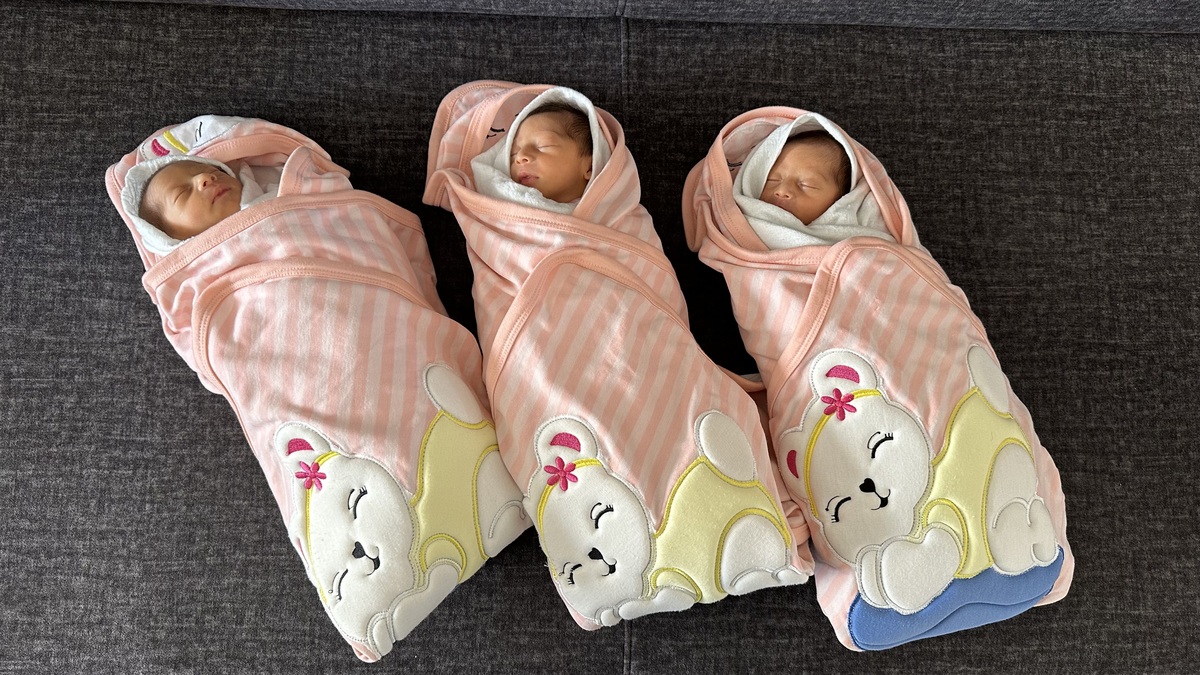
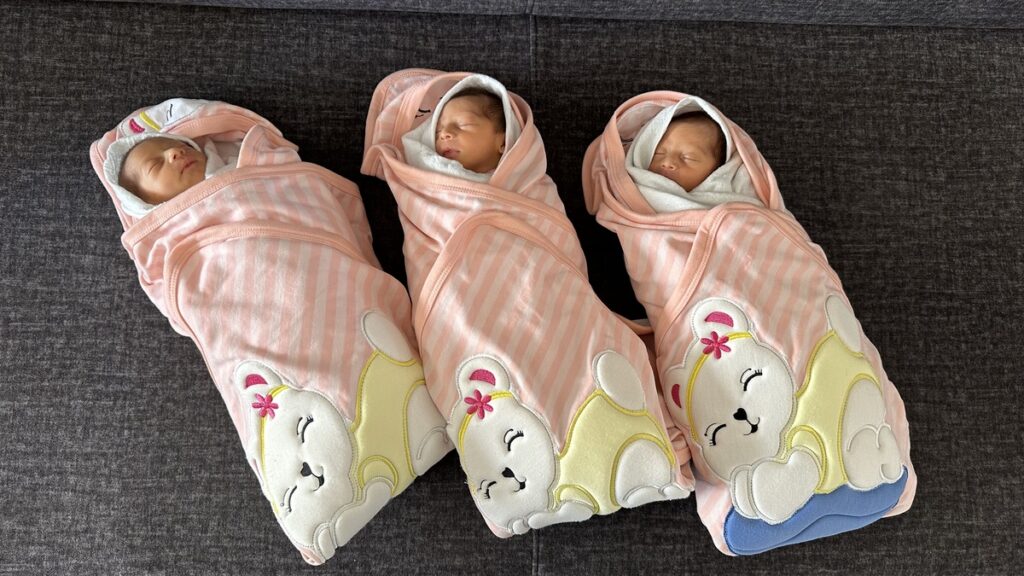
Triplet girls born through Islamic Relief’s maternal healthcare project, which provides rare lifesaving services in besieged Gaza.
Israel’s assault and blockade have turned Gaza into the worst place in the world to give birth. Dozens of babies and infants have starved to death. Where many pregnant women are now too malnourished to stand, and even doctors are facing starvation.
The Israeli blockade has cut off essential supplies, forcing pregnant women to undergo operations without anaesthetics. For nurses to squeeze three or four babies into a single incubator.
Doctors also report a huge increase in miscarriages. Where 28 children are now dying every day1. Moreover, Islamic Relief analysis shows July is now Gaza’s deadliest month since January 20242.
Amid the horrors, an Islamic Relief project to provide pregnant women with maternal care recently delivered triplet girls – Israa, Ayla and Aylol – all born underweight but alive.
Photo: Triplets Israa, Ayla and Aylol born underweight but alive in Gaza.
“They are my miracle. My proof that even in war, life insists on being born.”
During pregnancy, Alaa, 31 was terrified: “There were nights I went to sleep crying, not knowing if my daughters would still be alive in the morning or die. Two of my cousins had miscarriages this year – one lost her baby in the eighth month. I was sure I’d be next.”
Alaa and her family – her husband Louay, 36, and their two children, 7-year-old Alma and 2-year-old Ahmed – have been forcibly displaced three times by the relentless Israeli bombing and military orders demanding that Palestinians leave 88% of Gaza.
One night, the house next door was bombed, so Alaa and her family fled into the dark. “We ran in silence. I held my stomach with both hands and prayed my babies wouldn’t slip away while I escaped death,” she says.
Alaa and her family found shelter in an overcrowded school building. Inside, there was hardly any food, no clean water and no medical care. She became increasingly malnourished, and her hemoglobin dropped to dangerously low levels.
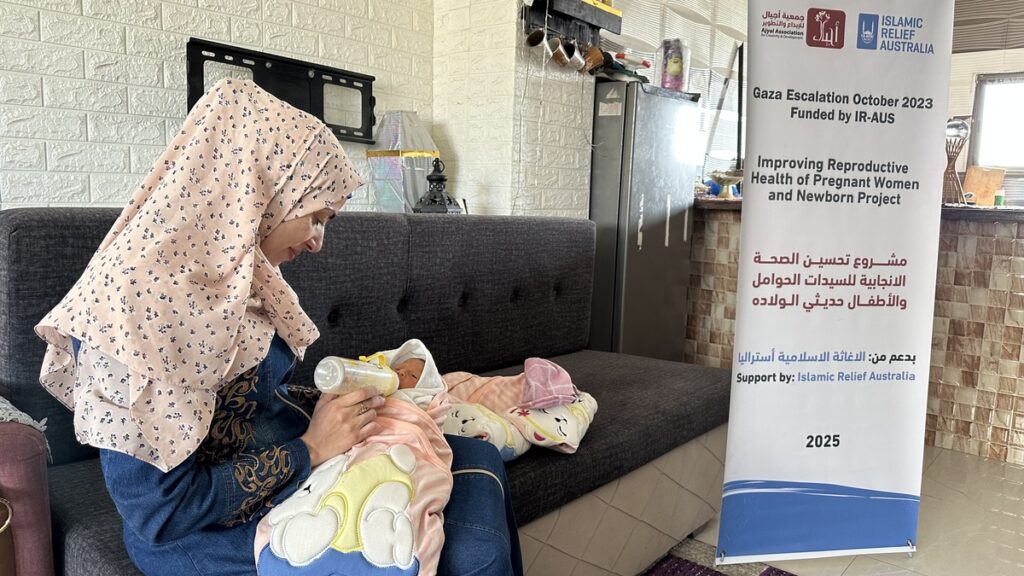
She was dizzy and weak when she met staff from Ajyal Association, one of Islamic Relief’s partner organisations in Gaza. Then, they registered her on our maternal healthcare project, which has so far supported more than 1,080 pregnant women and newborn babies.
Through this project, Alaa received regular check-ups, blood tests, vitamins, and ultrasound scans at Al Awda hospital, where Islamic Relief has previously provided vital equipment such as incubators that are still being used now.
Photo: Alaa feeding one of her triplets with formula, provided by Islamic Relief and Ajyal Association.
New incubators are among the many medical supplies that are now effectively banned under the Israeli blockade, as well as other vital maternal care equipment, such as ultrasound devices and oxygen pumps, and fuel to keep hospital services running. Most pregnant women in Gaza are now unable to get any pre- or post-natal checks.
Medics at hospitals like Al Awda are risking their lives to keep services going.
The Israeli onslaught has killed more than 1500 health workers and forced two-thirds of primary healthcare centres and half of all hospitals to completely shut down. The rest struggle to keep even partial services functioning. Al Awda has been besieged and hit by Israeli bombs dozens of times, injuring staff and patients and destroying medical supplies and storage facilities.
Alaa says that despite the extreme challenges, she was treated with care and dignity. “The medics didn’t just ask about my babies, they cared about me. They reminded me that my life matters too.”
During one of the checkups, doctors told Alaa she needed an emergency caesarean section, which has become increasingly necessary in Gaza during the crisis. Alaa and her family couldn’t afford it so Islamic Relief covered the costs, as well as the cost of the emergency blood transfusions.
Alaa says, “During the (C-section) operation, I lost a lot of blood. I could feel myself fading. But I heard a cry from one of my daughters.”
That cry brought me back. Without this project, I wouldn’t be here, and neither would they.
“This wasn’t just a medical intervention; it was a rescue mission for four lives.”
The triplets, born in April 2025, were born premature and underweight at 1.8kg (3.9lbs). They are now relatively healthy. But they still remain at risk from the dangers that face all babies and young children in Gaza.
Child malnutrition is rocketing as Israel uses starvation as a weapon of war, blocking humanitarian aid then shooting people trying to get food. Hundreds of thousands of families are now forced into just 12% of Gaza’s territory, with children at greatest risk as diseases spread amid the overcrowding.
Islamic Relief continues to demand that international governments take meaningful action to ensure a ceasefire. To end the Israeli blockade and ensure full, unimpeded humanitarian access. So that children like Israa, Ayla and Aylol can not only survive but have a safe and dignified future.
Islamic Relief has worked in the Occupied Palestinian Territory since 1997. During the current crisis our Palestinian staff and partners have provided vital aid to more than 600,000 people, including food, water, healthcare and education.
In the ongoing crisis, Gaza needs your help
Help us provide urgent medical supplies and other crucial, life-saving support now to families in need by giving with Islamic Relief.
As mass starvation spreads across Gaza, our colleagues and those we serve are wasting away
More than 100 organisations are sounding the alarm to allow in life-saving aid.
As the Israeli government’s siege starves the people of Gaza, aid workers are now joining the same food lines, risking being shot just to feed their families.
With supplies now totally depleted, humanitarian organisations are witnessing their own colleagues and partners waste away before their eyes.
Exactly two months since the Israeli government-controlled scheme, the Gaza Humanitarian Foundation, began operating, more than 100 organisations are sounding the alarm, urging governments to act.
To open all land crossings, restore the full flow of food, clean water, medical supplies, shelter items, and fuel through a principled, UN-led mechanism. To end the siege and agree to a ceasefire now.
“Each morning, the same question echoes across Gaza: Will I eat today?” said one agency representative.
Massacres at food distribution sites in Gaza are occurring near-daily. As of July 13, the UN confirmed 875 Palestinians were killed while seeking food, 201 on aid routes and the rest at distribution points. Thousands more have been injured.
Meanwhile, Israeli forces have forcibly displaced nearly two million exhausted Palestinians with the most recent mass displacement order issued on July 20, confining Palestinians to less than 12% of Gaza.
WFP warns that current conditions make operations untenable. The starvation of civilians as a method of warfare is a war crime.
Just outside Gaza, in warehouses — and even within Gaza itself — tons of food, clean water, medical supplies, shelter items and fuel sit untouched with humanitarian organisations blocked from accessing or delivering them.
The Government of Israel’s restrictions, delays, and fragmentation under its total siege have created chaos, starvation, and death. An aid worker providing psychosocial support spoke of the devastating impact on children: “Children tell their parents they want to go to heaven, because at least heaven has food.”
Doctors report record rates of acute malnutrition, especially among children and older people. Illnesses like acute watery diarrhoea are spreading, markets are empty, waste is piling up, and adults are collapsing on the streets from hunger and dehydration.
Distributions in Gaza average just 28 trucks a day, far from enough for over two million people, many of whom have gone weeks without assistance.
The UN-led humanitarian system has not failed. It has been prevented from functioning.
Humanitarian agencies have the capacity and supplies to respond at scale. But, with access denied, we are blocked from reaching those in need, including our own exhausted and starved teams.
On July 10, the EU and Israel announced steps to scale up aid. But these promises of ‘progress’ ring hollow when there is no real change on the ground.
Every day without a sustained flow means more people dying of preventable illnesses. Children starve while waiting for promises that never arrive.
Palestinians are trapped in a cycle of hope and heartbreak, waiting for assistance and ceasefires, only to wake up to worsening conditions. It is not just physical torment, but psychological.
Survival is dangled like a mirage. The humanitarian system cannot run on false promises. Humanitarians cannot operate on shifting timelines or wait for political commitments that fail to deliver access.
Governments must stop waiting for permission to act. We cannot continue to hope that current arrangements will work.
It is time to take decisive action. Demand an immediate and permanent ceasefire. Lift all bureaucratic and administrative restrictions. Open all land crossings. Ensure access to everyone in all of Gaza. Reject military-controlled distribution models.
Restore a principled, UN-led humanitarian response and continue to fund principled and impartial humanitarian organisations.
States must pursue concrete measures to end the siege, such as halting the transfer of weapons and ammunition.
Piecemeal arrangements and symbolic gestures, like airdrops or flawed aid deals, serve as a smokescreen for inaction.
They cannot replace states’ legal and moral obligations to protect Palestinian civilians and ensure meaningful access at scale.
States can and must save lives before there are none left to save.
More than 100 organisations have signed this statement – click here to see the list of signatories
On World Refugee Day, a mother and her children reveal the crushing reality of displacement: where every day is a battle for water, food, and hope.
The night the bombs came, Neda’a did not have time to gather shoes. She woke her 7 children in the dark, shouting over the explosions. They ran barefoot through streets strewn with broken glass and rubble, the younger ones crying as their feet bled.
Her eldest son, Ahmed, carried his 7-year-old brother Elyas on his back. By dawn, they reached a UN school-turned-shelter. It was the last time Ahmed would see his family.
The next day, he went to buy shoes for his siblings. He never returned.
Now, Neda’a sits on the floor of a crowded classroom that has become their shelter, recounting the moment she learned Ahmed was gone. “We lost our backbone,” she says.
Around her, the walls are cracked from shelling. There is no running water, no privacy, no space to grieve. This is life for Gaza’s displaced. A relentless cycle of survival where death is routine, and the idea of home is reduced to a single question: How do we make it through today?
Photo: Neda’a and her familyin a shelter (Gaza)
Fighting for water
This World Refugee Day, 123.2 million people are forcibly displaced worldwide – the highest ever recorded. But displacement is not just a statistic. It’s often a sudden, devastating rupture that overturns entire lives, leaving families scrambling to rebuild amidst chaos.
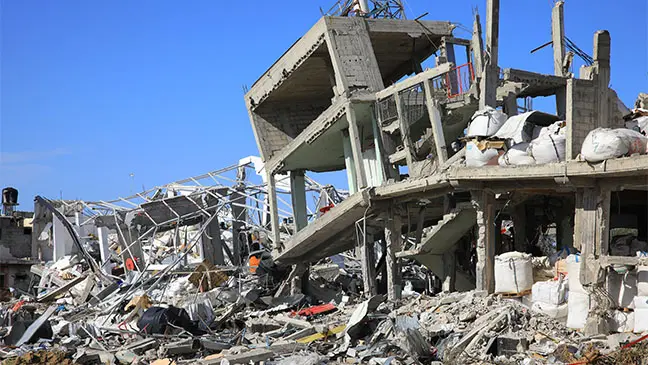
In Gaza, at least 1.9 million people – about 90% of the population – have been forcibly displaced, many of them multiple times. People have fled to try and escape bombs, or have been ordered to leave by the Israeli military. Families sleep in tents, in the skeletons of bombed-out buildings, in hospital corridors where the smell of antiseptic cannot mask the stench of overcrowding.
For Neda’a and her children, displacement means waking before sunrise to join the scramble for water. Mousa, her 12-year-old son, describes the daily ritual. It is the long walk to the well, the fights that break out when the water runs low, the weight of the buckets cutting into his hands as he carries them back. “Before the war, we turned on a tap,” he says. “Now we fight for every drop.”
We have nothing left
Displacement does not end with losing a home. It seeps into every part of life, twisting the ordinary into the unbearable.
For Neda’a’s daughters, it means giving up school to scavenge for firewood, their hands hardened from gathering scraps to burn for cooking. The smoke fills their shelter, making the younger children cough. But there is no gas, no electricity, no other way to eat.
For Mousa, it means bearing the burdens of an adult. To haul water, comfort his siblings when the bombs start again, and try to fill the space left by his older brother.
And for Neda’a, it means waking each morning to the same crushing reality. No money, no safe place, no way to protect her children from the war outside or the despair creeping in.
“I just want to wake up to news that this is over,” she says. “But even if it ends tomorrow, what then? We have nothing left.”
Photo: One of Neda’a’s sons carrying wood among makeshift shelters in Gaza.
Islamic Relief delivers aid in Gaza
While the horror continues, Palestinians have shown incredible resilience. Islamic Relief’s team and local partners in Gaza work tirelessly to provide lifesaving aid, even when they are themselves bombed, displaced and grieving. Over the past 20 months, we’ve cooked millions of hot meals and distributed hygiene kits and emergency cash. Right now, we’re providing aid such as maternal care for pregnant women and cleaning shelters for displaced people to prevent deadly diseases from spreading.
But the need is overwhelming. “We’re not just fighting hunger,” says Program Officer Yasmin Al-Ashy. “We’re fighting the slow death of hope.”
For Neda’a, hope is fragile. She looks at Mousa, now too serious for his age. Ritag, whose hands are rough from gathering wood. Elyas, who is restless every night. She wonders what future awaits them. “I don’t know if they will ever recover from this,” she says.
They desperately need international governments and world leaders to demand an immediate ceasefire and pressure Israel to end its siege.
This World Refugee Day, stand with families like Neda’s. Donate to Islamic Relief’s Palestine emergency appeal to provide lifesaving aid and hope to those who have lost everything. And call on your politicians and governments to demand meaningful political action to end the atrocities.
Today is Nakba Day, an annual day of commemoration. A day of remembrance made especially poignant this year, as we mark over 200 days into ongoing bombardment, displacement, and blockade of Palestinians in Gaza. Here we look at the origins and significance of the day.
What is Nakba Day?
May 15 is Nakba Day. It marks the beginning of the destruction of the Palestinian homeland. The mass displacement in 1948 of the majority of the Palestinian population.
Nakba means ‘catastrophe’ in Arabic. It is the word Palestinians and others use to refer to this historic moment from over 75 years ago. For some, the term is also used to describe the subsequent and ongoing persecution of Palestinians and loss of territory.
In 1998, Nakba Day was officially inaugurated by Palestinian leader Yasser Arafat. But the date had been marked with protests of remembrance and resistance since 1949.
What happened in May 1948?
May 1948 saw the start of a mass displacement, which forced over 700,000 Palestinians out of their homes.
Over the course of the 1948 Palestine War, Israeli forces destroyed more than 530 Palestinian villages and carried out several massacres, killing some 15,000 people. This war lasted until January 1949.
78% of Palestine’s historic territory was captured and used to establish what is now Israel. The remaining land was divided into today’s Occupied West Bank and Gaza Strip.
Following Israeli victory in the war, abandoned homes were given to Jewish settlers. The descendants of many of the Palestinians who fled in 1948 remain displaced to this day, both within Palestine and around the world. Today, there are now some 6 million Palestinian refugees.
What led up to this?
From 1920 to May 1948, Britain ruled over a territory called Mandatory Palestine under an agreement by the League of Nations – a precursor to the United Nations.
Following the end of World War II and the Holocaust, the British announced their intention to end the mandate. Then, the newly created United Nations began seeking to redraw the boundaries of Palestine to allow for the creation of a Jewish state.
None of the various partition plans suggested received support from the Palestinians or the Arab League. However, when the mandate ended, the establishment of the state of Israel was declared. This triggered the 1948 Palestine War, also known as the 1948 Arab-Israeli War.
What happened after the Nakba?
In the 76 years since the Nakba, the Israeli state has continued to encroach on Palestinian territory. They displace families and violate international law in the process.
Among the major instances of this was the Six-Day War of 1967. This war saw Israeli forces occupy all of historic Palestine, including Gaza and the West Bank, expelling 300,000 people from their homes.
In the decades since, tensions in the region have remained high, with relatively frequent flare-ups.
However, the scale of the current escalation is truly unprecedented. Since October 7th, 2023, over 52,700 people have been killed. Many more have been displaced, among them people who moved to Gaza after the Nakba. A reported 450,000 people are said to have fled Rafah over the past week alone.
What was Palestine like before the Nakba?
Immediately before the Nakba, Palestine was administered by the British. The establishment of Mandatory Palestine took place in a period of intense European colonial expansion. It followed the expulsion of Ottoman forces from the Levant in the Arab Revolt (1916-18). Prior to the Mandatory period, Palestine had been part of the Ottoman Empire for 400 years.
During the Mandatory period, Palestine became a cohesive political unit with Jerusalem as its capital. The period saw advances in bureaucracy, infrastructure, and technology. It is also considered to have laid the groundwork for the establishment of Israel in part by promoting Jewish immigration and depriving Palestinians of self-rule.
What are the long-term consequences of the Nakba?
The Nakba resulted in the world’s longest-running unresolved refugee crisis. Some 6 million Palestinian refugees reside within Gaza and the West Bank, as well as in neighbouring countries such as Jordan and Lebanon. In some cases, Palestinian refugees in the Middle East have endured wars and further displacement in their host countries.
The enormous loss of territory that began with the Nakba continues to affect the everyday lives of Palestinians. Many valuable resources are located on land now claimed by Israel. This prevents Palestinians from accessing them and potentially growing their economy.
The Israeli occupation, which has been ruled illegal under international law, impacts every aspect of Palestinians’ lives. It denies their basic human rights, undermines their dignity and entrenches poverty. Restricts movement, trade, and access to water, services, farmland, markets, families and religious sites. Cuts Palestinians in Gaza, East Jerusalem and the West Bank off from each other.
Gaza has been under Israeli blockade since 2007. The blockade restricts the movement of goods and people in and out of the Strip. It devastates the economy and people’s futures and disrupts humanitarian efforts.
For years, thousands of essential items have been restricted from entering Gaza because Israel considers them to have a ‘dual use’. This means items that could potentially be used for both civilian and military purposes. In practice, this can include almost anything that people need—things like fuel, water filters, solar pumps and surgical scissors have been refused entry.
Since October 2023, Israel has tightened the blockade even further, preventing many more vital items from entering. On 2 March 2025, Israel completely closed all crossings into Gaza and stopped all food, medicine, fuel, and other lifesaving supplies from entering.
How is Nakba Day commemorated?
For many, Nakba Day is an opportunity to draw attention to the persecution of Palestinians, historic and ongoing. It is a struggle that is still very much ongoing, particularly in years such as this, when Nakba Day falls during an escalation in the crisis.
The day is also a time to celebrate Palestine’s rich culture and history outside a narrative of suffering, which for many defines the territory and its people. Palestinians are not only resilient. They are talented writers and dancers, gifted embroiderers and generous hosts.
In 2023, for the first time in history, the United Nations marked Nakba Day. The global body held an event to “serve as a reminder of the historic injustice suffered by the Palestinian people,” as well as to highlight the ongoing refugee crisis. The event included speeches, music, photos and personal testimonies.
More than 30 countries voted against the resolution to commemorate Nakba Day. This reflects the inability of many states to balance the acknowledgement of Palestinian suffering with their own support of Israel. Israel often opposes official and unofficial commemorations of Nakba Day, describing them as an obstacle to peace in the region.
Why is Islamic Relief talking about Nakba Day?
Islamic Relief has been working in the Occupied Palestinian Territory since 1997, supporting Palestinians in need through emergency response efforts and development programming.
Many of our staff and local partners have become displaced since October 2023 and are facing the same challenges as the communities we support. Our office in Gaza is among the almost 900,000 buildings destroyed or damaged by the ongoing bombing campaign.
Despite immense challenges, we continue to support vulnerable people in Gaza. Whenever and wherever we can, we provide them with food and water distributions, orphan sponsorship and other assistance. This support is a lifeline for thousands of families in a time of desperate need.
However, our work and the work of many global and local humanitarian organisations is being curtailed as a direct result of the ongoing violence and the tightened blockade. Every minute that supplies are prevented from entering Gaza puts more lives at risk.
Islamic Relief is taking the opportunity presented by Nakba Day to remind donors, decision-makers and the general public, of the longstanding struggle and suffering of the Palestinian people. Their suffering is not consigned to the history books: it is a deepening and devastating humanitarian crisis unfolding before the eyes of the world. We are calling on international governments to demand a ceasefire, an end to the siege and full humanitarian access. As we near 600 days of the current escalation, families are still being separated, starved and killed. International governments must ensure that Palestinians can stay on their land.
This is the present-day reality for everyone in Gaza, but whether it remains their future too depends on the decisions made by world leaders and international bodies today. Please help Islamic Relief to continue supporting families in desperate need in Gaza.
In the ongoing crisis, Gaza needs your help
Help us provide urgent medical supplies, food and other crucial, life-saving aid now to families in need by giving with Islamic Relief.
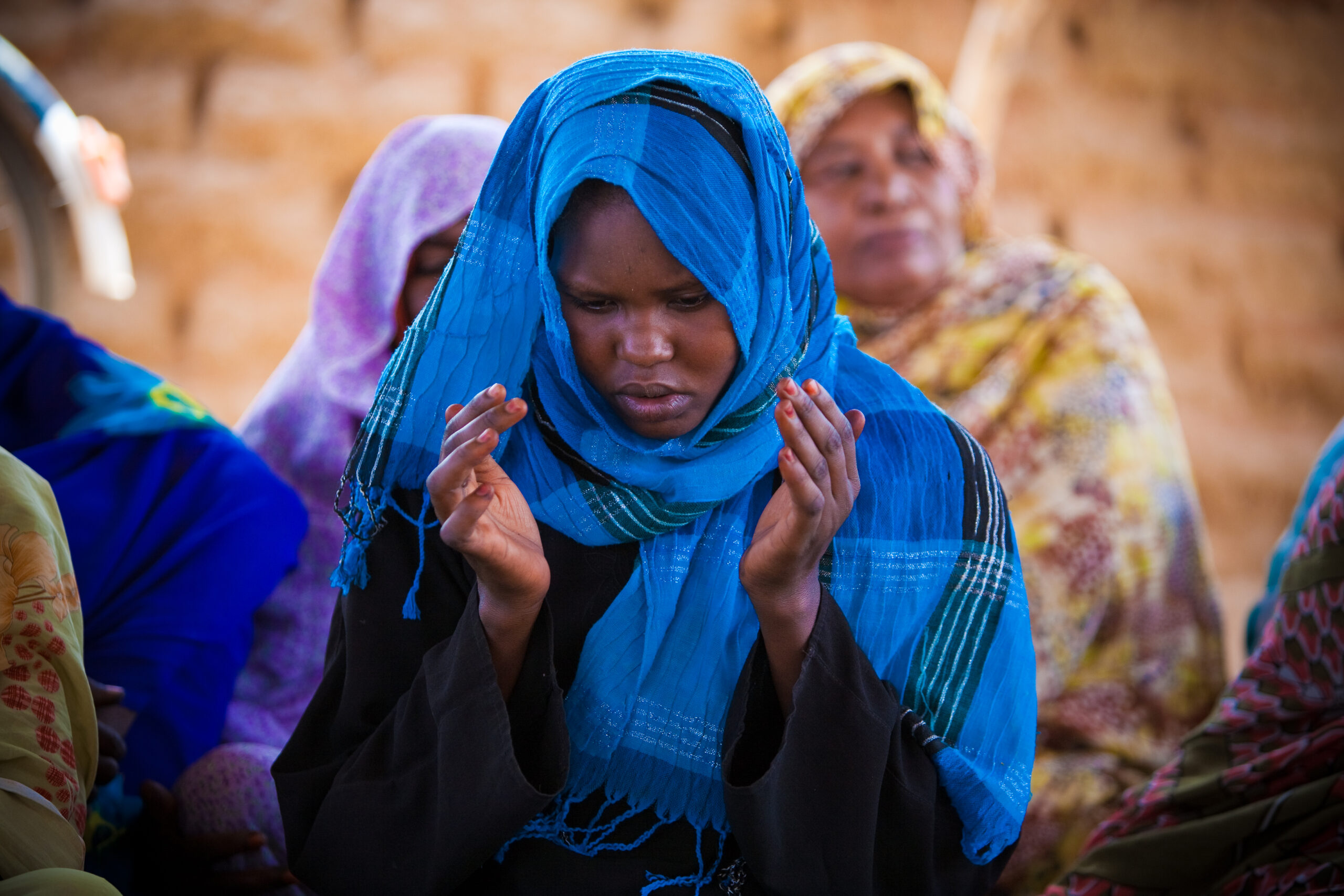
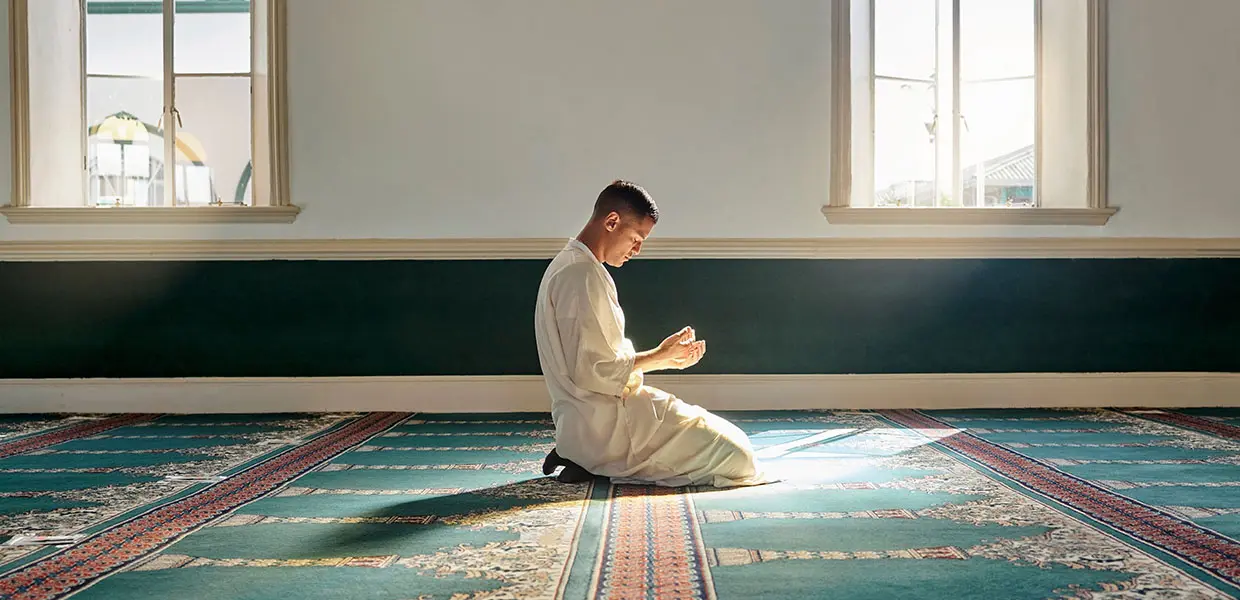
Making Du’a (supplication) is a powerful act of worship. We know that Allah loves it when we ask of Him, and He has promised to answer us quickly. With our brothers and sisters in Gaza still suffering beyond comprehension, now, more than ever, is the time to pray for Palestine.
When to say a Dua for Palestine?
You can make sincere Du’a for our brothers and sisters in Palestine at any time, but Du’a is more likely to be accepted at certain times.
Here are a few:
The last third of the night: It’s said this is a time when Allah (SWT) descends to the lowermost heaven. He says, “Who is calling Me, so that I may answer him? Who is asking Me so that I may grant him? Who is seeking forgiveness from Me so that I may forgive him?” [Hadith | Bukhari]
The last 10 days and nights of Ramadan: In particular, on Laylatul Qadr (the night of power)
Between the adhan and the Iqamah: Prophet (ﷺ) said, “A dua offered between the adhan and iqamah is not rejected.” [Hadith | Abu Dawud & Al-Tirmidhi]
On Fridays: There is an hour when, if a Muslim happens to pray at that time and ask Allah for something good, Allah will grant him whatever he is supplicating for. There are many views of the Ulama in regards to the exact moment of acceptance. Two of the most famous adopted opinions are: 1) After Asr until Maghrib, and 2) When the Imam sits for the Friday Khutbah until the completion of Salah.
When travelling or on a journey: The Messenger of Allah (ﷺ) said, “Three supplications will not be rejected [by Allah (SWT)], the supplication of the parent for his child, the supplication of the one who is fasting, and the supplication of the traveller.” [Hadith | Tirmidhi]
At the time of breaking the fast: As mentioned, the Prophet (ﷺ) said the Dua of a fasting person will not be rejected. [Hadith | Tirmidhi]
When supplicating for someone in their absence: The Prophet (ﷺ) said: “There is no believing servant who supplicates for his brother in his absence where the angels do not say, ‘the same be for you’” [Hadith | Muslim]
The Importance of Du’a
Prophet Muhammad (ﷺ) said:
The supplication of a Muslim for his (Muslim) brother in his absence will certainly be answered. Every time he makes a supplication for good for his brother, the angel appointed for this particular task says: ‘Ameen! May it be for you, too’.
Hadith | Muslim
It’s important to keep those suffering in Palestine and around the world in our Duas, as supplications made with sincerity and humility can earn us great benefits.
Dua for Palestine in Arabic
Here is a Du’a from the Qur’an that you can read to help our brothers and sisters in Palestine, as well as those in need around the world:
‘Allahumma aslih Ummata Muhammad. Allahumma farrij ‘an Ummati Muhammad. Allahumma Rham Ummata Muhammad [sallAllahu alayhi wasalam].
O Allah! Improve (help) the state of the Ummah of Muhammad. O Allah! Grant ease to the Ummah of Muhammad. O Allah! Have mercy on the Ummah of Muhammad.
Dua for Palestine in English
If making Dua in English, you can word your supplication like this, or make Dua from the heart:
“O Allah, help and protect the people of Palestine. O Allah, ease their pain and suffering. O Allah, bestower of Mercy, bestow your mercy on them. O Allah, open people’s hearts to give in this time of crisis. O Allah, help those who are in need, wherever they may be.”
Other Du’as to recite
In times of calamity, we are also advised to recite the following general Du’as from the Qur’an:
Hasbun Allahu wa ni’mal wakeel
حَسْبُنَا اللَّهُ وَنِعْمَ الْوَكِيلُ
Allah is sufficient for us, and He is the best disposer of affairs.
Quran | Ali Imran | 3:173
Inna lillahi wa inna ilayhi raji’oon
إِنَّا لِلَّهِ وَإِنَّا إِلَيْهِ رَاجِعُونَ
Indeed, to Allah we belong and to Him we shall return.
Quran | Al-Baqarah | 2:156
Palestine in the Quran
The following Qur’anic verses refer to Palestine:
Surah Al-Baqarah, Verse 58
And [recall] when We said, “Enter this city and eat from it wherever you will in [ease and] abundance, and enter the gate bowing humbly and say, ‘Relieve us of our burdens.’” We will [then] forgive your sins for you, and We will increase the doers of good [in goodness and reward].– This verse was addressed to Bani Israeel.
Surah Al-Anbya, Verse 71
“And We delivered him [Ibrahim] and Lut to the land which We had blessed for the worlds”
Surah Al-Mu’minun, Verse 50
“And We made the son of Mary and his mother a sign and sheltered them within a lofty place of lasting restfulness and unsullied springs”
Surah Al-Ma’idah, Verse 21
“O my people, enter the Holy Land which Allah has assigned to you and do not turn back [from fighting in Allah‘s cause] and [thus] become losers.” — These are the words of the Prophet Musa (AS).
Surah Yunus, Ayat 93
“And We had certainty settled the Children of Israel in a most goodly abode…” — this is said to refer to Shaam and Jerusalem.
Surah Al-Anbya, Verse 81
“And to Sulaymaan (Solomon) [We subjected] the wind, blowing forcefully, proceeding by his command toward the land which We had blessed. And We are ever, of all things, Knowing” – The Kingdom of Sulaymaan (AS) was in present-day Palestine, and had Al-Quds (Jerusalem) as its capital.
Surah Saba, Verse 18
And We placed between them and the cities which We had blessed [many] visible cities. And We determined between them the [distances of] journey, [saying], “Travel between them by night or day in safety.” — The reference to the blessed cities here refers to the cities of Shaam, including Al-Quds.
Surah Sad, verses 21-22
And has there come to you the news of the adversaries, when they climbed over the wall of [his] prayer chamber – When they entered upon David, and he was alarmed by them? They said, “Fear not. [We are] two adversaries, one of whom has wronged the other, so judge between us with truth and do not exceed [it] and guide us to the sound path” – The Mihrab, mentioned above, was situated within the Masjid Al-Aqsa Compound.
Surah Ali ‘Imran, verse 39
“So the angels called him while he was standing in prayer in the chamber, “Indeed, Allah gives you good tidings of Yahya (John), confirming a word from Allah and [who will be] honourable, abstaining [from women], and a prophet from among the righteous.” — Sayyidina Zakariyya (AS), who was an Imam of Masjid Al-Aqsa, beseeched Allah (SWT) to be blessed with a son, despite his advanced age. Allah (SWT) responded to his fervent Du’as, and the glad tidings of his offspring were conveyed to him as he stood at his Mihrab inside Masjid Al-Aqsa.
Surah Al-A’raf, verse 161
And [mention, O Muhammad], when it was said to them, “Dwell in this city and eat from it wherever you will and say, ‘Relieve us of our burdens,’ and enter the gate bowing humbly; We will [then] forgive you your sins. We will increase the doers of good [in goodness and reward].” – Reference here is to the City of Al-Quds
We ask Allah (SWT) to accept all our prayers and Duas, as we pray for Palestine and all those suffering around the world – Ameen.
Gaza is in the grip of starvation as nearly 2 months of Israel’s total closure have left markets empty, children malnourished, and famine conditions spreading.
The humanitarian response is now at a critical breaking point unless supplies are urgently allowed in.
Israel’s illegal and immoral shutdown of all supply routes into Gaza is a deliberate campaign to starve civilians.
Islamic Relief staff on the ground say the situation is now the worst we have ever seen there. Many children are going whole days without eating. Aid trucks packed with food are cruelly blocked from entering just a few miles away.
Supplies in Gaza at a Critical Low
Meat, fruit, eggs, and dairy products are almost impossible to find. Likewise, the scarcity of vegetables means that prices are up to 15 times more expensive than before the crisis. These come at a time when few people have jobs or access to cash.
Almost 18 months of Israeli attacks have destroyed Gaza’s ability to feed itself. Most agricultural land, greenhouses, and fishing boats have been destroyed, and most cattle have been killed. This has left all civilians in Gaza reliant on humanitarian aid. But none have been allowed to enter since 2 March.
A recent survey of 43 aid agencies in Gaza found that 95% have been forced to reduce or suspend activities due to the total closure and the relentless, indiscriminate bombing. Attacks that have killed more than 51,000 people and targeted hospitals and shelters. Our staff hear horrific daily accounts of families burnt to death in their tents and children maimed by the bombing.
Islamic Relief on the Ground
Islamic Relief staff and partners are doing everything we possibly can to keep aid flowing. But even our own response has been severely impacted.
It is becoming increasingly difficult to keep providing food as supplies run out. Over the past week we have been working with the UN World Food Programme (WFP) to distribute high-energy biscuits, date bars and vegetable oil to more than 7,000 people a day. But it is nowhere near enough and no substitute for nutritious meals.
Islamic Relief also continues to provide other life-saving assistance. We are carrying out daily cleaning of more than 60 shelters for displaced families. To help stop the spread of diseases in the overcrowded and desperate conditions.
Hundreds of thousands of people have yet again been forced from their homes by Israeli military orders in recent weeks, herded into ever-shrinking areas. Zones where there is no clean water, no functioning sanitation and no safety.
Israel has now declared almost 70% of Gaza as inaccessible to civilians through a combination of forced displacement orders and military no-go zones.
People affected by malnutrition and disease are unable to access decent healthcare and treatment. As the Israeli closure also blocks all medical supplies from entering. Fuel is also blocked, forcing generators needed for life-saving operations to shut down.
There needs to be a permanent ceasefire in Gaza
There must be a renewed and lasting ceasefire. Starving civilians and denying them humanitarian aid is in clear violation of international law, but the world continues to turn a blind eye. The international community’s lack of action makes them complicit in Israel’s use of starvation as a weapon of war.
Statements of concern are meaningless without genuine action, such as ending arms sales. Governments must put real political and economic pressure on Israel to abide by international law, reopen crossings and allow humanitarian aid and commercial supplies into Gaza without any further delay.