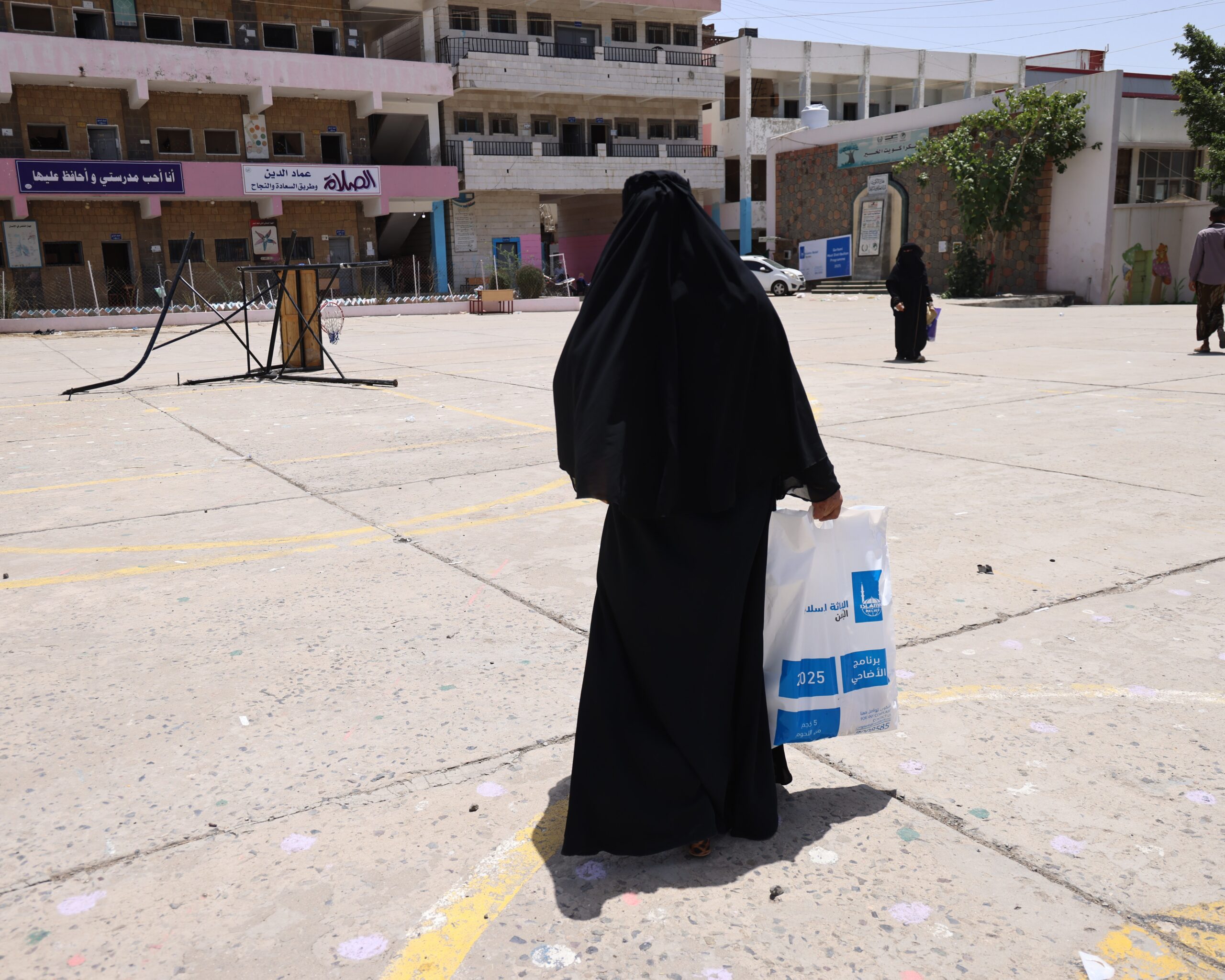
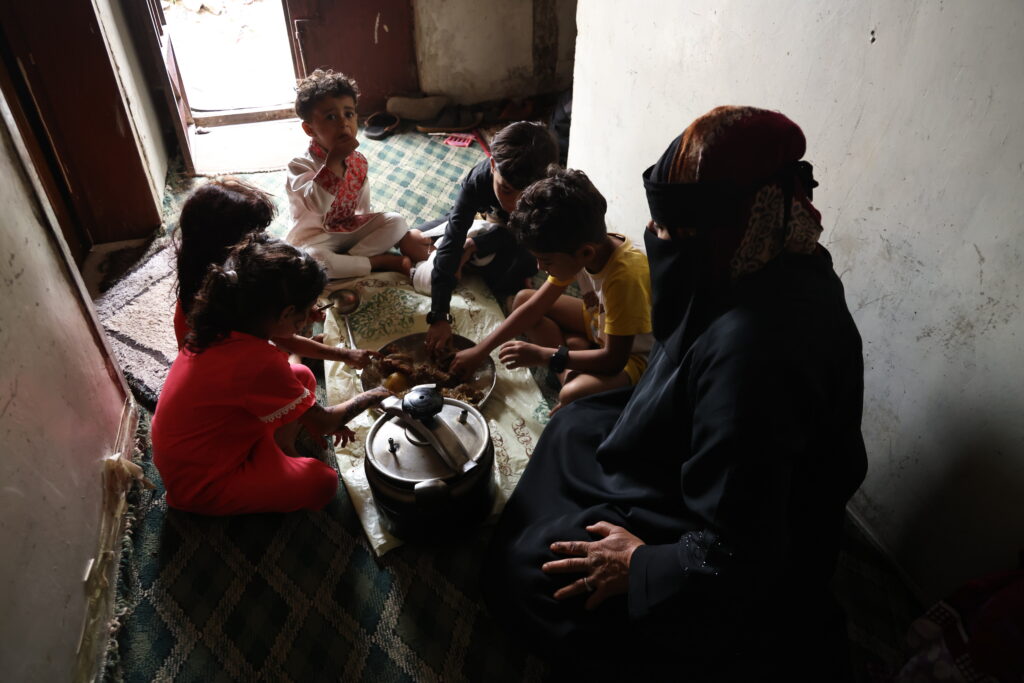
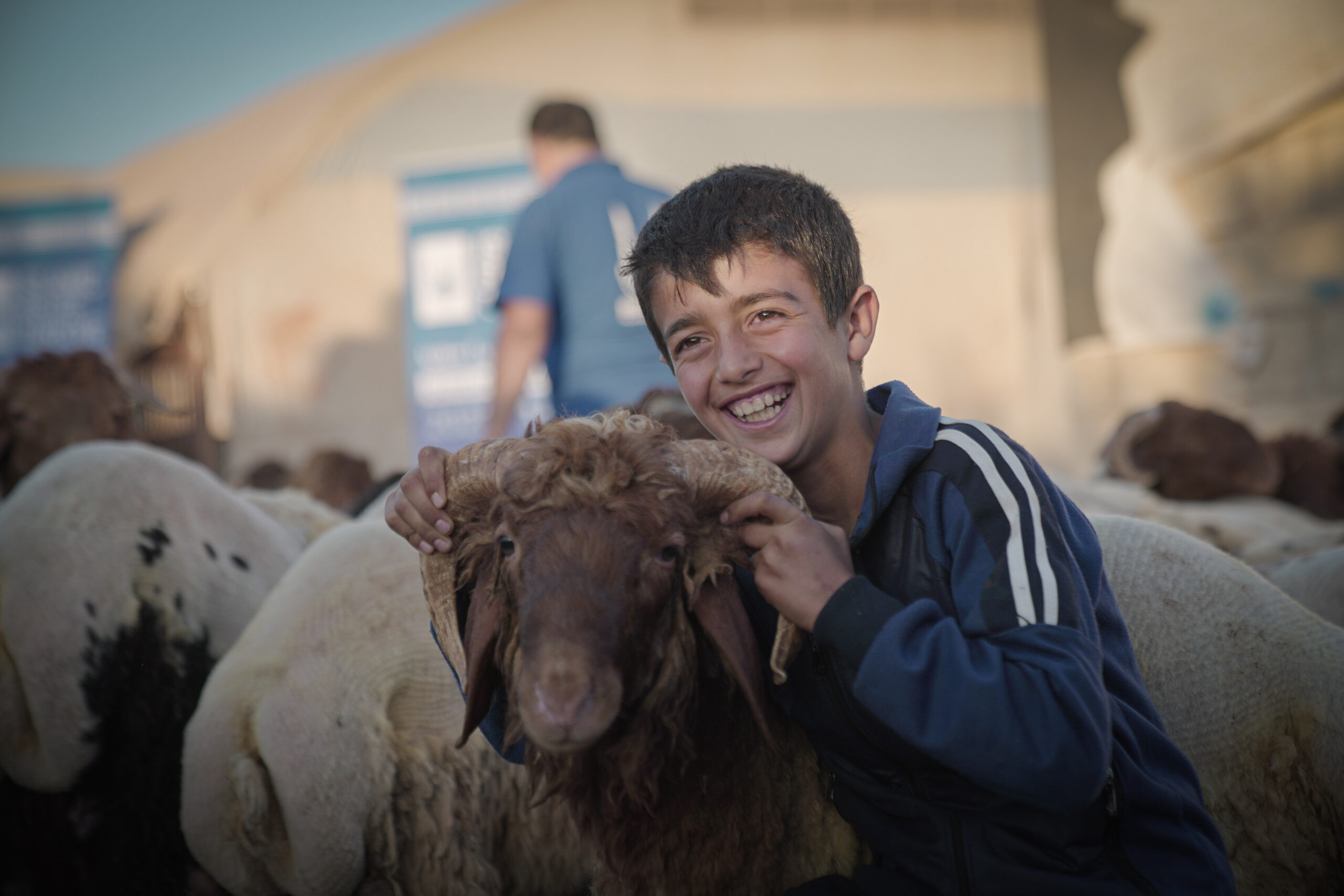
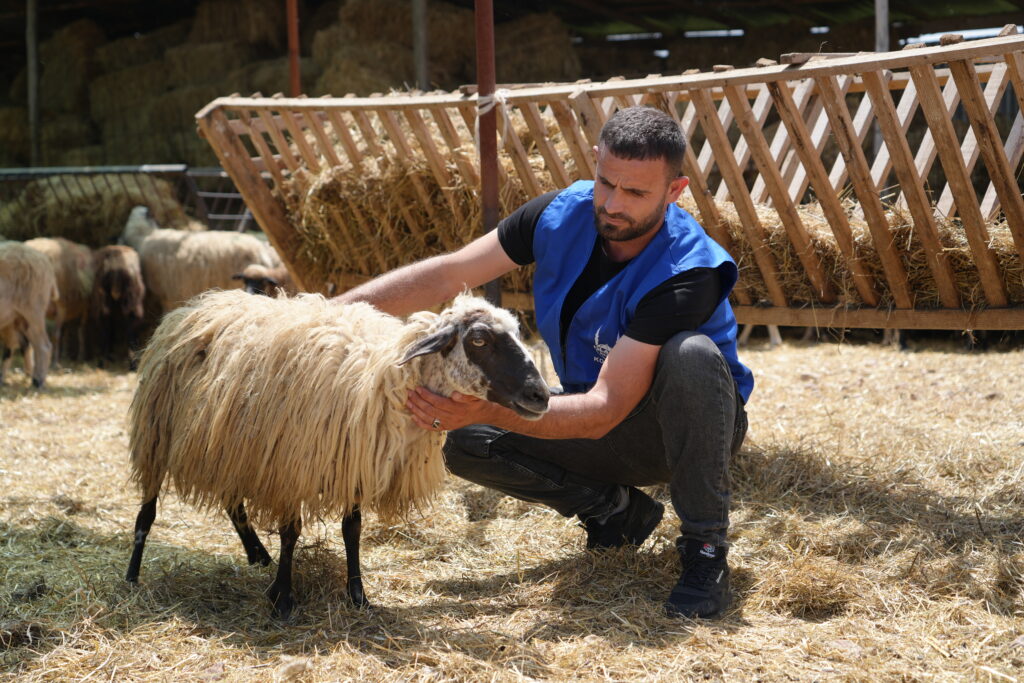
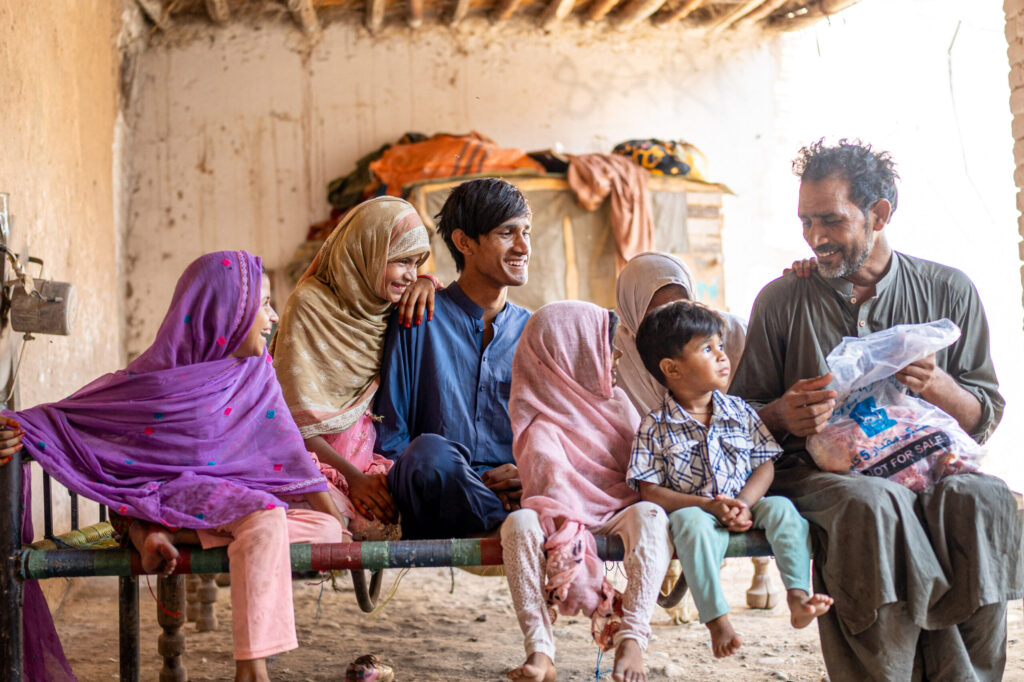
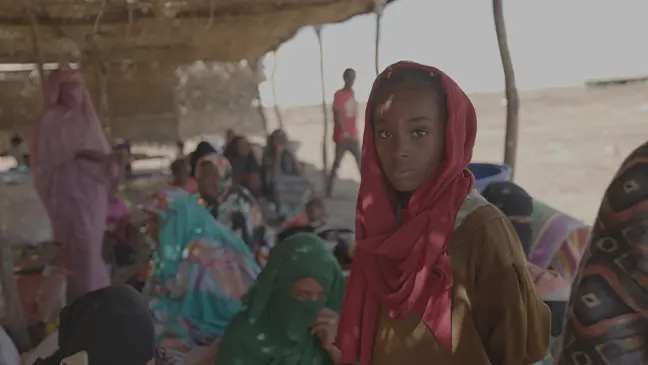
Saltanah, 50, lives in the southwestern city of Taiz, Yemen, with her 6 children. Outside of seasonal distributions such as qurban and Ramadan, the family also receives support from Islamic Relief’s Orphan Sponsorship Program.
“[Eid] is a special time of happiness because it’s the only time in the year when my children and I get to eat meat. They wait for this day all year long,” Saltanah says.
Suffering from an illness that prevents her from working, Saltanah has no option but to rely on aid to meet her family’s needs.
“We have no source of income and no family to support us. We survive on what Islamic Relief provides,” she explains. “Everything is too expensive… access to food, clean water and basic needs is a daily struggle.
“Meat is not part of our regular diet. We only eat it once a year when Islamic Relief provides it during Eid al-Adha… most days, we eat yoghurt because it’s all we can afford.”
Bringing joy, restoring dignity
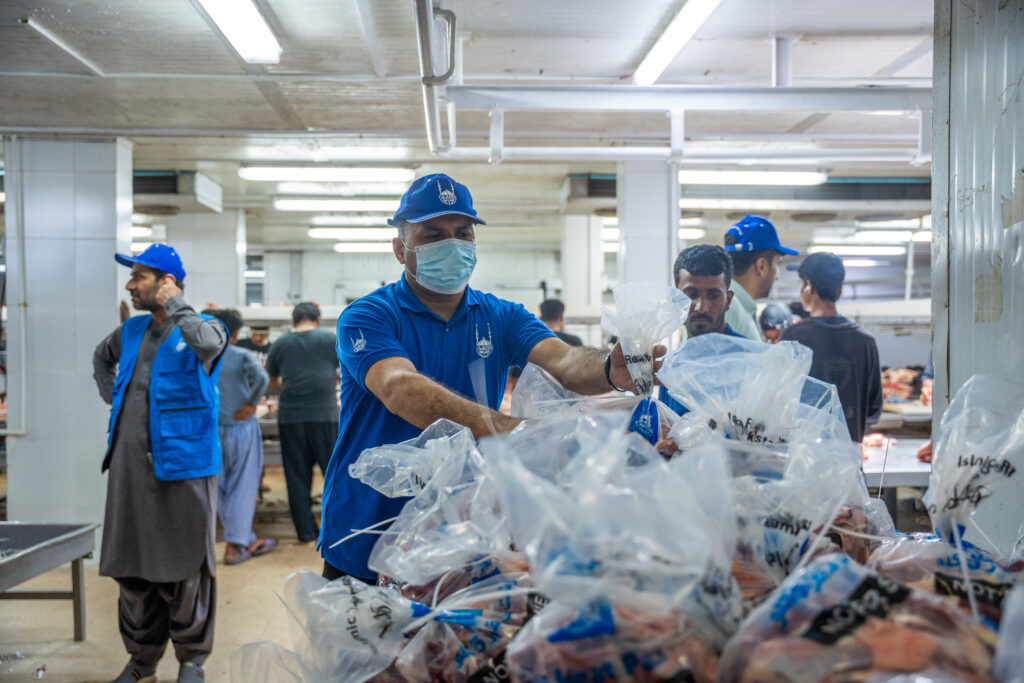
Saltanah was among the almost 70,000 people in Yemen that received a qurban meat parcel through Islamic Relief’s distribution in 2025.
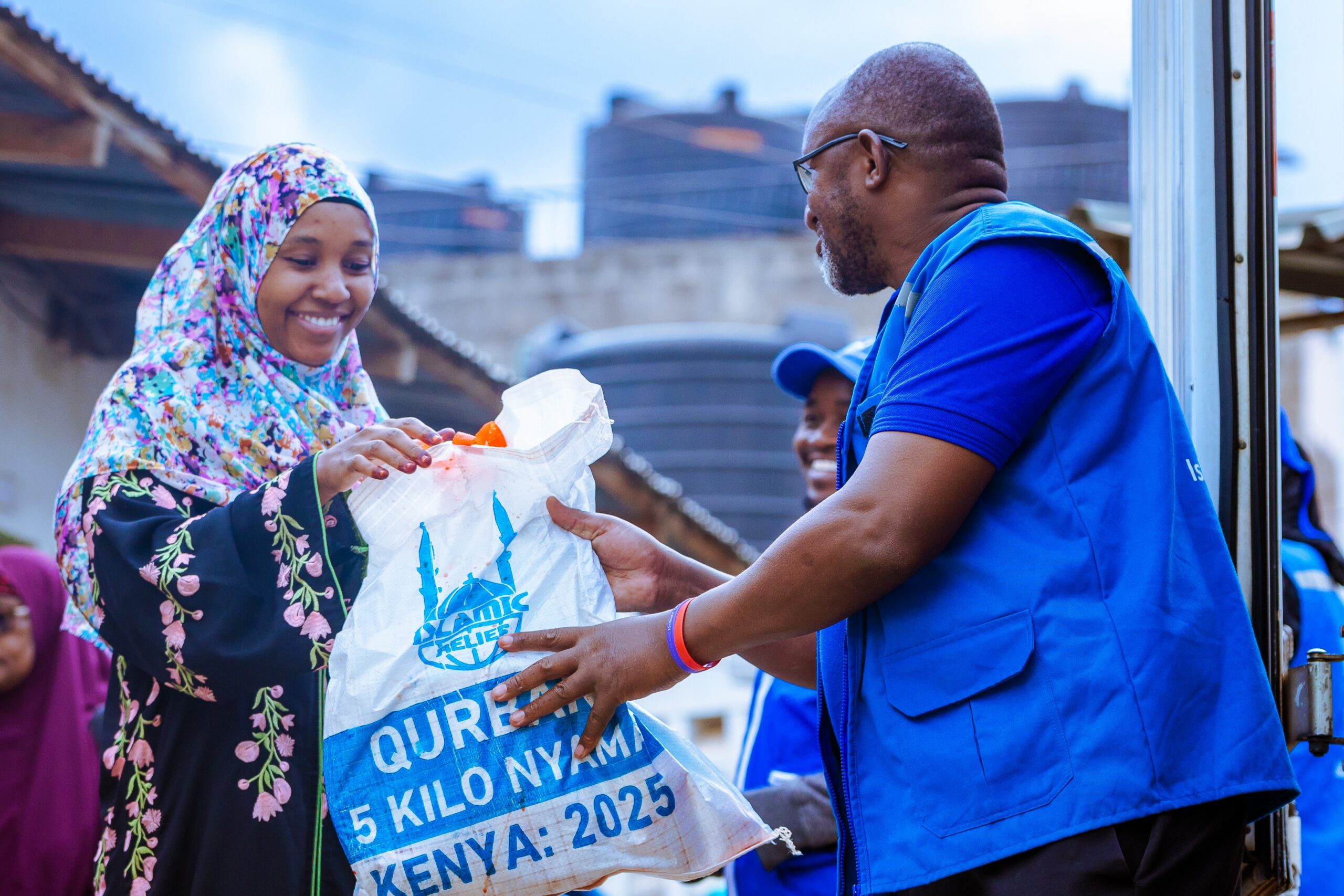
In 2025, Islamic Relief’s annual qurban distribution reached more than 3.2 million people in 29 countries, easing the burden on vulnerable families, supporting their nutrition and sharing the joy of Eid.
This year, needs in Yemen are even greater as families like Saltanah’s grapple with a severe hunger crisis and dwindling international support.
“It is extremely difficult [to buy meat] – impossible, really. We simply can’t afford it,” Saltanah says. “The lack of proper nutrition, including meat, has weakened my health and makes daily life even harder.”
Amid this hardship, your generosity allows Islamic Relief to provide families like Saltanah’s with a moment of respite during a special time of year.
“[The meat pack] brought us joy and allowed my children to eat something they never get the chance to. It restored some of our dignity and gave us a reason to smile during Eid,” Saltanah says.
“May Allah bless Islamic Relief and our sponsor. They have restored some hope in our lives.”
Fulfil your Qurban this Eid. Give generously to our Qurban Appeal to help us reach even more families like Saltanah’s in Yemen and beyond this year.
This Dhul Hijjah, Share Your Blessings
Help the world’s most vulnerable families enjoy their Eid when you give Qurban with Islamic Relief.
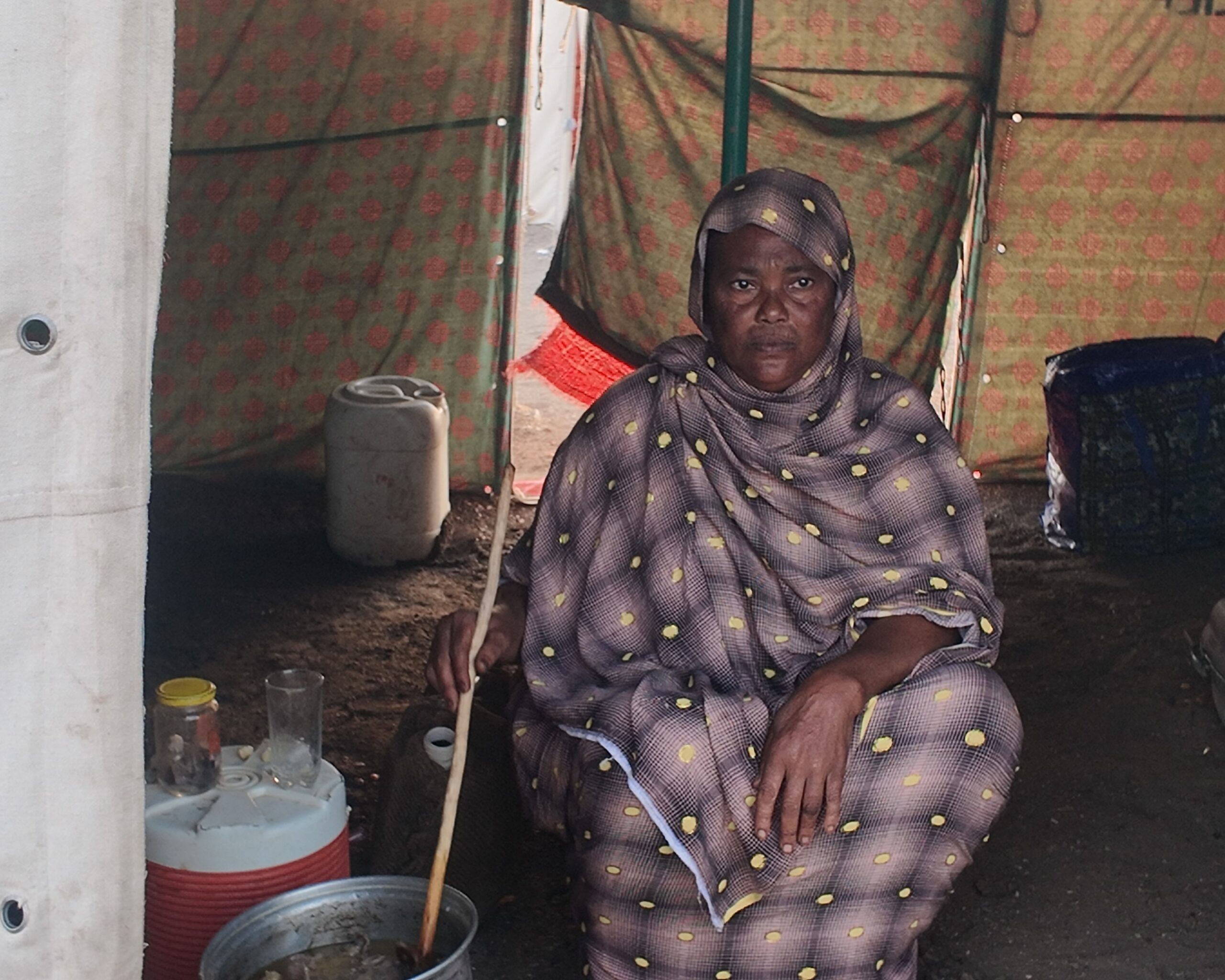
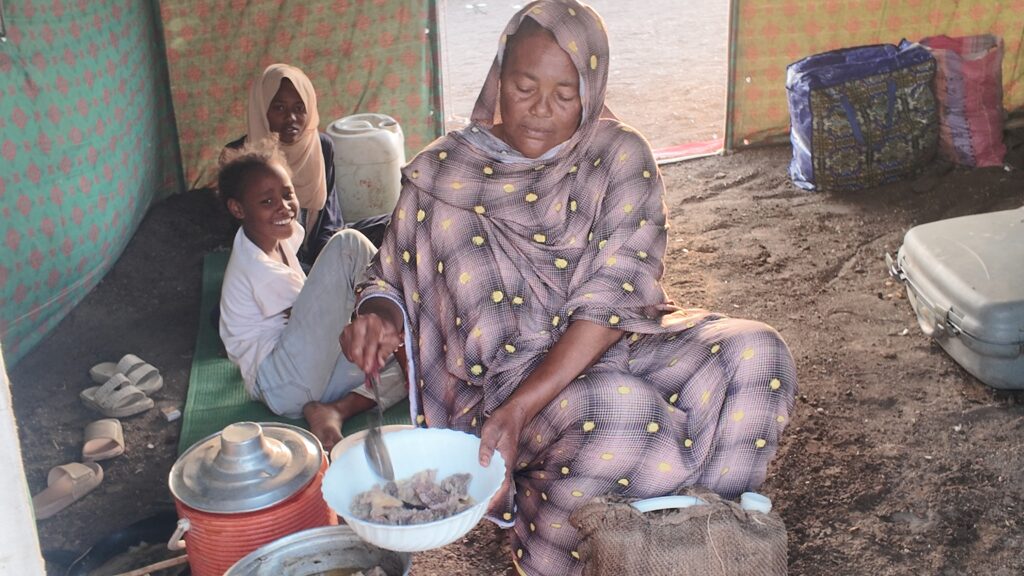
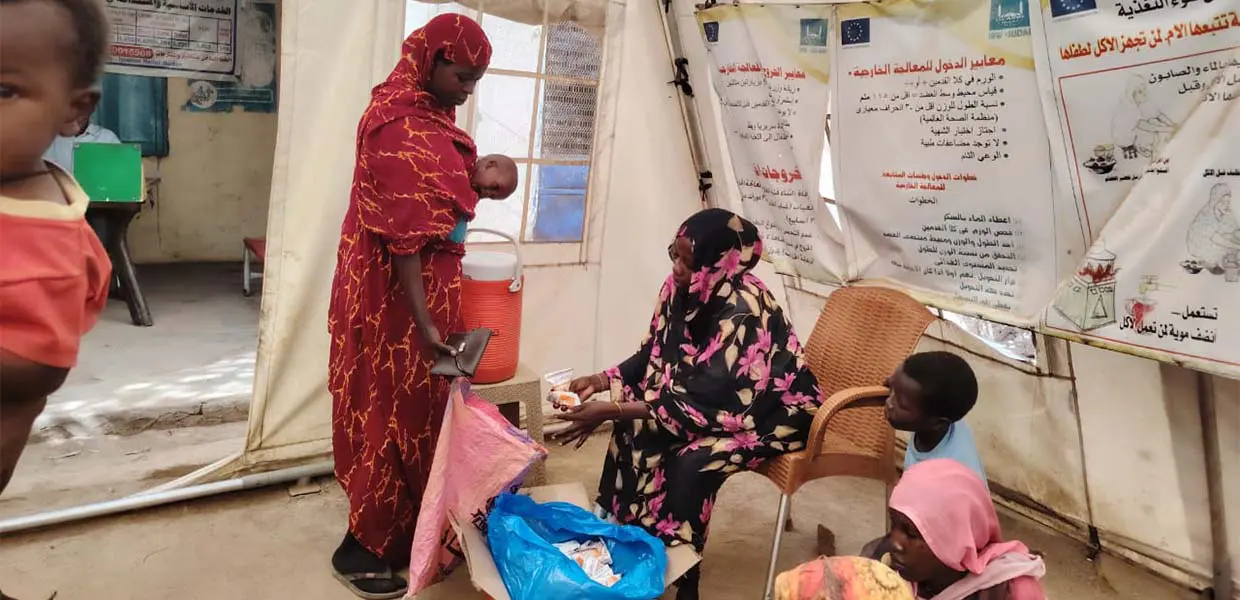
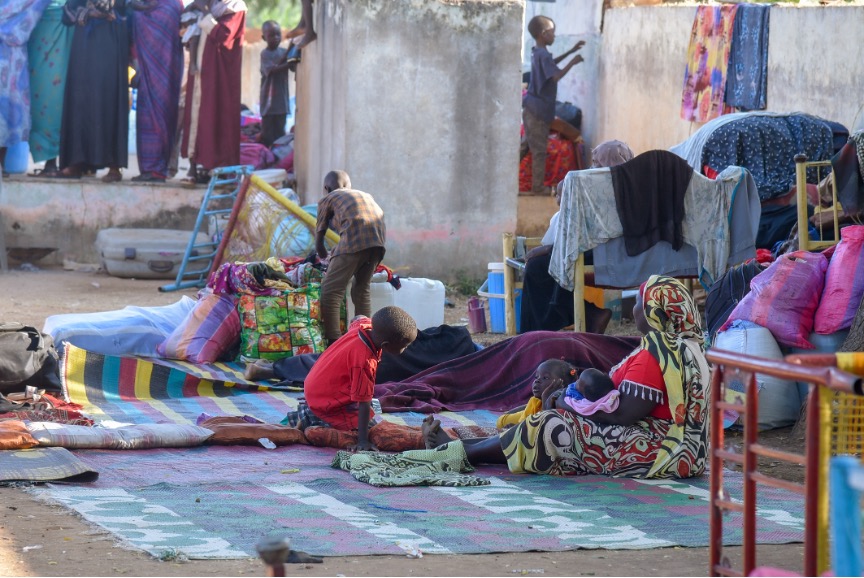
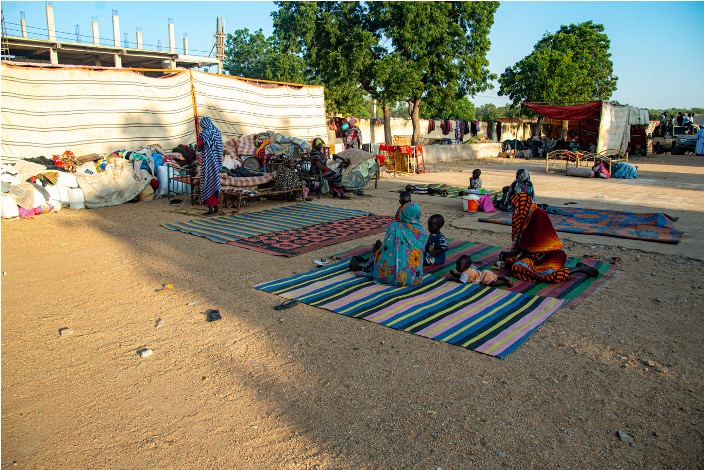
Halima lives with her 4 children in a camp for displaced people in Gedaref, Sudan. Like millions of others, the family were forced to flee their home amid the crisis that has engulfed the country for the last 3 years.
“Living as [internally displaced people] is very difficult,” Halima says. “We have no income and just depend on aid. The living conditions in the camp itself are very difficult; tents are hot, there are lots of insects, as well as snakes and scorpions.
“Everything is expensive and we cannot buy from the market. There is no education or school for our children. But the most difficult thing is getting [medical treatment]. There are no health services in the camp, sick people go to Gedaref City, but it is very expensive.”
Halima says she struggles to afford meat. With so many other pressing needs, it’s difficult to justify paying the high prices for meat.
“We didn’t eat meat for a month or more. Yes, that affects our health, but we use available food like red beans to cover the lack of meat in our diets.”
‘A great happiness’
Halima is among the more than 92,500 people in Sudan that received a qurban meat pack from Islamic Relief in 2025.
Our team in Sudan focused on the most vulnerable groups, including displaced people like Halima, pregnant women, and people with chronic illnesses and disabilities.
Worldwide, Islamic Relief’s 2025 qurban distribution reached more than 3.2 million people in 29 countries, easing the burden on vulnerable families, supporting their nutrition and sharing the joy of Eid.
“Eid al-Adha means everything to me,” Halima says. “It is a time when we thank Allah, but also a time when we meet with families and friends. But Eid after the war is not like before, we lost our houses and there are many things we can’t afford here in the camp.
default
“We haven’t eaten meat for months; we didn’t expect to get meat this Eid either. This has become a great happiness for my children. This has been a great help to my family.
“Since we have been displaced, Islamic Relief is the organisation that has supported us the most, including by providing some cleaning materials, recreational items, shelter [tent and plastic sheeting], in addition to qurban now.”
Fulfil your Qurban this Eid. Give generously to our Qurban Appeal to help us reach even more families like Halima’s in Sudan and beyond this year.
This Dhul Hijjah, Share Your Blessings
Help the world’s most vulnerable families enjoy their Eid when you give Qurban with Islamic Relief.
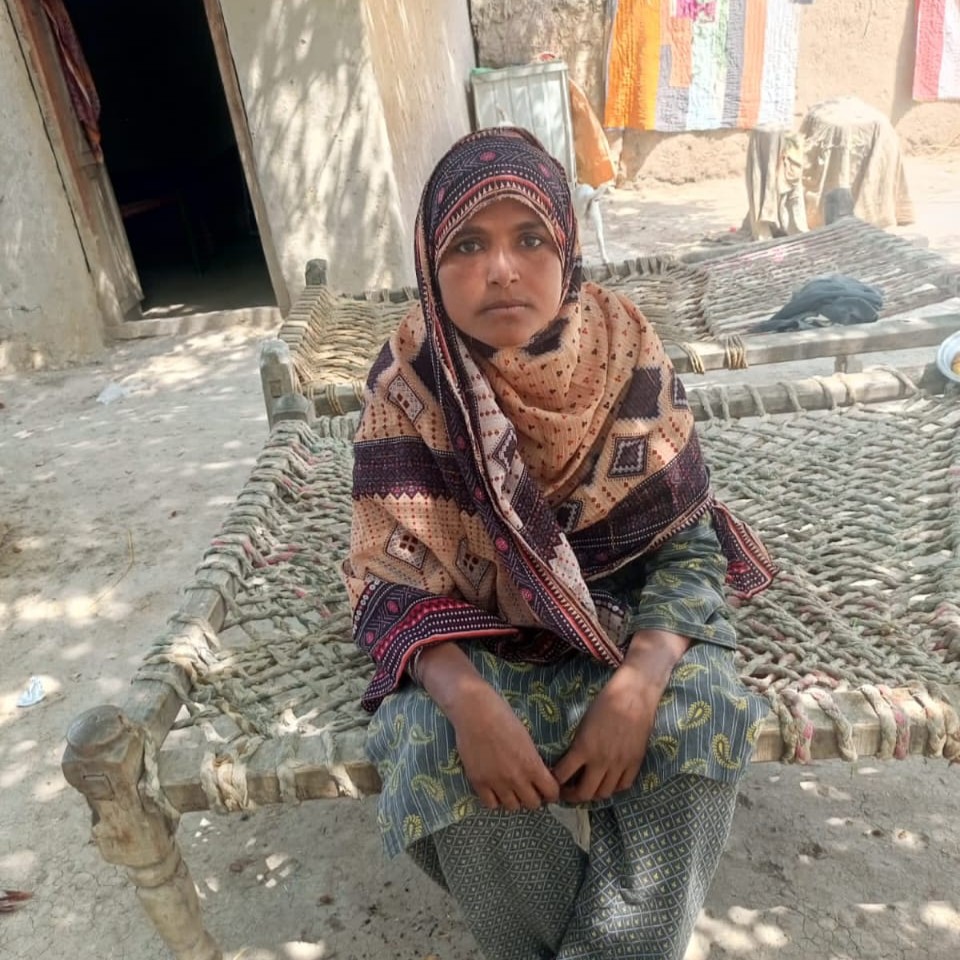
Shahnaz lives with her husband, two daughters and son in Rabnawaz village in Rajanpur, a district in Pakistan.
“My husband works as a daily wages labourer and we survive mostly off his income. I help during the harvest and receive some of the crop as payment. This helps supplement our income,” Shahnaz explains.
“Our standard of living is very basic. We often struggle to buy enough food, and meat is a rare luxury. We live in a small mud house and water leaks through the walls and ceiling when it rains.
“My children go to a nearby government school, but we can’t afford extra books or toys for them. When someone falls sick, we rely on government hospitals or home remedies. Still, we are grateful for whatever little we have, and I keep hoping for a better tomorrow.”
“Meat is not part of our daily diet. Months go by without it. My husband, my children and I feel the difference in our bodies. My husband wakes up tired. I also feel weak as I can’t work as long or as hard as I used to. Back pain, joint stiffness and body aches have become a routine part of life. My children are also suffering from malnutrition.
“Meat is like gold for us and I save money for days to buy healthy and nutritious food like meat for my children to make them happy and healthy. We only get enough [meat] on Eid al-Adha.
Bringing joy and happiness to Pakistan
Shahnaz is one of almost 75,000 people in Pakistan to receive a qurban meat parcel from Islamic Relief in 2025.
Worldwide, Islamic Relief’s 2025 qurban distribution reached more than 3.2 million people in 29 countries, easing the burden on vulnerable families, supporting their nutrition and sharing the joy of Eid.
“Eid al-Adha is the only time in the year when we eat meat properly,” Shahnaz says. “It brings joy and happiness to my family, especially my children, and a sense of equality. We feel included, like others. It reminds us that Allah provides and gives us hope to keep going despite hardships.
“The qurban meat pack brought happiness to our home. My children were excited to eat meat after a long time. It made our Eid special and gave us a feeling of being cared for. We felt blessed and thankful to those who shared with us.
“I want to say thank you to Islamic Relief for remembering families like ours. Your support brings home and dignity to our lives. May Allah bless you for your kindness and efforts.”
Fulfil your Qurban this Eid. Give generously to our Qurban Appeal to help us reach even more families like Shahnaz’s in Pakistan and beyond this year.
This Dhul Hijjah, Share Your Blessings
Help the world’s most vulnerable families enjoy their Eid when you give Qurban with Islamic Relief.
Dhul Qadah is the 11th month of the Islamic (Hijri) Calendar. It is one of the four sacred months as ordained by Allah (SWT).
“Indeed, the number of months with Allah is twelve [lunar] months in the register of Allah [from] the day He created the heavens and the earth; of these, four are sacred. That is the correct religion, so do not wrong yourselves during them…”
Qur’an, 9:36
It is during this month that the initiation of fighting (unnecessary violence) is prohibited. As it is also in the three remaining sacred months, Dhul Hijjah, Muharram and Rajab.
They ask you [Prophet] about fighting in the prohibited month. Say, “Fighting in that month is a great offence…”
Qur’an, 2:217
When is Dhul Qadah 2026?
In 2026, Dhul Qadah began on Saturday, 18th April 2026, according to the sighting of the moon. It follows the month of Shawwal, which follows Ramadan.
How many days are in Dhul Qadah?
As with other Islamic months, there are either 29 or 30 days in Dhul Qudah. This also depends on the sighting of the moon’s crescent.
Importance of Dhul Qadah
While there are no days of worship that are prescribed for Muslims during the month of Dhul Qadah, Ibn Kathir mentions it is a month that has been selected by Allah (SWT) as one of His sacred months. In it, both the sins and good deeds of humanity are deemed to be of more significance.
“In all (twelve) months, Allah then chose four out of these months and made them sacred, emphasising their sanctity, making sinning in them greater, in addition to multiplying the rewards of righteous deeds during them.”
Tafseer Ibn Katheer
History of Dhul Qadah
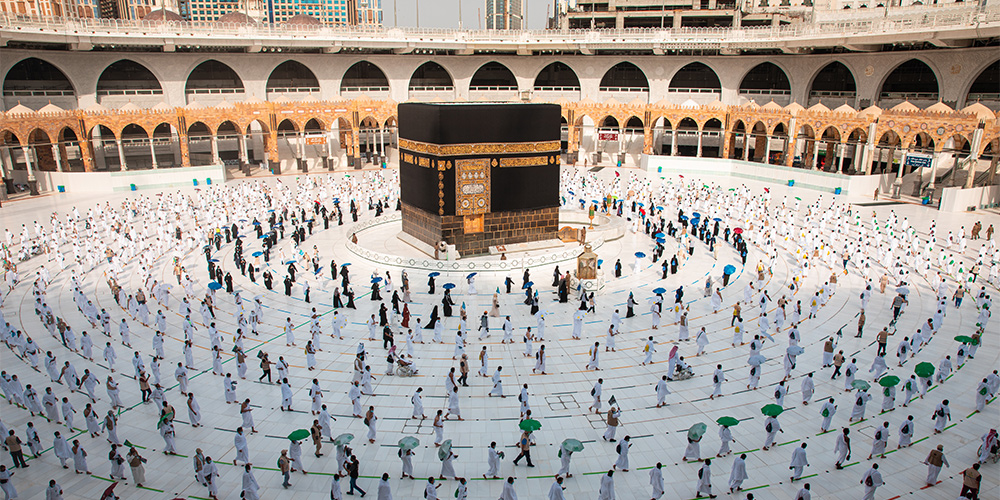
Historically, since violence is prohibited by Allah during the month of Dhul Qadah, pilgrims have been able to perform Hajj safely without the worry of war.
The month also holds some notable events, and dates are significant to Islam. This includes the signing of the Treaty of Hudaybiyyah in 628 AD, signifying the day the Quraysh tribe recognised Islam. This allowed Prophet Muhammad (ﷺ) and his companions to safely return to Mecca without fear of violence.
This ultimately led to the Prophet (ﷺ) and his companions being able to complete the first Umrah to Makkah, after their migration to Madinah, which took place in 629 AD.
Tips for increasing your good deeds in Dhul Qadah
As this sacred month amplifies our sins as well as our good deeds, there are a number of acts you can do to increase your blessings during the month of Dhul Qadah.
Here are some things you can do:
Don’t hurt others: Fighting (to harm others) is prohibited during this holy month. It’s important not to take out your anger on others or be resentful towards them this month.
Increase in voluntary acts of worship: Increase in your Sunnah and Nafl prayers, incorporate Tahajjud prayers, increase Dhikr or read more Qur’an. As good deeds are amplified during this month, we should reap the benefits and do as many voluntary acts of worship as we can.
Give Sadaqah: The Prophet (ﷺ) said: “Charity extinguishes sinful deeds just as water extinguishes fire.” [Ibn Majah]. Give charity with Islamic Relief during this blessed month.
Seek forgiveness: As sins are heavier in this month, turn to Allah (SWT) in repentance and ask for forgiveness for the wrong you have done.
Embrace the Sacred Months
Dhul Qadah is an opportunity Allah (SWT) gifts us to reflect and renew our intentions. A chance to amplify our good deeds and be extra mindful of our actions.
It is a time to distance ourselves from wrongdoings, while drawing closer to Allah (SWT) through doing good. By honouring the sanctity of Dhul Qadah, we show our respect for Allah’s divine commands and prepare our hearts for the approaching season of Hajj and Dhul Hijjah.
Let us make the most of this sacred month. So that we may enter the months ahead with a heart purified and a spirit renewed.
Sana Basim, Head of Programmes for Islamic Relief Lebanon, looks back on the country’s ‘Black Wednesday’ – the deadliest day of bombing in many years.
Lebanon carries many dates etched into its memory, days of loss, pain, and survival. But 8 April will remain one of the ugliest scars, a date marked by inhumanity, injustice, and brutal violence that cannot be forgotten.
Despite the 2024 ceasefire, Israeli violations never truly ceased. Attacks on southern Lebanon continued, relentless and normalised.
Then came the escalation following the US‑Israel‑Iran war, triggering mass displacement across the country. Nearly 20% of Lebanon’s population was forced from their homes. Once again, civilians paid the highest price.
Islamic Relief Lebanon has been among the frontline responders, working tirelessly to support conflict‑affected communities.
In the days following this deadliest hour, I spoke with several displaced people. What struck me most was not their words but their silence. They didn’t know what to say. Yet one fear, unspoken but unavoidable, was written clearly on their faces:
Are we going to become another Gaza?
Will the world let that happen to us, the way it let it happen to Palestinians in Gaza?
Their silence was deafening. So were the questions in their eyes.
As a humanitarian worker, someone who speaks about humanitarian principles, international humanitarian law, and justice, I found myself utterly speechless. In moments like this, those concepts felt hollow. For the people of Lebanon, they had become words on paper, stripped of meaning, value, and protection.
A day like any other
April 8 began like any other day of crisis. My team was distributing water in one of the shelters in Beirut, while I was preparing situation reports and drafting emergency response plans.
Since the war began, Islamic Relief Lebanon has been operating in a hybrid modality: staff living outside Beirut working remotely or coming in when needed, while Beirut‑based staff continued to report to the office. That Wednesday was no different.
Then I heard a loud sound.
At first, I thought it was Israeli jets breaking the sound barrier, something they often do, which terrorises the population. But then came another blast. And another.
We gathered in one room where we could see thick grey smoke rising into the sky. Panic set in. Phones started ringing with non-stop calls, messages, and alerts. Shock, fear, and disbelief filled the space.
HR immediately launched a headcount poll on our staff WhatsApp group to make sure everyone was safe. The security focal point rushed to contact the distribution team.
One of the airstrikes had landed just 3 kilometres away from Islamic Relief distributions, but all staff remained safe.
The team reported chaos at the shelter. Children were crying and screaming. The sound of the strikes was overwhelming. Smoke filled the air. The smell of explosives was strong and suffocating. Fear was everywhere.
Soon after, videos began flooding our phones. They felt unreal like scenes from a movie, except this was real life.
Bombs dropping everywhere. People crying and running. Ambulance sirens cutting through the air. People honking on the roads as panic spread. Many abandoned their cars in the middle of the street and ran, desperate to escape.
Within minutes, Beirut, the city of life, movement, and resilience, turned into a horror scene.
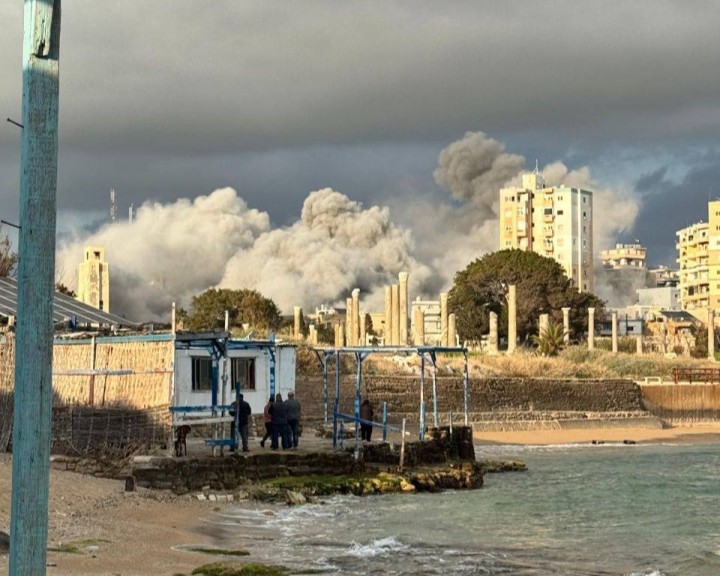
Later, media reported that over 100 airstrikes were carried out in just 10 minutes, without any prior warning. Residential and commercial buildings were hit. People went missing. More than 300 casualties were reported, with hundreds more injured.
That hour changed everything. And for many, survival itself became an act of resistance.
A fragile, temporary peace
Last night, a 10-day ceasefire was announced – a welcome piece of news but one which is being met with some scepticism in Lebanon.
The agreement applies only to the part of the country lying north of the Litani river and, more worryingly, only to air-based attacks and not Israel’s ground invasion.
People remain fearful that fighting will break out again after the 10-day pause, if it even lasts that long.
Islamic Relief hopes the ceasefire holds and urges the international government with leverage and all parties involved to ensure that it is fully respected.
Islamic Relief is working to support vulnerable communities in Lebanon throughout this crisis. Please help us to continue this life-saving work. Donate to our Lebanon Emergency Appeal today.
Give hope to the people of Lebanon
Your compassion can save lives. With your support we are able to respond immediately to human suffering in Lebanon.
Giving Qurban is a sacred duty given by Allah (SWT). Every year, during Eid Al-Adha in Dhul Hijjah, Muslims worldwide engage in this important act of worship. One that reflects on Prophet Ibrahim (AS)’s devotion to Allah (SWT) and his ultimate sacrifice.
What is Qurban?
Qurban (also known as Qurbani or Udhiyah) means sacrifice. It refers to the slaughtering of an animal – typically a sheep, goat, camel, or cow – for the sake of Allah (SWT), during the days of sacrifice.
“That they may witness benefits for themselves and mention the name of Allah on known days over what He has provided for them of [sacrificial] animals. So eat of them and feed the miserable and poor.”
Quran 22:28
The ritual commemorates Prophet Ibrahim (AS)’s willingness to sacrifice his beloved son, Ismail (AS), for the sake of Allah (SWT), and both their steadfastness in carrying out this order from the Creator. Their story reminds us to trust in Allah (SWT) and know that He will help us overcome our hardships.
“Then when the boy reached the age to work with him, Ibrahim said, “O my dear son! I have seen in a dream that I ˹must˺ sacrifice you. So tell me what you think.” He replied, “O my dear father! Do as you are commanded. Allah willing, you will find me steadfast.”
Then when they submitted ˹to Allah’s Will˺, and Ibrahimlaid him on the side of his forehead ˹for sacrifice˺, we called out to him, “O Ibrahim! You have already fulfilled the vision.”
Indeed, this is how We reward the good-doers. That was truly a revealing test. And We ransomed his son with a great sacrifice, and blessed Ibrahim ˹with honourable mention˺ among later generations: “Peace be upon Ibrahim.”
Quran 37:102-109
Qurban is usually carried out after Eid prayer, on the first day of Eid Al-Adha. But it can also be performed on 11th, 12th and 13th of Dhul Hijjah. Once the sacrifice is completed, the animal’s meat is then divided into three equal portions. One-third is shared with the needy, one-third is distributed to relatives and neighbours, and the remainder is kept for one’s own family.
Eid al-Adha 2026 will fall on Wednesday, May 27, 2026, depending on the moon sighting. It takes place in the twelfth and final month of the Islamic calendar, Dhul Hijjah.
What are the rules of Qurban?
Who needs to give Qurbani? When do we offer our sacrifice? Are there any other things we need to take into consideration?
Worry not! We’ve put together everything you need to know about this sacred sacrifice.
Qurban Rule #1: Sacrifice is a sacred duty
Giving Qurban (Qurbani or Udhiyah) is an important act of worship. Every sane, adult Muslim who has wealth in excess of their needs is highly urged to give Qurban. Normally, those who are eligible to pay Zakat should also give Qurban.
In the Hanafi school of thought, Qurban is obligatory for every sane Muslim of mature age (who has reached puberty) who is not travelling and owns wealth which is beyond their needs, equal to (or more than) the current level of nisab (87.48 grams of gold or 612.35 grams of silver).
Qurban Rule #2: Your sacrifice must be given on time
It is best to purchase your Qurban as early as possible. This is because it is better to carry out the sacrifice immediately after the Eid prayer. This is the Sunnah of the Prophet Muhammad (ﷺ). His first meal on the day of Eid was also meat from the sacrifice, the third given to one’s family.
However, if one is unable to pay for Qurban before Eid, payments can be made right up until the end of the third day (13th of Dhul-Hijjah) before Maghrib salah.
At Islamic Relief, we purchase the animals to be slaughtered in advance based on forecasted quotas. Hence if you give a Qurban on any of these days, the Qurban will be carried out in time. We aim to implement all Qurbans over three days (10th to 12th Dhul Hijjah).*
*There is a difference of opinion amongst the scholars as to whether Qurbans can be done over three or four days. To respect this difference of opinion, Islamic Relief strives to perform Qurbans in three days. We only extend into the fourth day in localities where this is religiously accepted by the local Muslim population. – and if there is an operational need for this extra day.
Qurban Rule #3: Offering a sacrifice comes with restrictions
For those who want to offer a sacrifice, it’s recommended that once the new moon of Dhul Hijjah appears (i.e. on the 1st of Dhul Hijjah), one does not remove anything from his hair, nails or skin until the sacrifice has been offered. This is because the Prophet ﷺ said:
“When you see the new moon of Dhu’l-Hijjah, if any one of you wants to offer a sacrifice, let him not remove anything from his hair or nails until he has offered his sacrifice.”
Sahih Muslim
Why donate your Qurban to Islamic Relief?
When you donate your Qurban to Islamic Relief, we prioritise providing meat to the most vulnerable families around the world.
Our international teams work hard to get your donation to the most hard-to-reach regions and conflict-affected areas, including Sudan, Afghanistan and more. Where we cannot perform Qurban, we still provide meat packs and food packs to our brothers and sisters in need worldwide, including in Gaza.
Typically, meat is sourced locally in order to support the local economy and distributed fresh, though, in difficult situations like conflict zones, we may send frozen meat so it can arrive to our recipients in good condition. Each Qurban feeds a family of approximately 4-8 people.
All logistics—from sacrifice to transportation—are handled in accordance with Islamic principles, and with the best hygienic practices possible. When you give Qurban with Islamic Relief, we considered it our Amanah. To deliver it with Ihsan and with the highest standards of compliance.
This Dhul Hijjah, Share Your Blessings
Help the world’s most vulnerable families enjoy their Eid when you give Qurban with Islamic Relief.
Sudan is at a critical moment. Three years since violence escalated, the country is experiencing a deepening split between the east and west coast. In parts of the east and centre, there are fragile signs of stability.
But in the west, the situation is rapidly deteriorating – with horrific violence, deepening hunger, and entire communities cut off from help.
For millions of people, it is a daily fight to survive.
A shifting war
In late 2025, global attention briefly turned to El Fasher in Darfur after 18 months of siege and horrific violence – but attention has faded again, even as the suffering continues.
Today, the epicentre of the war has now shifted into the Kordofan region, where heavy fighting and drone strikes are ongoing as aid is being blocked. Entire communities are being pushed into isolation.
More than 1 million people are now displaced within Kordofan alone, and over 88,000 people have fled the region since October 2025.
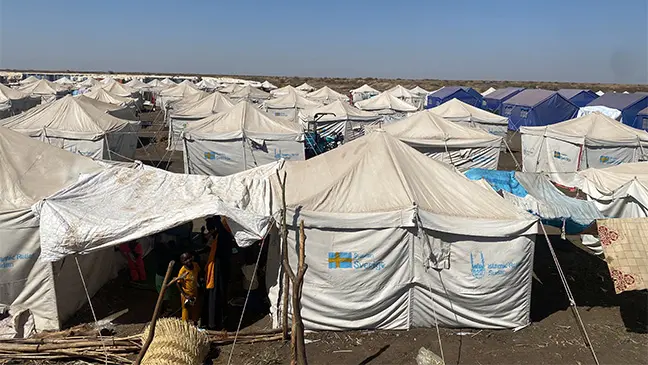
Photo: Overcrowded living conditions in a displacement camp. Limited sanitation and scarce resources have led to disease outbreaks among vulnerable families.
Without urgent action, the situation will continue to deteriorate.
Hunger and the risk of famine
Severe hunger has spread across Sudan. The war and actions of armed groups have obstructed humanitarian aid, looted markets and supply routes, shattered the economy and essential services, and forced farmers and communities from their land.
Today, more than 61% of people across Sudan – over 29 million people – are suffering acute food shortages.
The worst levels of hunger are now in Darfur and Kordofan, where violence is raging, and towns are under siege.
In late 2025, the IPC confirmed famine in and around El Fasher in Darfur and Kadugli in South Kordofan, warning that it would spread without urgent action.
In February this year, famine was confirmed to have spread to another two areas in North Darfur, and at least 20 more areas are at high risk of famine.
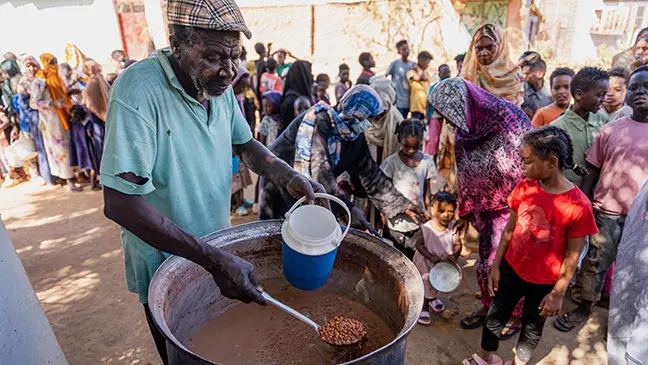
Photo: Families queue up to receive food.
Since the start of the crisis, local communities and mutual aid groups have been at the heart of the response. These efforts have stopped famine from spreading even further.
A health system under attack
Sudan’s health sector has been decimated.
Many health facilities are out of service due to attacks, lack of funds, and shortages of staff, medical supplies, water and electricity.
Health workers are facing unprecedented violence. Hundreds of attacks on healthcare facilities have been documented since the start of the war.
Under international humanitarian law, health facilities and workers must be protected and must never be targeted, but despite this, at least 122 health workers have been killed.
Displacement, return and uncertainty
More than 9 million people are displaced across Sudan, with the majority in Darfur and Kordofan, where ongoing violence continues to prevent people from returning home. Many families in eastern and central Sudan remain displaced as they can’t afford to return or have nothing to go back to.
Photos: Families often live in overcrowded shelters and temporary homes.
In places like Gedaref in eastern Sudan, we are seeing newly displaced families arrive, fleeing the violence in Kordofan and the border regions with South Sudan.
At the same time, more than 3.5 million previously displaced people have now been able to return home to places like Khartoum and Wad Medani, but there is little for people to return to. Many are returning to communities where infrastructure is damaged or destroyed, and basic services remain limited.
In late January, the government returned to Khartoum, and the central bank finally reopened there. Aid agencies are also beginning to move back, with Islamic Relief restarting our projects in Khartoum and Omdurman last year. However, major challenges remain.
Returnees need greater support from Australia and the international community so they can begin to rebuild their lives.
Aid is vital, but it cannot end the crisis alone
Humanitarian aid is saving many lives across Sudan.
Where access is possible, aid is helping to prevent starvation and provide essential support.
Since the outbreak of the war in April 2023, Islamic Relief has delivered aid to over 1.2 million people across Sudan. Our local teams are working tirelessly across the country, including in central Darfur, north and west Kordofan, Khartoum, Gedaref, Red Sea State, Al Jazirah, Sennar and Blue Nile.
We are providing food and clean water to families, delivering vital medicines and supplies to health clinics, and supplying seeds and livestock to farmers so they can earn a living.
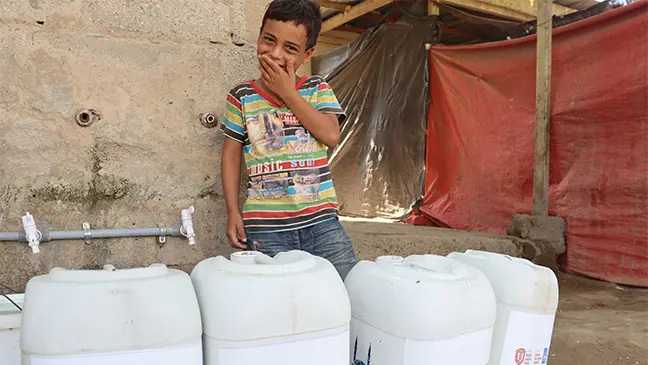
Photo: A young Sudanese boy is thrilled as he receives water storage kits at one of our distributions.
Many Islamic Relief staff and volunteers in Sudan have been displaced themselves, yet they continue to do everything they can to support the most at-risk communities.
Although more aid is needed, aid alone cannot solve this crisis – we need sustained diplomatic engagement to kickstart the peace process, agree a ceasefire, protect civilians, and ensure humanitarian access.
Sudan cannot be overlooked
The crisis in Sudan is critical. Australia must act urgently.
This includes:
Scaling up diplomatic efforts, including through the UN Security Council, to push for an immediate, nationwide ceasefire as the first step towards lasting peace.
Protecting civilians, aid workers and local emergency responders by backing efforts to prevent further attacks, atrocities and International Humanitarian Law violations.
Securing rapid, safe, sustained humanitarian access across Sudan, especially to conflict-affected and besieged areas, so aid can reach every community in need.
Increasing funding now, especially to local aid groups and women-led organisations, to help stop famine spreading further and provide life-saving assistance and services, especially to women and children forced to flee their homes.
Supporting a regional response to this crisis, working with neighbouring countries to increase humanitarian assistance to refugees, enable safe cross-border access for humanitarian aid, and prevent the conflict from spreading further.
As violence shifts and intensifies and hunger deepens, millions of people remain in urgent need of protection and support. Without immediate action, the risk of further famine, displacement and loss of life will only grow.
Sudan cannot be overlooked. Call on the Australian government to act urgently to help end the crisis or find out other ways to help the people of Sudan here.
Shihab Mohamedali, Islamic Relief’s Senior Programme Manager in Sudan, was forced to flee his home in the capital, Khartoum, at the start of a violent conflict that has since engulfed the country. Three years on, he is finally returning to Khartoum – but the city he is coming back to is not the one he left behind.
On the road south out of Khartoum, on those first terrible days of the war, I saw 2 things at once. On one side, a group of people looting a store, carrying whatever they could find on their shoulders, on donkey carts, on motorbikes.
And not far away at all, on the other side, a group of young men were standing in the middle of the road, handing out sandwiches, water and juice to every family passing through. I could not believe what I was seeing. The same moment. Same road. Same crisis. And people are responding to it in completely opposite ways. I have not stopped thinking about those images in the 3 years since.
The Thursday we thought was just a Thursday
Our last working day was 13 April 2023 – a normal Thursday. Some of us left laptops at our desks, passports in drawers, cameras on shelves – the things you leave when you expect to come back after the weekend. Nobody thought to take anything home.
On the morning of 15 April, Khartoum became a war zone. I was living close to a military artillery section. For 12 days, I heard shooting day and night without pause.
We left the house once, my son and I, to find food and turned back when the fighting came too close. Islamic Relief evacuated us on the twelfth day of the conflict. A driver arrived at our house. I told my family to leave everything, that we would be back in a few weeks, so we did.
At every checkpoint on the road to Gedaref, an armed man came out to inspect. I knew what they could do – ask someone to step out, take the car, order the family to walk. That is what had happened to others. I kept reading Ayatul Kursi (a verse from the Qur’an) and, by the mercy of Allah, we passed through each time.
A city stripped to its bones
Our office was looted completely – vehicles, equipment, everything. It wasn’t just theft – it was deliberate destruction of anything that could not be taken. The guard was forced out. When he returned days later, he photographed what was left[MG1][CM2] and sent the images to the team in Gedaref. It was through those photographs that Shihab and his colleagues first saw the scale of the destruction.
Across Khartoum, the story was the same. Walls were opened up to pull out copper wiring, which could be sold for scrap – one of the few materials that still holds value in a collapsed economy. Doors and windows were removed entirely. Holes were dug into the floors of homes by people searching for hastily stashed gold. Wooden bedframes were cut and burned as cooking fuel because there was nothing else.
My mother had been displaced to the River Nile State. When she returned and saw her house, she said, “I immediately got stomach pain.” She asked my brothers to take her back to the River Nile State.
Those who refused to leave paid the hardest price. A colleague lost her father – he stayed, was detained, and died before the family could reach him. In Halfayat Elmilook in Khartoum North, people were found so weakened that they had to be rushed to hospital. Some did not survive the day they arrived.
We were displacedtoo but we still had work to do
There is one aspect of this crisis that does not get talked about enough: when the war erupted, Islamic Relief’s Khartoum staff became displaced people ourselves. We were scattered – to Gedaref, to Port Sudan, to wherever family or circumstance took us.
Some colleagues lost their homes entirely. Some lost relatives. And yet, from those same displacement locations, we kept working.
In those 12 days under fire, my 16-year-old daughter stopped sleeping. She would leave her room at night and come to sleep near her mother. I understood what was happening. I have spent my career in humanitarian work, learning what displacement does to people.
Slowly, she came through it. Alhamdulillah, she is now studying in Türkiye, and this year she was among 8 girls selected from a Hadith competition to travel to Umrah. I cannot describe what that meant.
It is a strange thing to be a humanitarian worker and a displaced person at the same time. To be supporting families in camps while quietly dealing with your own losses – your own looted home, your own family split across cities, your own uncertainty about when or whether you would be able to go back home.
That weight has sat with all of us throughout these years, even as the work continued.
Closing the Khartoum office didn’t just mean losing a building. It meant losing direct access to millions of people in the city where the need was most acute. Reopening is not simply a matter of finding office space. It means re-earning trust from communities who went through something enormous without us there, and rebuilding relationships with partners and health workers who are now operating in a city that looks almost nothing like the one we left.
Islamic Relief is back – distributing cash assistance to families who have returned to empty homes, supporting health facilities, and providing food to people beginning again with nothing. Coming home is not the end of the journey. It is the beginning of a long piece of work.
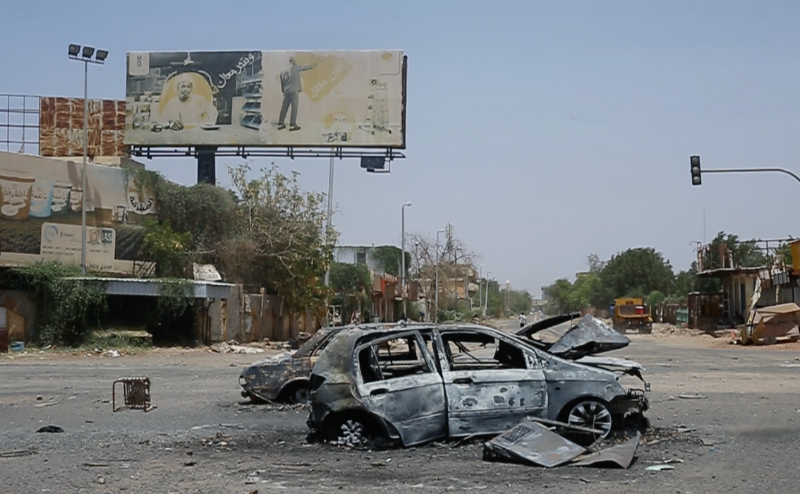
Photo: A burned-out vehicle on a Khartoum street. Across the city, infrastructure was systematically destroyed or looted during the conflict.
The first sleep back home
A relative of mine returned to his house recently and found it had been looted; there was almost nothing left. He and his family cleaned, and neighbours who had come back a little earlier brought food. That night, he slept from evening until the following morning – his first deep sleep since leaving 3 years ago.
I have heard similar stories from others. People are coming back to damaged, empty houses but still feeling something that they could not find anywhere else in their years of displacement. Some are saying they will not leave again, even if fighting returns to the capital. They have learned, they say, that it is better to face whatever comes in your own place than to live somewhere else, however unsafe home may be.
My own family is still abroad. They are planning to return in May. I am already thinking about how they will absorb the shock of coming back – and I know it will be a huge shock. But I hope to make it a positive experience. This conflict has left many people emotionally handicapped, but they will find their way back to themselves. We believe this. We have to.
Khartoum has not yet recovered. The markets have come back faster than almost anything – traders, movement, a certain ordinary noise beginning again. But the city has years of work ahead of it, and so do we. Those of us who locked that office that Thursday, 3 years ago, thinking we would be right back – we are finally coming back. The work we return to is harder than the work we left. And so it matters even more.
Sudan still needs the world’s attention as millions remain displaced, and those returning to Khartoum are coming home to almost nothing. Islamic Relief is on the ground by providing food, cash assistance and healthcare to families across Sudan.Please support our Sudan Emergency Appeal and help us reach the people who need us most.
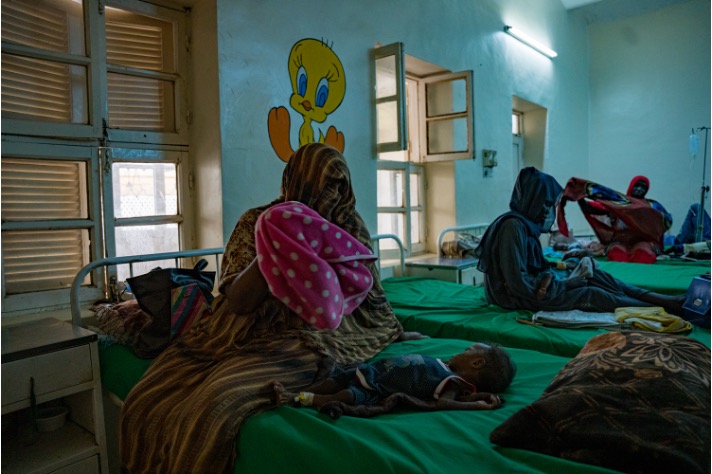
Haleema has worked in the nutrition ward at Hussein Mustafa Children’s Hospital in Gedaref since 2013. In the 3 years since the conflict in Sudan began, she has watched her ward become a frontline of the country’s hunger crisis.
Haleema starts every morning at Hussein Mustafa Children’s Hospital the same way: she walks the wards, checks the files, weighs the children, and makes her rounds with the doctors. By the time the morning is done, there are always new patients waiting to be seen.
“In a single day, we currently admit around 7, 8, or 10 cases,” she says. “Roughly around that number, every day.”
Before the war, the ward was still busy – malnutrition in Sudan predates April 2023, and families in Gedaref state have long had to grapple with food insecurity. The conflict, however, has certainly made the situation worse.
The families arriving now are mostly displaced, having fled the capital, Khartoum, or the central city of Wad Madani with nothing, and are now living in camps and settlements where food access is uncertain and clean water is not guaranteed.
Daily challenges
The symptoms of the children who arrive at the hospital’s stabilisation centre present in ways that are difficult to describe without clinical language, and the clinical language itself is hard to absorb.
Emaciation, oedema (swelling caused by severe protein deficiency), skin that blisters and peels, diarrhoea and vomiting that persist regardless of what medicine is prescribed.
“The most common signs we see are emaciation and swelling,” Haleema explains. “Sometimes the children also have diarrhoea and vomiting. The diarrhoea and vomiting often don’t stop. The children suffer a lot.”
The ward also treats children with kala-azar (visceral leishmaniasis), a serious parasitic disease that is endemic to Gedaref and is significantly worsened by malnutrition.
Treatment for severe acute malnutrition cannot be rushed. The body of a child who has been malnourished for a prolonged period cannot safely absorb nutrients in normal quantities, so starting too aggressively can overwhelm the system and cause further harm.
The first formula given, F-75, is a low-protein starter milk, carefully calibrated to stabilise children without overloading their systems. Only once a child is stable does treatment move to F-100 or RUTF, which are higher in protein and energy and designed for the rehabilitation phase. The process moves in stages and requires constant monitoring.
“We give F-75 and F-100 meals every 2 hours,” Haleema explains. “Some children get it every 3 or 4 hours. We give it to them in their beds. The children also receive their medications from the hospital pharmacy, free of charge.”
Photo: Mothers and children at the stabilisation centre in Hussein Mustafa Children’s Hospital, Gedaref. Haleema and her team admit up to ten new cases daily.
Teaching mothers is part of treating children
A significant part of Haleema’s days is spent sitting with mothers, explaining what treatment is required, demonstrating how to administer RUTF correctly, and teaching the principles of hygiene and feeding that will benefit the child after they are discharged.
“We work on health education for mothers,” Haleema says. “We show them how to give RUTF according to the child’s required portion [and] make sure they understand.”
This work is central to the child’s recovery. A child who leaves the ward and returns to a household where food is scarce and clean water is uncertain is at risk of relapse, so the knowledge a mother carries out of the ward with her is as important as the treatment her child received during their stay.
Medicine shortages and daily weighing
Medicine shortages add even more complexity to the delicate process of treating children with malnutrition.
More than 80% of hospitals in Sudan’s worst-affected areas are not fully functional. Power cuts are routine. While Haleema’s hospital is not in one of these areas, it still faces similar issues.
“We work day and night, without sleep,” Haleema says. “And we pray that God gives us the strength to continue supporting [our patients].”
Daily weigh-ins are the most reliable measure of progress when treating malnourished children.
As a child who arrived swollen and feverish, unable to keep food down, begins to stabilise, the oedema recedes, their skin heals and their weight increases. At a certain point, Haleema and the doctors make a judgment: this child is ready to leave.
What discharge means in practice is that treatment continues at home, with RUTF portions the child’s mother has been shown how to administer, follow-up appointments, and the knowledge that the ward is there if things deteriorate.
“Thankfully, many of our children recover,” Haleema says.
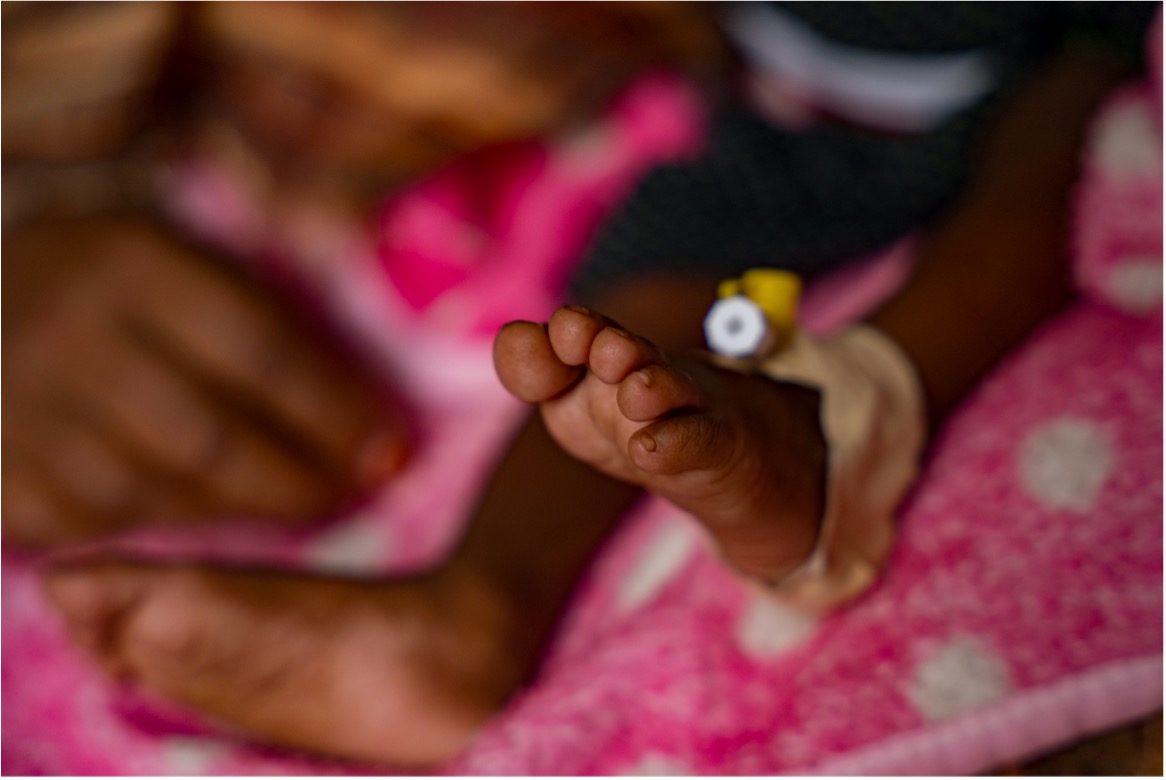
Photo: A child receiving treatment for severe acute malnutrition. Recovery requires weeks of carefully staged nutritional therapy and constant monitoring.
What Haleema hopes for amid Sudan’s war
When asked what she wishes for, Haleema does not speak about herself. She speaks about the ward.
“I hope that the nutrition department continues to be well supplied,” she says. “That the medicines, food and drinks do not run out. That all the basic needs and comforts for the children are always available, because we rely on them heavily.”
Islamic Relief has been working at Hussein Mustafa Children’s Hospital in Gedaref, providing food supplies and nutritional support for malnourished children and their mothers as part of its emergency health response. The supplies Haleema relies on – therapeutic milk, RUTF, medicines distributed free from the hospital pharmacy – depend on that support continuing.
Every day, children like Haleema’s patients are waiting for help. With your support, Islamic Relief can help ensure that children receive the supplies, medicines and therapeutic food they need for a chance at recovery.
Give relief to the people of Sudan
Help us continue reaching people like Haleema’s patients with the life-saving aid they desperately need.
When Sudan’s war reached the major city of Omdurman, Adam fled with his wife and 4 daughters. Three years on, Adam’s family is scattered across different cities, but they are surviving and slowly rebuilding their lives.
Adam does not linger on the moment he made the decision to leave. He describes it the way people often describe the unbearable; plainly, with very few words. He waited as long as he could for his 2 sons, who had gone to the market that morning as the fighting in Omdurman intensified, to return, but they never came back, so he gathered his wife and daughters and left.
That is what displacement so often looks like in Sudan. Not a single dramatic moment, but a series of impossible calculations made in real time, with little information and no certainty.
Holding his family together
Like the hundreds of thousands of other families who fled Omdurman and the nearby capital, Khartoum, in the early weeks of the war, Adam’s family made their way to Wad Madani, Sudan’s second-largest city.
It sits 140 kilometres south of the capital, and was the country’s most significant hub for displaced families at that time.
The people of Wad Madani received them with generosity. They were housed in a school, and for a time, life was manageable.
In December 2023, armed groups swept into Wad Madani. Up to 300,000 people fled the city within days, including Adam’s family.
At Madani bridge, as the family tried to leave the city, they were stopped at a checkpoint. Armed men attempted to separate Adam from his daughters, aged 17 and 21, but Adam refused. Another armed man intervened, telling Adam to take his daughters and go.
Photo: Islamic Relief food distributions have been a lifeline for displaced families in Gedaref, providing flour, oil and essential household supplies.
Finding ground to stand on
The family made their way to Altadamun School in Gedaref, where they spent the next 2 years in a school that had been converted into an emergency shelter for displaced families.
Islamic Relief provided Adam’s family with food baskets, flour, oil and essential household supplies. This made the difference between coping and not coping. “Without the support from the organisations, we would have nothing,” Adam says.
Photo: Adam now serves as deputy head of the camp committee, coordinating food distribution and welfare across 13 sites representing 305 families.
Eventually, Adam’s wife decided to take the daughters to Al-Duka, a town in eastern Gedaref near the Eritrean border, where her family is originally from.
They were given a plot of land to farm and are now in their second year of growing crops. This has given the family some stability, grounded in something more durable than emergency relief.
Adam lives separately, having to be close to his work. Due to high transport costs, he visits his family roughly every 2 weeks, and works hard to try to send them money on a monthly basis.
Forming community in displacement
What Adam has built in the camp where he now lives says something about who he is. He is deputy head of the camp committee — a body formed across 13 former school sites, representing 305 families.
He checks tents, coordinates food distribution, ensures the sick and elderly receive their share, and manages the relationship between displaced residents and the local community with deliberate care.
Adam remembers how man from a different tribe who Adam didn’t know before arriving gave him a large bag of sorghum (grains) for his family in their first few days in the camp. Later, after hearing that man had died, Adam went to offer his condolences.
“The people here honoured us from the start,” Adam says. “And we appreciate them.”
How Islamic Relief is responding in Sudan
Islamic Relief has been working in Sudan since 1984 and we are currently operational across 9 states, including Gedaref.
Since April 2023, Islamic Relief has reached more than 2 million people across Sudan with life-saving aid, including food, medical supplies, agricultural support and emergency cash transfers.
At the time of Adam’s interview in October 2025, food distributions in his camp had stopped for approximately 4 months due to protracted fighting which has caused food systems to break down.
Markets are no longer functioning, aid can’t get through and food prices are soaring. A quarter kilogram of any basic staple in the market costs around 6,000 Sudanese pounds.
Three years since the war in Sudan began, millions of Sudanese families remain displaced, separated and waiting. Adam’s is only one of them.
More than 30 million people in Sudan are in need of humanitarian assistance. They cannot wait. Please support our Sudan Emergency Appeal and help us continue reaching families like Adam’s with the life-saving aid they urgently need.
Give relief to the people of Sudan
Help us continue reaching families like Adam’s with the life-saving aid they desperately need.