02.27.25

Balancing School and Worship: How to Build the Ultimate Ramadan Routine as a Student 

  Publications     Ramadan

Balancing school and Ramadan can be challenging, especially when managing fasting, prayers, and assignments all at once.  

The key to a successful Ramadan while keeping up with school is having a solid routine. With a little planning, you can stay energised, keep up with your studies, and make the most of this blessed month. 

Whether you write your plan down in a physical or digital planner. Here’s how to build the ultimate school-friendly Ramadan routine. 

Plan Your Suhoor for Energy and Focus 

Skipping suhoor might seem tempting, but having a nutritious meal before you start fasting is essential. It helps with staying focused in school by keeping you energised throughout the day.

Set yourself an alarm at least 30 minutes before Fajr (when fasting starts) to give yourself enough time to eat, pray, and start the day feeling refreshed. Placing the alarm across the room can make getting out of bed easier.

When it comes to preparing your suhoor meal, the best kinds of energy-boosting foods are whole grains, fruits, and protein (tofu, chicken, etc.) to keep you going throughout the day. You can also plan out your meals in a journal.

If you’re used to eating your favourite cereal or leftover food for breakfast, try to make them more filling. Eat your cereal with fruits and Greek yoghurt, or have leftovers with added protein and vegetables. Also, don’t forget to drink plenty of water!

Stay Productive During Ramadan on School Days 

Fasting can sometimes make it difficult to concentrate in class, so here are a few strategies to help you maintain focus. 

First, figure out when your energy levels are at their peak. Because of suhoor, you’ll likely have the most energy in the morning. Or, if you’re a night owl, you might have peak energy levels after iftar.  

If you can stay up after Fajr, use this time to get ahead on schoolwork—review notes, start an assignment, or do some quick studying before school. If you prefer to sleep in, try to take 10-15 minutes after Fajr for a quick revision session. You can also use this time for spiritual reflection, such as dhikr, dua, or Quran reading. 

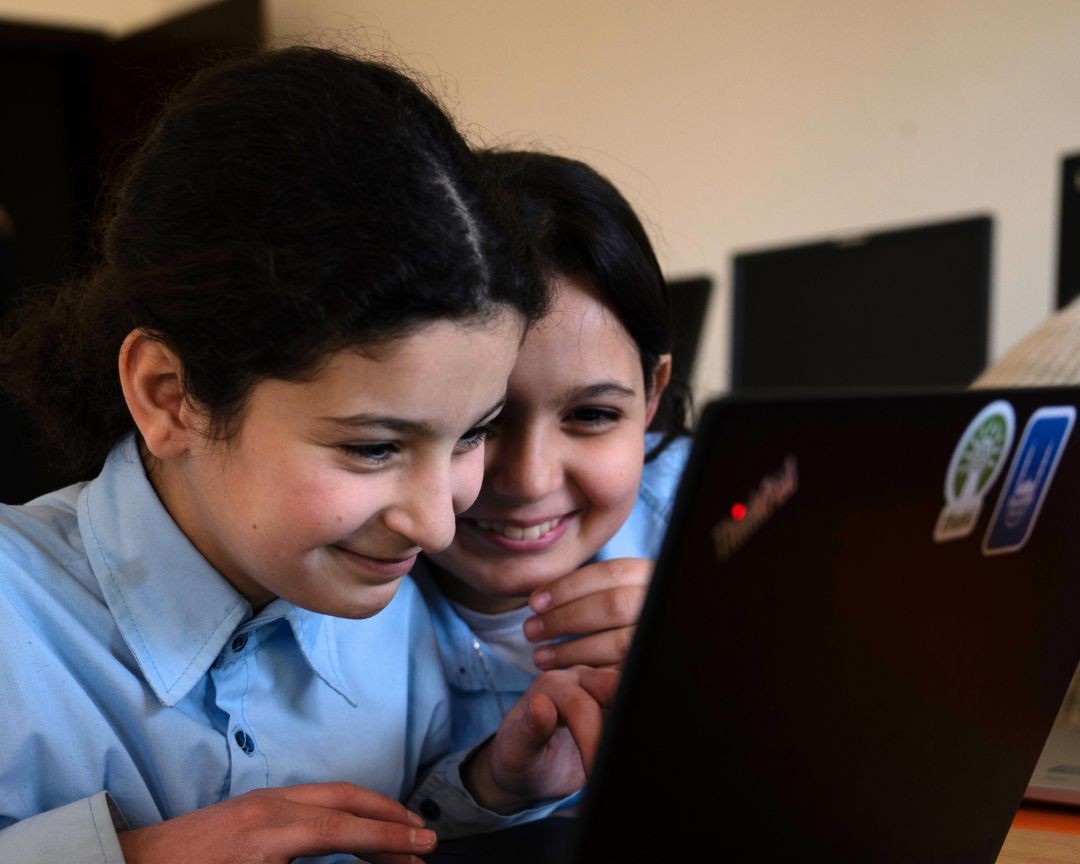
Student staying on top of studies during Ramadan

During school, try to minimise distractions by setting a screen time limit or blocking certain apps on your phone. With Ramadan being a month filled with many opportunities for rewards, you can maximise your time by using your break times at school for quiet reflection, dhikr, or reviewing Quran verses. 

After iftar, between Maghrib and Taraweeh, plan your study schedule or start an assignment early. This way, you can use the time after Taraweeh to unwind and focus on your spiritual goals. Even working on something small for 10-15 minutes can make a difference. Then, start winding down for bed so you can wake up early for suhoor feeling refreshed. 

Balance Your Ramadan Worship, School, and Extracurricular Activities 

Fasting while managing school, worship, and extracurricular activities can be challenging, but, with the right approach, you can stay engaged while maintaining your energy. 

If you’re involved in sports, it’s important to listen to your body. If you start feeling lightheaded or exhausted, take a break or ask your coach for modifications. Instead of high-intensity drills, focus on stretching, technique, or skill-based activities. 

Staying hydrated is also essential, so drink plenty of water at suhoor and iftar. For harder training, consider scheduling it after iftar when you feel more energised. Talking to your coach about Ramadan will also help them understand your needs so they can make necessary accommodations. 

If you’re involved in other extracurricular activities like debate teams, clubs, or prefects duty, prioritise essential tasks and temporarily step back from taking on extra work. This can help create more space for worship and schoolwork. You can also use downtime during meetings or rehearsals for quiet reflection, like dhikr.  

All in all, if you need to be part of an event that requires significant energy or late hours, communicate with teachers or leaders about possible adjustments during Ramadan. 

Nap Smartly to Avoid Burnout 

Fasting, school, and late-night prayers can leave you feeling drained. If you’re exhausted after a long school day, a short nap can help restore energy without disrupting your night’s sleep. 

Try to keep naps between 20 to 30 minutes. This helps you avoid feeling groggy afterward. 

It’s also best to time naps for after school but before Asr prayer to maintain a balanced schedule. If you’re able to nap in school, try to find a quiet spot during your break times (preferably just before or after Dhuhr time) to snooze.  

Maximise Your Iftar and Evening Routine 

After a long day of fasting and school, the evening is the best time to refuel and refocus on worship. 

Break your fast with dates and water, following the Sunnah, before having a balanced meal. 

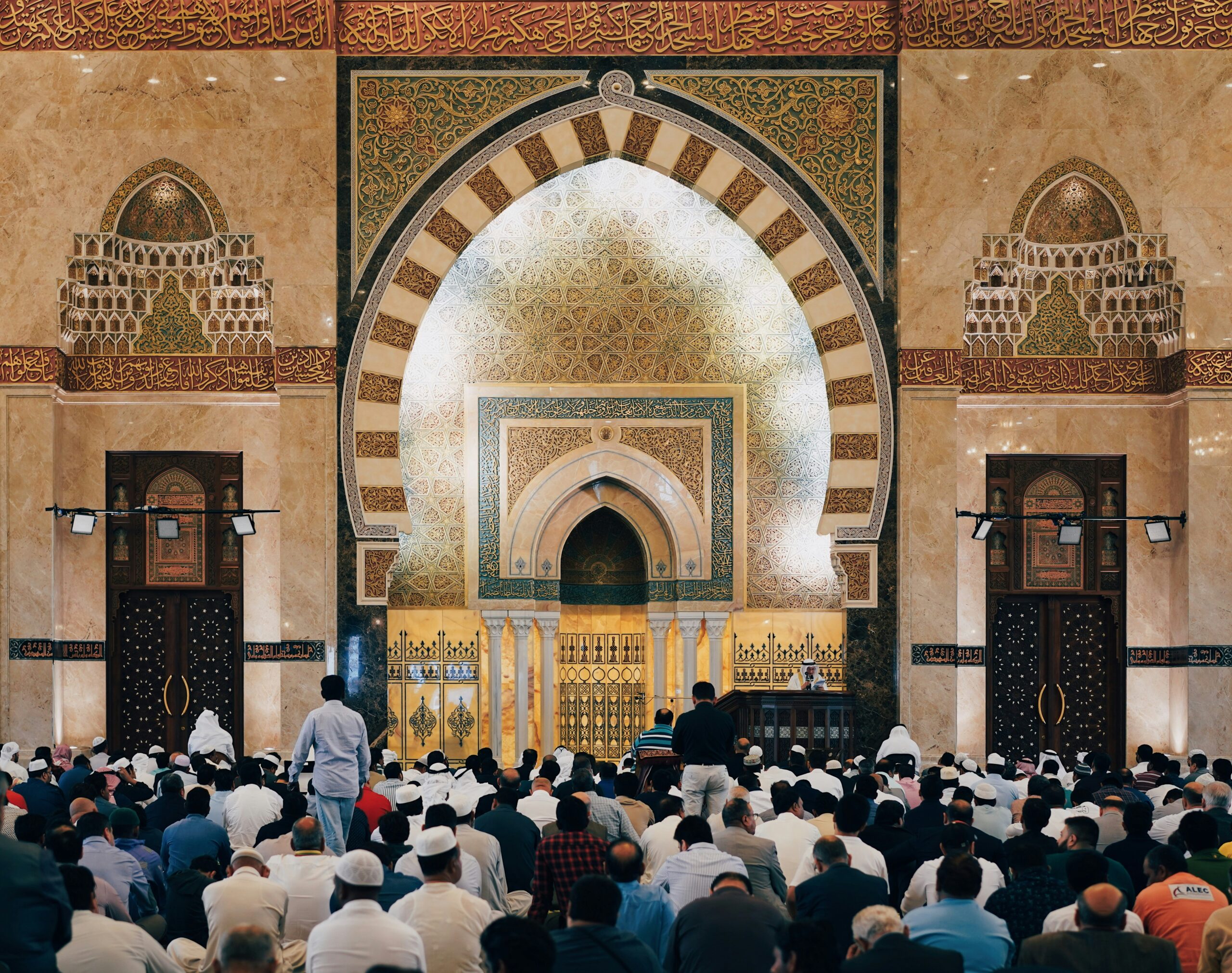
Plan your evening schedule to prioritise Maghrib, Isha, and Taraweeh. If possible, encourage or join your family to pray at the mosque to maximise your Ramadan experiences. 

After iftar is also the best time to take time away from your social media and engage in ibadah (acts of worship). This can include reading Quran, more dhikr, or spending time with family reflecting on Ramadan.  
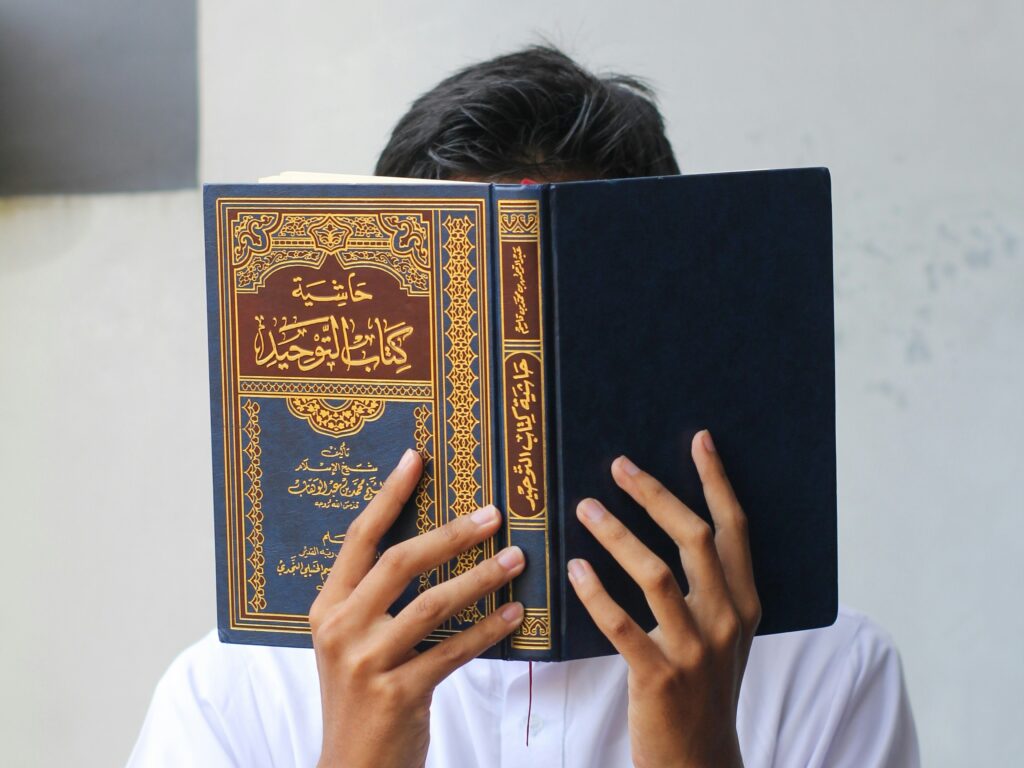
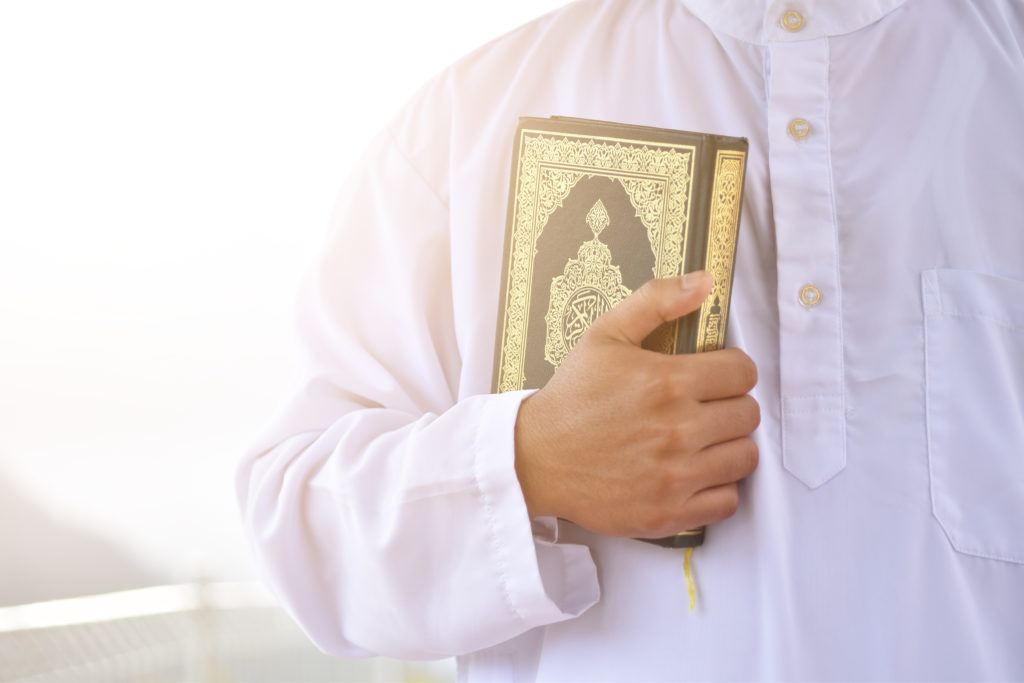
reading Quran is one of the recommended actions to do in Ramadan

Having a checkbox list (you can make one in your planner or journal for Ramadan) on hand can help keep track of your Quran progress, Taraweeh, dhikr, and more, helping you stay motivated to do them daily.  

After you’re done with your evening activities, wind down for bed so you can get up early for suhoor. Aim for at least 6-8 hours of sleep each night, as this can help keep your energy levels going throughout Ramadan.  

Stay Consistent and Flexible 

Not every day will go according to plan, and that’s okay. Adjust your routine when needed, especially during exam periods or school events. Keeping a record of the changes in your planner can also make things less overwhelming.  

If you have trouble focusing on ibadah during school days, make the most of weekends instead. Whether it’s through Quran recitation or getting involved in community, make the intention to do it for the sake of Allah (SWT) and you’ll go far.  

In turn, if you miss a goal on one day, it’s okay, don’t get discouraged. Refocus and try again the next. Ramadan is about progress, not perfection.  

As the Messenger of Allah, peace and blessings be upon him, said, “Take up good deeds only as much as you are able, for the best deeds are those done regularly even if they are few.” 

 Sunan Ibn Majah 

Build a Routine That Works for You 

Balancing school and Ramadan is definitely not easy, but it’s possible with a well-structured routine and a focused mindset.  

By planning around prayer times, managing school hours wisely, and dedicating specific times for ibadah, you can have a fulfilling Ramadan without falling behind on your studies. 

The Ramadan Activity Booklet is a great tool to help stay on track. Using the habit tracker, word searches, and prayer checklists can keep motivation high throughout the month. 

Get the Ramadan Journal

How do you make the most of Ramadan? For the most blessed time of the year, here’s a daily planner to help you stay organised.

02.24.25

Ramadan Planner: How to Use One for Spiritually Productive Month! 

  Publications     Ramadan

Ramadan is a time of reflection and making the most of its many blessings. However, with our busy schedules, it can be hard to stay on track with our spiritual goals for the blessed month. That’s where a Ramadan planner helps organise your worship, track progress, and ensure you make the most of this sacred month!

Why a Ramadan Planner?  

Using a Ramadan planner helps you stay consistent with your spiritual goals for the blessed month.  

The structured guide of a planner makes it easier to stay motivated by ensuring you keep track of your ibadah (acts of worship) and personal growth. 

Whether it’s increasing in Quran recitation, sunnah and nafl prayers, or giving more charity (sadaqah), the planner is here to help you achieve them! 

Don’t have a Planner for Ramadan yet? Get Our Pre-made Ramadan Planner PDF! 

A Ramadan Planner can be digital or physical – whichever you prefer. To make things easier, you can get your very own printable Ramadan Planner PDF (for free!) right here, at Islamic Relief Australia.

Ramadan Jounral (aka the Ramadan Planner) title page

So now that you’ve got your free Ramadan Planner PDF, what next? Here’s how to cater your planner to your own needs.  

How to Use Your Ramadan Journal/Planner

Setting Your Intentions and Goals 

Before Ramadan begins, take a moment to define your objectives. The Prophet Muhammad (ﷺ) said, “Actions are judged by intentions.” (Bukhari and Muslim) 

Setting clear goals ensures that your efforts are focused and meaningful. It helps you remind yourself of what you need to work on throughout the month and ensures you stay on track! 

In the planner, we’ve put these key areas to consider:

  • Quran Recitation – Decide how much you want to read daily or weekly. If you aim to complete the Quran during Ramadan, plan to read one juz per day. 
  • Charity & Good Deeds – Plan how you will give sadaqah. This can be through financial donations, volunteering, or acts of kindness. 
  • Strengthening Relationships – Plan out how you want to make an effort to connect with family, friends, and the community during Ramadan. 
  • Seeking Forgiveness – Write down all the ways you can seek forgiveness. This can be through Istighfar (seeking forgiveness from Allah (SWT)) or asking for forgiveness from and forgiving others. 
  • Intentional Positive Actions – Think about what daily actions you want to perform more of that helps you increase acts of worship and spread kindness. 
  • Building Good Habits – Ramadan is the time to build new positive habits and break old negative ones. Write down what small, daily positive changes you can add to your routine that you can even continue beyond Ramadan. 

Using the Ramadan Planner Features   

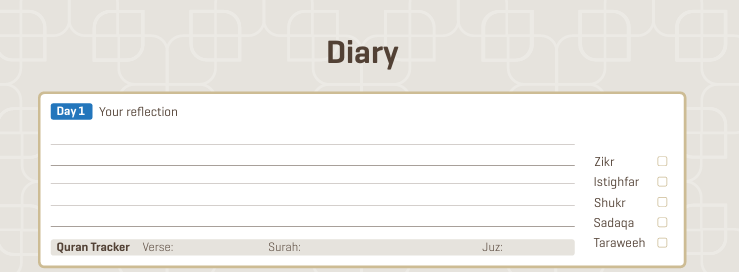
A structured planner allows you to monitor your spiritual growth. In the Ramadan Planner PDF, you can keep track of your duas, Quran progress, daily reflections, ibadah, sadaqa and prayers daily! 

The Diary in your Ramadan Planner PDF
Photo: A sneak peek into the Ramadan Journal/Planner for 1446/2025

Here is what to do for each of the sections that help you track your habits. 

  • Ramadan Duas Page – Note a supplication to memorise and recite. 
  • Your Reflection Box – Write key insights, gratitude points, or struggles you faced during the day. 
  • Quran Tracker Box – Record the surah, verse, and juz you read each day.
  • Sadaqa Checkbox – Whether financial or in the form of good deeds, tick it if you’ve done at least one type of sadaqah. 
  • Dhikr (Zikr) Checkbox – A reminder to increase remembrance of Allah (SWT) throughout the day, tick it once you’ve done it.  
  • Shukr Checkbox – A reminder to express gratitude to Allah (SWT) for His blessings. Whether through words, actions, or heartfelt reflection, tick it once you’ve taken a moment to acknowledge and appreciate something in your life. 
  • Taraweeh Checkbox – Encourage consistency in your night prayers by marking this after completing Taraweeh. Whether at home or in the mosque, aim to make it a regular part of your Ramadan routine. 
  • Habit Tracker Page – Keep track of the positive habits you’re building this Ramadan. Whether it’s praying on time, reading Quran, limiting distractions, or practicing patience, tick a box once you’ve successfully maintained a habit for the day.  

Building Your Plan for Laylatul Qadr  

The last ten nights of Ramadan are the most important and sacred nights of the Islamic year. Because in them lies Laylatul Qadr (Night of Power), the night better than a thousand months. A well-prepared plan allows you to make the most of these final, spiritually rewarding nights. 

the moon, seen on the last ten nights of Ramadan, when Laylatul Qadr is
The Night of Decree (Laylatul Qadr) is better than a thousand months. (Quran 97:3)

The Ramadan Planner PDF has an inbuilt reminder for you to keep Laylatul Qadr in mind. Use to make sure you… 

  • Mark the odd nights (21st, 23rd, 25th, 27th, 29th) for increased worship. 
  • Set aside extra time for Tahajjud (night prayers) and Quran recitation. 
  • Prepare a list of duas you want to make on these blessed nights. 
  • Schedule Sadaqah donations during these nights.  
  • Plan small daily acts of kindness, such as checking in on family members, visiting the sick, or helping a neighbour. 

Take a Break with the Planner Activities  

Ramadan is a time of deep spiritual reflection, but it’s also important to take mindful breaks to refresh and recharge.  

The Ramadan Planner PDF includes a colouring page and word search, which are perfect for moments when you need a mental reset but still want to reflect on Ramadan themes. 

Taking short breaks with these activities can help prevent burnout and keep your Ramadan experience balanced. Whether it’s a few minutes of colouring after Iftar or a quick word search before Suhoor, enjoy these moments of relaxation while staying connected to the spirit of the month! 

Commit to Your Planner for a Meaningful Ramadan 

A Ramadan planner helps you stay accountable, organised, and spiritually engaged. Having this structured approach to worship can transform your Ramadan experience for the better! May Allah (SWT) help you stay steadfast on your Ramadan goals!  

Get the Ramadan Journal

How do you make the most of Ramadan? For the most blessed time of the year, here’s a daily planner to help you stay organised.
02.18.25

Five Pillars of Islam

  Publications

Five Pillars of Islam are core obligations that serve as a guide for every Muslim. Ones that nurtures their spiritual growth, self-discipline and devotion to Allah (SWT). 

Together, these pillars form the foundation of Islamic belief and practice. It unites Muslims around the world in a shared commitment to the deen (faith).

What are the 5 pillars of Islam?

The five pillars of Islam include: Shahada (faith), Salah (prayer), Zakat (almsgiving), Sawm (fasting), and Hajj (pilgrimage).

Shahada (Faith)

The Shahada is the first and most fundamental pillar of Islam, serving as the very foundation of a Muslim’s faith. This is the declaration of faith in one God (Allah) and His messenger (ﷺ).

Ash-hadu an la ilaha illa Allah, Wa ash-hadu anna Muhammadan Rasulu-Allah

أشهد أن لا إله إلا الله وأشهد أن محمدًا رسول الله

“I bear witness that there is no god but God, and I bear witness that Muhammad is the Messenger of God”

This testimony affirms the core belief of Tawheed (the oneness of God), rejecting any association of partners with Him. It also acknowledges Prophet Muhammad (ﷺ) as the final messenger of Allah (SWT). As his legacy is one that follows a long line of prophets sent to guide humanity.

Salah (Prayer)

Salah is the second pillar of Islam and a fundamental act of worship. This is the ritual prayer every Muslim must perform five times a day (at fixed times) throughout their lifetime. It establishes a direct and personal connection between a Muslim and Allah (SWT).

The prescribed times for Salah are:

  1. Fajr – Before dawn
  2. Dhuhr – After midday
  3. Asr – Afternoon
  4. Maghrib – Just after sunset
  5. Isha – Night

These prayers are a constant reminder of a Muslim’s faith, reinforcing discipline, humbleness, and mindfulness of Allah (SWT) throughout the day.

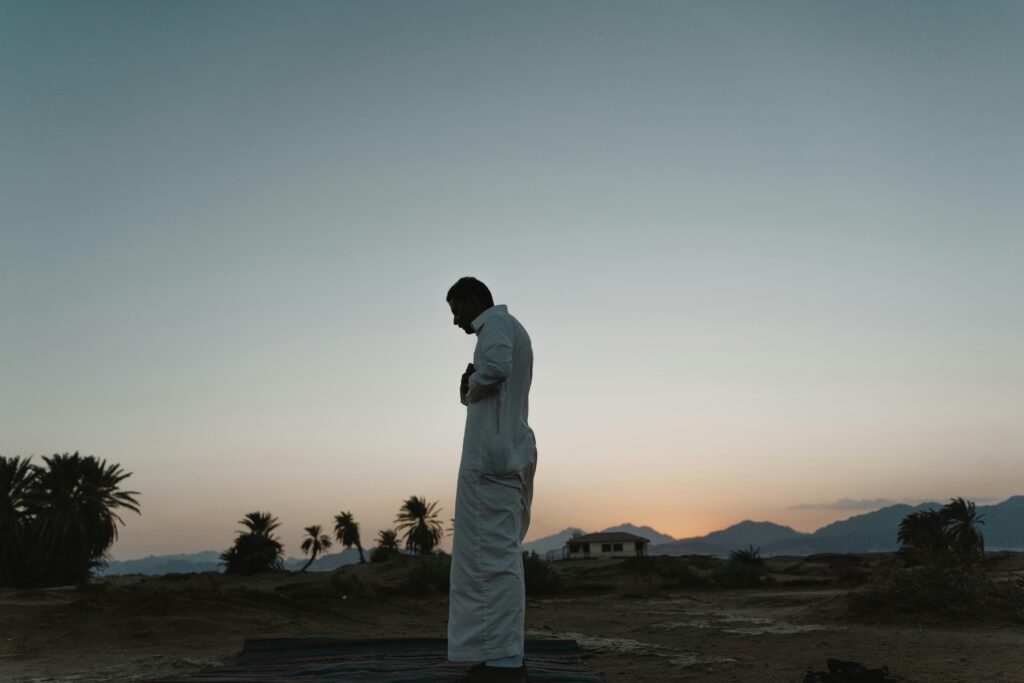
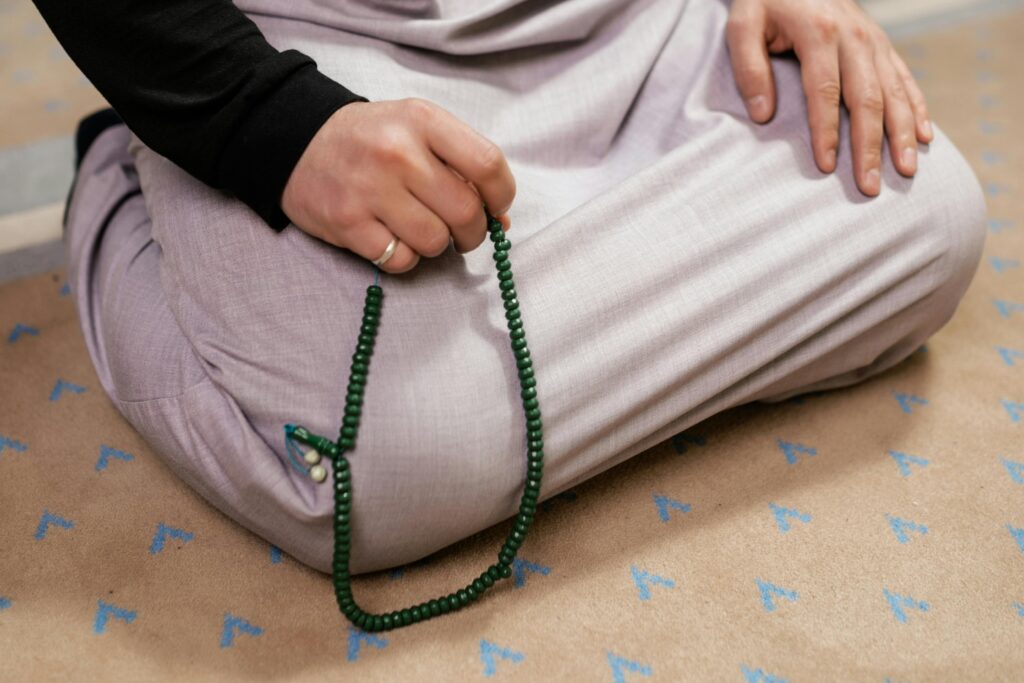
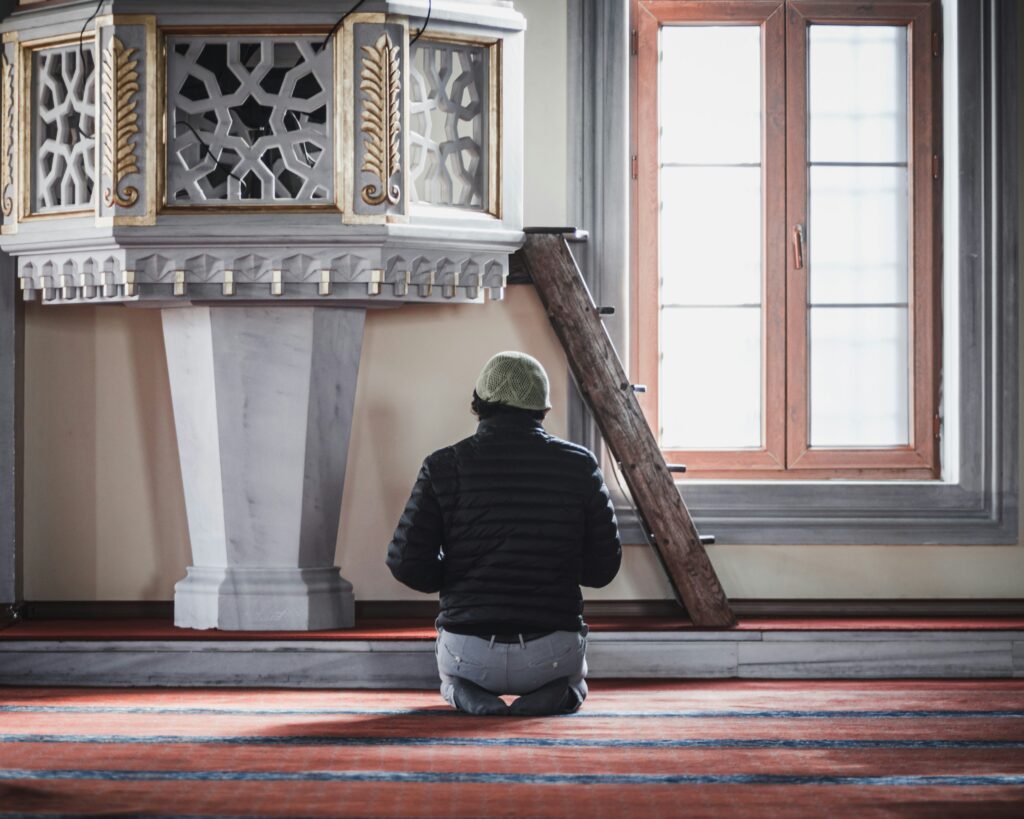
Muslim man standing in prayer (salah), one of the five pillars of Islam

Zakat (Almsgiving)

Zakat, the third pillar of Islam, purifies a Muslim’s wealth and soul. It is an obligatory form of charity that requires Muslims who are of age, sound mind, and meet the Nisab (minimum wealth threshold) to give 2.5% of their savings annually to those in need.

The Quran outlines eight eligible recipients, as stated in Surah At-Tawbah, in this verse (ayat).

Alms-tax is only for the poor and the needy, for those employed to administer it, for those whose hearts are attracted ˹to the faith˺, for ˹freeing˺ slaves, for those in debt, for Allah’s cause, and for ˹needy˺ travellers. ˹This is˺ an obligation from Allah. And Allah is All-Knowing, All-Wise.

Quran 9:60

By fulfilling Zakat, Muslims uphold social responsibility and deepen their faith, ensuring that wealth benefits the entire community.

Sawm (Fasting)

Sawm, the fourth pillar of Islam, is a compulsory act of worship observed during Ramadan. It requires Muslims to abstain from food, drink, and other physical needs from dawn (Fajr) to sunset (Maghrib). As the blessed month of Ramadan is a time of spiritual purification, self-discipline, and devotion to Allah (SWT).

Key aspects of fasting include suhoor, the meal eaten before fajr prayer, and iftar, breaking the fast at sunset.

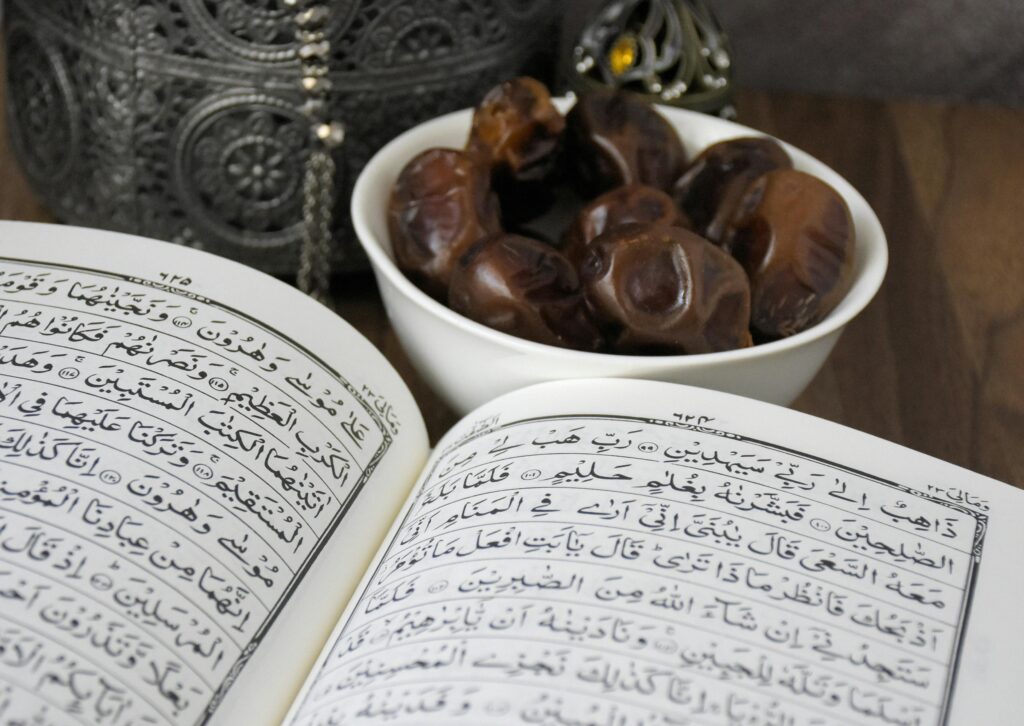
Eating dates for iftar and reading Quran are some of the recommended acts when fasting (one of the five pillars of Islam) for Ramadan

Every Muslim who are of age (i.e. has reached puberty) must fast during Ramadan. But there are also exemptions, such as those who are sick, elderly, travellers, and others with valid reasons (such as pregnancy or menstruation). However, they must also make up their fast once able to, if possible. If not, then they should pay compensation, called fidya, to the needy.

Beyond Ramadan, voluntary fasting on special days, such as Mondays and Thursdays or the Day of Arafah, is encouraged for extra rewards.

Hajj (Pilgrimage)

Hajj, the fifth and final pillar of Islam, is the sacred pilgrimage to Makkah (Mecca). It is required once in a lifetime for Muslims who are physically and financially able.

Taking place in Dhul Hijjah, it symbolises submission to Allah (SWT) and unity among believers. Key aspects of hajj include:

  • Ihram – Entering a state of purity and wearing simple white garments.
  • Tawaf – Circling the Kaaba seven times in devotion.
  • Sa’i – Walking between Safa and Marwah, honoring Hajar’s struggle.
  • Arafah – The most significant day, spent in deep prayer and repentance.
  • Rami al-Jamarat – Stoning the pillars representing Shaytan.
  • Qurban – Sacrificing an animal in remembrance of Prophet Ibrahim (AS).

What do the 5 pillars of Islam mean?

Overall, the five pillars of Islam are Shahada, Salah, Zakat, Sawm, and Hajj. They are the five key practices that all Muslims are obligated to fulfil throughout their lifetime. These practices are referred to as pillars because they form the foundation of Muslim life.

Why are the five pillars of Islam important?

Each of the five pillars works in tandem with one another to bring the essence of Islam into the lives of every Muslim:

Monotheism and the belief in Prophet Muhammad (peace be upon him) as the last messenger of God is the central tenet of Islam around which everything else revolves. Thus, reciting the Shahada (shahadah) in prayer each day serves to remind Muslims of this integral belief.

Salah (salat) occurs five times a day. This, hence, offers five different opportunities for remembrance of Allah (SWT) and our purpose in this life to worship Him.

The month of Ramadan requires every Muslim to abstain from their most basic needs and desires, like food, drink and physical relations for a period of time each day. Every year, the Sawm (fasting) gives Muslims the opportunity to gather control over their human needs. Without these distractions, Muslims can instead nurture good conduct and their connection to Allah (SWT).

While Sadaqah (charity) is greatly encouraged to be a part of everyday Muslim life, it is obligatory to offer Zakat (alms) once a year. This ensures that wealth is continuously redistributed to those who are in need of it.

During the Hajj (pilgrimage), Muslims must each wear the same simple garments and perform the same ritual acts of devotion to Allah. Stripped of worldly distinction, people are reminded that all are equal before God.

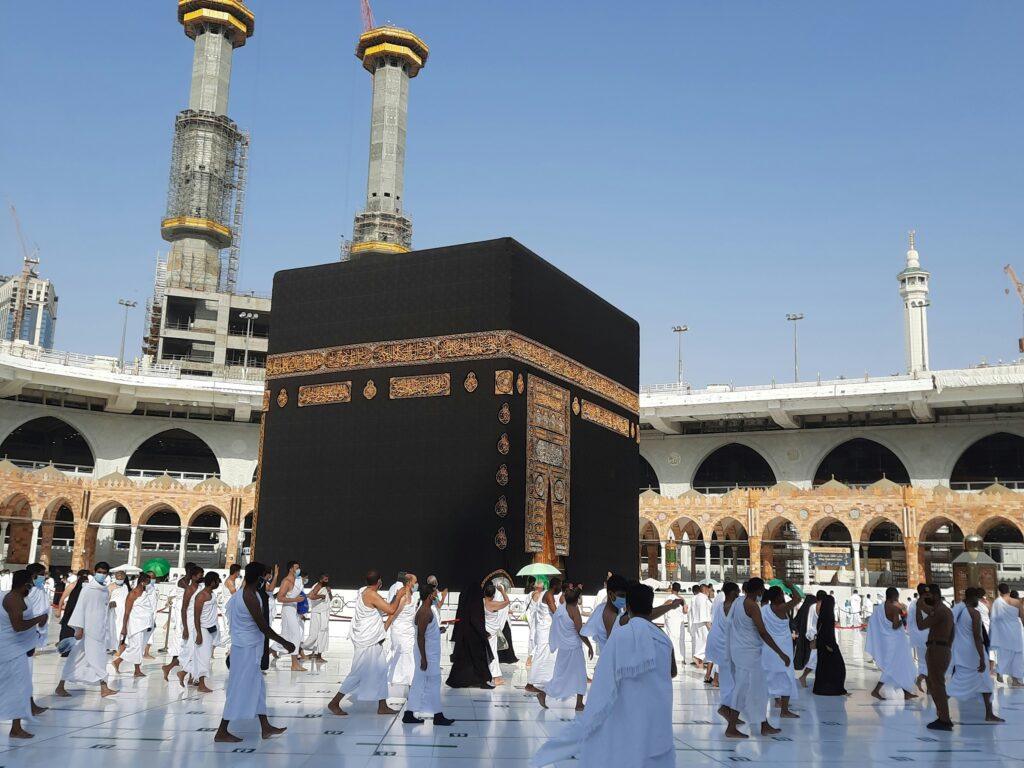
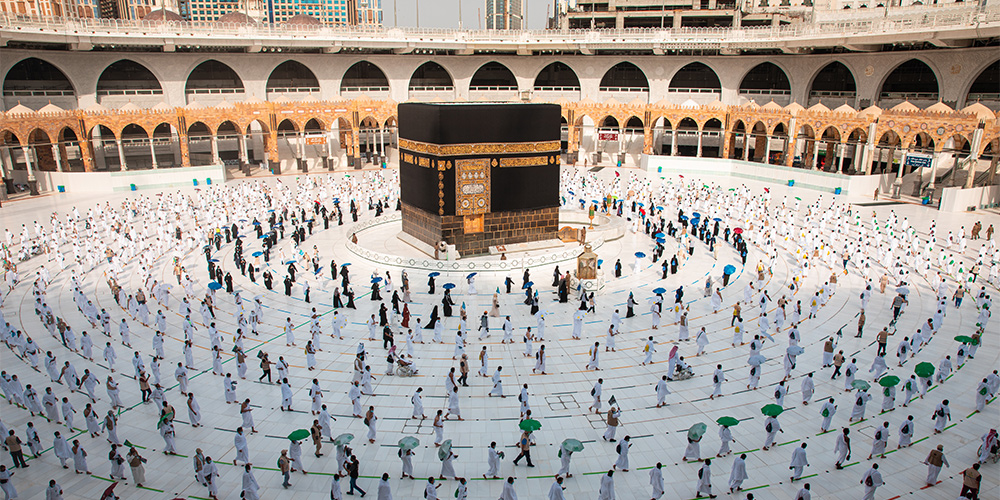
Muslims in Makkah circling the Kabaa (doing Tawaf) for Hajj, the last of the five pillars of Islam

Knowing the Key Facts about the Five Pillars of Islam

The Five Pillars of Islam form the foundation of a Muslim’s faith and practice, guiding their spiritual and daily lives. While these obligations are essential, Islam also recognises individual circumstances, offering exemptions and alternatives for those unable to fulfil certain pillars due to health, financial, or other valid reasons.

By embracing these pillars, Muslims strengthen their connection with Allah (SWT), helping build a just and compassionate society.

02.17.25

10 Top Tips for Ramadan for Busy Muslims

  Publications     Ramadan

Ramadan, for Muslims, is the most blessed time of the year. It opens the door for opportunities to lose bad habits and exchange them for healthier ones – all while gaining immense rewards.  

Abu Hurayrah (may Allah be pleased with him) narrated, the Messenger of Allah (ﷺ) said:  “Every deed of the son of Adam will be given a ten-fold reward, up to seven hundred. Allah says: ‘Except fasting, for it is for Me, and I shall reward for it, for he gives up his desire and his food for My sake…’ and the fasting person has two joys, one joy when he breaks his fast and another when he meets his Lord. And the smell from his mouth is better before Allah than the fragrance of musk.” 

 Sahih Al Bukhari

However, in this day and age, it can be hard to match up our big plans for Ramadan with our busy schedule. Even with our best intentions and efforts, staying on top of chores, family commitments, school or work, on top of the additional worship is often more complicated than we think!  

So how do we make the most of it? How can we maximise the benefits of Ramadan without getting overwhelmed?  

Top Tips for Tackling Ramadan on a Busy Schedule  

Many of us are super-worried about our productivity during Ramadan. What is the right balance between staying on top of our daily tasks while also squeezing in more ibadah (acts of worship) in our lives?

That’s why we’re giving you 10 practical tips for Ramadan to help you reach your spiritual goals for this blessed month without burning out!  

1 | Start Ramadan with Sincere Intentions  

Having sincere intentions, working hard and making lots of dua is the hack for an ultimate productive Ramadan.  

Umar ibn al-Khattab reported, the Messenger of Allah (ﷺ) said: “Verily, deeds are only with intentions, and every person will have only what they intended.” 

Bukhari and Muslim

Intentions lead to results. When a change in intention occurs, when we commit to take action, it makes us more motivated to do it.  

Having the intention is enough for Allah (SWT) to make a change in our reality, so we should not dismiss how a change in intention (our internal condition, our mindset) needs to occur so we can take steps to change our external condition.

2 | Plan Ahead and Set Clear Goals for Ramadan

Before Ramadan starts, set personal goals for yourself. Break them down step by step to make it easier for you to tackle them.  

For example, set a goal for how many chapters of Quran you would like to finish during the month. Once you do that, split the task and divide it. Have a set number of pages or ayat to read each day. Then decide if you want to set a whole block of your day for reciting or have multiple smaller time slots throughout the day.  

You can also set similar goals for dhikr, duas, extra prayers, and more. However, be sure to be realistic – know your limits. Highlight the small, consistent acts that are challenging but you know you can complete. Then have another list for the ibadah you want to add on after you smash your initial goals. That way, you’re always striving to do better throughout the month! 

3 | Prioritise Your Spiritual Obligations 

Even with our busy schedules, we need to always have time for prayer and remembering Allah (SWT) – especially during the holiest month of the year, Ramadan.  

Try to work your schedule around salat (prayer) times rather than the other way around. Set reminders or alarms on your phone to ensure you don’t forget your spiritual obligations amidst your busy schedule. Soon enough, it’ll come naturally to you, and you’ll be able to maximise every moment during Ramadan.

4 | Build Environments that Make it Easier to Stay Focused  

Fasting can make it hard to concentrate, especially in the afternoon. But with the right approach, you can stay productive. 

Adjust your work or school schedule to accommodate for fasting and prayer times in Ramadan. Likewise, talk to your employer or supervisor to see if they can offer flexible working or a lighter workload during Ramadan. 

Muslimah (muslim woman) with books with notes, balancing study/work in Ramadan

For school or work, focus on demanding tasks right after Suhoor (the meal you eat before you fast) when your mind is fresh. In turn, if you can, take power naps. A short nap (around 10-20 minutes) after Dhuhr can go a long way in boosting your energy. 

Overall, having this strategic approach to your busy schedule prevents exhaustion and helps keep you on track. 

5 | Step Back From Socials 

If you’re someone who spends a good chunk of their day browsing and surfing on social media forums, it might be a good idea to take a step back for Ramadan. Turn off notifications, temporarily deactivate your accounts, or maybe even delete the applications from your phone.   

Taking these steps will help you not get distracted by socials in the first place. This way, you have more time to work on beautifying your ibadah – doing more dhikr, dua, Quranic recitation and more! 

6 | Eat Healthy Meals for Suhoor and Iftar  

Eating well is key to staying productive. It keeps your energy steady, making ibadah and daily tasks easier. So, what foods should you eat for suhoor and iftar?  

For suhoor, focus on slow-digesting foods that help you stay full longer. These include oats, eggs, whole grains, and nuts. Try to limit salty and sugary foods as they cause you to get dehydrated more quickly. 

For iftar, break your fast with dates and water, following the Sunnah of the Prophet (ﷺ). Then have a balanced meal with lean proteins (like chicken, fish, or tofu), healthy fats (like nuts or eggs), and complex carbs (like potato or whole grains). 

To make things less overwhelming, try meal prepping! It saves time, ensuring you have a nutritious meal ready to go, even on the busiest days.  

One of the key tips to Ramadan meal prep is cooking in batches and freezing meals. You can also prepare smoothies or overnight oats for quick suhoor options. And for those moments you feel a bit hungry after taraweeh? Keep healthy snacks on hand to avoid reaching for junk food. 

 All in all, keep things clean and simple! By eating right, you won’t make work and worship harder on yourself during this blessed month.  

7 | Continuously Ask Allah (SWT) for Forgiveness  

Allah (SWT) loves those who engage in constant ‘istighfar’ – constant repentance. So, one of the best things you can do in Ramadan is seek Allah’s (SWT) Mercy.  

Ramadan is a blessed month when Allah (SWT) widens the gates of communication and mercy.   

Ibn’ Abbas (may Allah be pleased with him), narrated that Prophet Muhammad (ﷺ) said: “If anyone constantly seeks pardon (from Allah), Allah will appoint for him a way out of every distress and a relief from every anxiety, and will provide sustenance for him from where he expects not.” 

Abu Dawud

8 | Include Frequent Dhikr in Your Schedule 

One of the easiest acts of worship to include in your busy schedules is Dhikr (Remembrance of Allah (SWT)). It’s short, and Allah (SWT) gives you great rewards for it!  

Dhikr (plural, adhkar) includes sayings that glorify Allah (SWT), such as Allahu Akbar, subhanAllah, and Alhamdulillah. Adhkar can also include reciting dua or certain verses in the Qur’an for the purpose of remembering Allah (SWT).  

They’re short enough to memorise or recite fairly quickly during any free time you get in between your daily tasks of the day.  

For example, if you are driving to work and you have a 15-20 minute journey in between, use that time to engage in dhikr. Or use your breaks in between work meetings, or spend a few minutes after salah to make dhikr with tasbeeh.  

Muslim man holding tasbeeh making dhikr, a simple ibadah (act of worship) for Ramadan

While it might not seem like much, by maximising your ibadah time in this way, when you add them all together, that’s quite a lot of potential good deeds! 

9 | Maximise Ramadan Nights for Worship, Even with a Busy Routine 

The nights of Ramadan, especially the last ten, are filled with many blessings. But it can be quite the struggle to balance Taraweeh, family time, and rest during these nights. 

To help maximising your time for worship at night, focus on what works best for you. If you can’t pray long Taraweeh, pray shorter ones. Even two extra rak’ahs bring rewards. 

In turn, if you struggle to stay up late, do small but consistent ibadah. Keep a list of short duas handy and make those supplications sincerely. Do tasbeeh (glorifying Allah) or reflect on a few Quranic verses.  

If your time is limited, quality matters more than quantity. Because, with sincere intentions, even small efforts during the night can bring great rewards. 

10 | Manage Your Ramadan Workload  

Even if we have a plan for our goals, we can still get overwhelmed or underestimate how long things will take. This is especially true during Ramadan, where many of us will have more commitments, including being invited to iftar dinners and taraweeh prayers to perform.  

That’s why it’s essential to have a strategy in place to manage our workload during Ramadan. Prioritise tasks, delegate where possible, and avoid taking on additional responsibilities if you can.  

And remember, don’t get discouraged if everything doesn’t go as planned. Keep planning, keep trying. For Allah (SWT) is the best of planners, and whatever He puts in your path He knows you can overcome it! 

In Conclusion… 

Ramadan doesn’t have to be overwhelming, even for the busiest Muslims. With the right mindset and planning, you can balance work, worship, and family – all while making the most of this blessed time. 

Remember, Allah (SWT) rewards efforts, not perfection. Even small acts done with sincerity can bring immense barakah (blessings).  

So, make an extra effort in this Holy month – it will go a long way! May this Ramadan be a time of growth and blessings for you and your loved ones! 

Get the Ramadan Journal

How do you make the most of Ramadan? For the most blessed time of the year, here’s a daily planner to help you stay organised.

02.12.25

Ramadan Preparation: How to Build Your Action Plan

  Publications     Ramadan

With the Holy month of Ramadan just around the corner, Muslims across the globe are rushing to prepare themselves for this sacred time – including us! 

Ramadan is a marathon that rewards you for doing your best and participating in it from start to finish. With each trial faced, with each sincere intention made, with each act of worship (ibadah) carried out for His sake, Allah (SWT) promises His believers multiplied rewards and blessings.

Allah (SWT) created Ramadan to be a fulfilling experience for the believer. It’s a month that’s made to ease the heart and mind and purify the body and soul. But if you’re not sure where to start, don’t worry! Here are some easy-to-follow Pre-Ramadan preparation tips to help you build your action plan for the month!

Note Down the Bad Habits You Want to Break

Ramadan, a month of mercy and forgiveness, is one of the best times to break bad habits. For one, Allah (SWT) has locked all Shayateen (devils) during this time. Thus, He makes it easier for us to stay away from harmful acts. Likewise, having to fast from dawn to dusk for the whole month further encourages us to control our appetite. It also helps keep our actions in check as we receive more rewards for it. 

Keep yourself accountable by first noting down the bad habits you feel confident in getting rid of for Ramadan. Then, write down the steps you plan to take to break that habit. For example, one habit you might have is praying at the last minute. Here is a list of actions you might want to take to break it:

  1. Set an alarm 10-15 minutes before prayer time (or your local Juma’at time) so you have time to make wudu or ghusl and get yourself in the mindset for prayer.
  2. Get a friend or family member to ask if you’ve prayed or not well before prayer time ends.
  3. Make sure you’ve packed a lightweight prayer mat (Sajadah) and wear clothes you can pray in if you plan to go out.

Salah is an important pillar of Islam, and is especially important during Ramadan

Of course, some habits are harder to break than others. Especially if it’s one we’ve had for many years. But, even if you start small, every effort you take towards bettering yourself for Allah (SWT)’s sake will weigh heavily in your favour. In this life and the Hereafter.

Write Down Your Short-Term and Long-Term Goals

Many of us go into Ramadan determined to make the most of it. We make plans to perfect our Salah (prayer), read more Quran, learn more about Islam, give more charity, and do more good overall. However, it can be hard to stay motivated or know if we’re improving on our good habits if we don’t have specific goals in mind. 

Keep yourself focused by writing down a list of all the goals you want to work on during Ramadan. Include both the short-term goals you want to complete during the month. As well as the long-term goals you want to continue working on beyond Ramadan. 

Writing down your goals (e.g. in a book) for Ramadan helps you make the most of it

For example, maybe one of your long-term goals is to memorise the whole Quran. Then, one of the short-term goals you might list to help achieve this goal can be having a specific time of day to read and memorise the Quran (e.g. half an hour after Fajr, 20 minutes before Maghrib, etc.). Another goal can be choosing a couple of Surahs (chapters) of the Quran to memorise during the month. 

Whatever your goals might be, make sure it’s doable for you. Don’t feel bad about taking things slow. Gradual but consistent improvement is better than speeding through goals just to get them done.

Going back to the Quran example, maybe for now you can only memorise one or two short surahs during the month, but one day you’ll be able to memorise a page a day or maybe even more. Ramadan is the best time to build good habits after all and you should be able to enjoy the journey it takes to develop them. 

Get on Top of Your Health

Looking after our health is an important part of our faith, as, in Islam, our bodies have a right over us (Sahih Bukhari). Fasting in Ramadan includes going long hours without food and drink. Hence, we should make sure we are physically and mentally prepared for it. So, we can spend the month focused on our worship of Allah (SWT). 

Before Ramadan arrives, check on how your mind and body feel. Do you have any symptoms you want a health professional to look at? A chronic health condition? Is there any medication you must take at certain times of the day? Schedule a visit with your doctor if you can. Then, ask them to help you figure out a plan that works best for you while fasting.

Even if you feel fine and don’t have any outstanding medical conditions, it’s still important to know how to look after your mind and body throughout Ramadan.

While fasting has many benefits that can help reach many health goals (e.g. losing weight, decreasing stress levels, preventing further health conditions, etc.), it can also get overwhelming or tiring.

One of the ways to combat this is by eating wholesome meals for Suhoor (or Sehri) and Iftar. This includes having foods with nutrients that help you feel energised for a long time, such as fibre-rich grains, fruits, or vegetables. 

Nutritious foods for suhoor (sehri) help you stay energised

By preparing your mind and body for the month of fasting ahead, you have more time to focus on your spirituality and thus work on making the most of Ramadan’s blessings.

Make Space In Your Ramadan Calendar for Community

The month of Ramadan is a time of community. Many families gather together for iftar and Masajid (Mosques) are often fuller in Ramadan than at any other time of year, especially for Taraweeh prayer.

Before Ramadan, many Islamic community centres will post their schedule of activities and workshops for or in preparation for the month. Your family or community themselves might also have big events planned, whether it be iftar gatherings, fundraisers, halaqahs or Quran circles.

In either case, take some time to make note of these events in your calendar and how you can work them into your Ramadan goals.

In the month when blessings are multiplied and there are more opportunities for rewards, when we come together to worship Allah (SWT), working your schedule around the community events can help you make the most of this month. Thus, strengthening your bond with your loved ones and Allah (SWT).

Keep Your Action Plan With You Throughout Ramadan

Now that you know your schedule and goals for Ramadan, keep that action plan close to you throughout the month.

Make time each day to keep track of your progress, go over the goals you need to work on and see what events you have on that day. By having this system in place, it helps make Ramadan less overwhelming and can even encourage us to keep these organised habits even after the month ends!

So make the most of the time you have left before Ramadan to make an action plan. Be sure to take note of all the habits you want to break and your key goals (short-term and long-term). Likewise, keep up to date with your health requirements and any plans you, your family or your community might have for Ramadan. 

Get the Ramadan Journal

How do you make the most of Ramadan? For the most blessed time of the year, here’s a daily planner to help you stay organised.
02.05.25

Shaban 2026: The Month of Nurturing and Growing

  News     Ramadan

Shaban (or Sha’ban, Shaaban), is the eighth month in the Islamic calendar. Coming before the ninth month, Ramadan, it is a bridge to the blessings the holy month brings.

Thus, we explore, “What is Shaban?”, as a time to prepare for the important month ahead, and one we must not neglect.

When is Shaban 2026?

Shaban, this year, begins on the evening of Monday, January 19, 2026, according to the new moon’s sighting. This makes the first day of Shaban, Tuseday, January 20, 2026.

This Islamic month may end on the evening of Friday, February 17, 2026, depending on the moon’s sighting for the start of Ramadan.

A crescent moon in the night sky, the sighting of which can be used to determine the dates for the Islamic months, such as Shaban
Photo: The sighting of the moon is used to determine the dates of the Islamic months of the lunar calendar.

What is the Significance of Shaban?

Imam Abu Bakr al-Warraq al-Balkhi (RA), the uncle of Imam Tirmidhi (RA), said: 
“The month of Rajab is the month of planting (your seeds), Sha‘ban is the month of irrigating / watering (them), and Ramadan is the month of harvesting the crop.”

Lataiful Ma’arif

Shaban, being the month just before Ramadan, is a perfect time to prepare for the blessed month. But it too, holds great importance on its own. Here are key reasons why:

More Fasting Than Any Other Month (Except Ramadan)

The Prophet Muhammad (ﷺ) would fast in Shaban more than any other month except Ramadan. Aisha (RA) said:

“I never saw the Messenger of Allah ﷺ fasting for an entire month except in Ramadan, and I never saw him fasting more than he did in Sha’ban.”

Sahih Al-Bukhari

He (ﷺ) also loved to fast in this month. So much so, that it was recorded in hadith. In Sunan Abu Dawud, it states, “The most beloved of months for the Messenger of Allah ﷺ to fast in was Sha’ban, and his fasting in Sha’ban was continuous with his fasting in Ramadan.”

More Opportunity for Rewards

Many scholars of the past (Salaf) also believed that fasting in Shaban was better than fasting in other months, even the sacred ones.

Ibn Rajab (RA) said, “Fasting in Sha’ban is better than fasting in the Sacred Months, and the best of voluntary fasts are those that are (observed in the months) closest to Ramadan, before or after.”

A hadith in Silsilat ul-Ahadith-as Sahiha also states, “Allah forgives all the believers in general; except the polytheists and the jealous people on the middle night of Sha’ban.” Some Muslims refer to this night as a Shab-e-Barat, however no Quranic verses specifically mention it.

Good Deeds to Do on Sha’ban

There are a lot of good deeds you can perform in the month of Shaban to make the most of it. Here are some simple acts of worship (ibadah) to add to your daily routine to earn good deeds AND prepare for Ramadan.

1. Do Voluntary Fasts

Prophet Muhammad (ﷺ) used to fast most of the days of Shaban. Thus, we should follow his Sunnah (actions and way of living) and keep as many voluntary fasts as we can in Shaban too. If it is hard to fast most of the month, try to fast on the 13th, 14th, and 15th as they are the White Days (Al-Ayyam al-Bid) of the Islamic month.  

However, there are also exceptions to fasting in Shaban. Abu Hurayrah (RA) mentioned that the Messenger of Allah (ﷺ) said, “Do not anticipate Ramadan by fasting one or two days before it begins, but if a man habitually fasts, then let him fast.” (Sahih Muslim)
He also reported that the Prophet (ﷺ) said to not fast if Sha’ban is half over. (Tirmidhi)

The exception to this would be someone who fasted regularly, such as the Prophet (ﷺ) and many of his companions. Thus, if you are someone who regularly observes the sunnah fast, then you may still observe them in the second half of Sha’ban. It is also permissible to make up a Ramadan fast at this time, if necessary, as Aisha (RA), one of the wives of the Prophet (ﷺ), herself said she would make up fasts in Shaban.

2. Recite the Quran

Ramadan is the month of revelation of the Quran. Naturally, it is the month when we recite it the most. Thus, to help us get ready and see the best results in Ramadan, we should start the habit of reciting it more, starting from Shaban. 

Salamah ibn Kuhayl (RA) said, “It was said that Shaban was the month of the Quran readers.” (Lataiful Ma'arif)
Salamah ibn Kuhayl (RA) said, “It was said that Sha’ban was the month of the Quran readers.” (Lataiful Ma’arif)

3. Make Lots of Duas

Apart from obligatory prayers and observing fasting in Shaban, reciting different duas, tasbeeh, and staying engaged in remembrance of Allah (SWT) is also a good way of making the most of this month.

Here are some duas you can say to seek forgiveness and blessings from Allah (SWT).

“O Allah (SWT), I seek refuge in Your pleasure from Your anger and in Your forgiveness from Your punishment. I seek refuge in You from You. I cannot praise You enough. You are as You have praised Yourself.”

(Sahih Muslim)

Rabbanā lā tuākhidh’nā in nasīnā aw akh ta’na

رَبَّنَا لاَ تُؤَاخِذْنَا إِن نَّسِينَا أَوْ أَخْطَأْنَا

“Our Lord! Take us not to task if we forget or fall into error”

Qur’an 2:286

4. Perform Voluntary Prayers

To make it easier to do more voluntary prayers in Ramadan, start the practice of praying Tahajjud from Shaban. It will help you get used to the Ramadan schedule quicker and also bring you many rewards. 

5. Start Preparing Money for Ramadan

The Prophet Muhammad (ﷺ) was the most generous in giving charity (Zakat and Sadaqah) during Ramadan. To prepare for giving in Ramadan, we should start getting ready in Shaban, including finding Zakat calculations.

Like other forms of Ibadah, charity in Shaban is also an act of worship as you show kindness to others. For every good deed, specifically charity during Shaban, you can gain blessings in abundance.

Shaban: A Pathway to Blessings and Rewards

The Prophet Muhammad (ﷺ) said, “(Shaban) is a month to which people do not pay much attention, between Rajab and Ramadan. It is a month in which the deeds are taken up to the Lord of the worlds, and I like that my deeds be taken up when I am fasting.” (An-Nasa’i).

With this in mind, it is important not to neglect this blessed time. To make the most of it by increasing worshipping, observing fasting, reciting Quran and duas, and engaging in charitable activities.

Thus, it will be a month that not only strengthens your bond with Allah (SWT), but also help you prepare for the sacred month of Ramadan.

Your Zakat Heals Our Ummah

Make the most of Shaban by preparing for Ramadan. Give the gift of happiness and hope to our brothers and sisters in need with Islamic Relief.

01.26.25

Isra’ and Mi’raj 2025: The Night Journey (27th Rajab)   

  Publications     Ramadan

Isra’ and Mi’raj is an important night occurring on the 27th of Rajab. One that we should not slip by without reflecting on its lessons and its significance. 

This year, Al Isra’ wal-Mi’raj 2025 is predicted to take place on the evening of January 26th 2025, depending on the sighting of the moon. 

What is Isra’ and Mi’raj (Al-Isra’ wal-Mi’raj)? 

Isra’ and Mi’raj, known as Al-Isra’ wal-Mi’raj in Arabic, is a miracle second only to the revelation of the Qur’an.  

Translated, it means the Night Journey and Ascension. It refers to the event when that transported Prophet Muhammad (ﷺ) from al-Masjid al-Haram to al-Masjid al-Aqsa, from where he (ﷺ) ascended to heaven. It was an incredible journey, filled with many wonders and miracles.  

Night, when the Prophet (ﷺ) embarked on the incredible night journey and ascension (Isra’ and Mi’raj)
Photo: Night, when the Prophet (ﷺ) embarked on the incredible night journey and ascension.

When did the Night Journey and Ascension (Al-Isra’ wal-Mi’raj) Happen?  

Isra’ and Mi’raj took place during a time when Prophet Muhammad (ﷺ) was facing intense hardship and pain.  

The Quraysh constantly ridiculed, humiliated and oppressed the Prophet (ﷺ) and his followers. Moreover, he (ﷺ) had just faced the Year of Sorrow (’Aam al-Huzn), during which he (ﷺ) lost his beloved wife Khadijah (RA) and his uncle Abu Talib, his protector and ally. 

In addition to all these struggles, when the Prophet (ﷺ) travelled to Ta’if to spread the message of Islam, the people of Ta’if rejected him, sending their children after him to stone him until he left the city. 

Having gone through so much grief and suffering, Al-Isra’ wal-Mi’raj came to the Prophet (ﷺ) as a beautiful and comforting gift.  

He was transported not only through the skies but ultimately into the presence of Allah (SWT), the source of all comfort and hope.

Al-Isra’: From the Ka’bah to Al-Aqsa 

When the Prophet (ﷺ) was sleeping in the house of Umm Hani (ra) in Makkah when the roof of his house opened and the Angel Jibril (AS) descended (Bukhari).  

He (ﷺ) was then taken to the Hijr, the semi-circular wall of the Ka‘bah. It was there that Jibril (AS) opened the Prophet (ﷺ)’s chest and washed it with Zamzam water. Jibril then brought a golden tray full of wisdom and faith, and having poured its contents into the Prophet (ﷺ)’s chest, he closed it. (Bukhari) 

Jibril then brought to the Prophet (ﷺ) a white beast called al-Buraq (from the Arabic word barq, meaning lightning). It was bigger than a donkey and smaller than a mule. Its stride was as long as the eye could reach. (Muslim)

Buraq first shied from the Prophet (ﷺ) before they set off. So Jibril (AS) said to a saddled and reined Buraq, “Is it from Muhammad (ﷺ) that you do this? For nobody has ridden you who is more honourable to Allah than him! Then Buraq started sweating profusely. (Tirmidhi) 

At several points along the journey, Jibril (AS) stopped Buraq and told the Prophet (ﷺ), “Dismount and pray”. The first stop was at “the place of emigration”, Madinah. Soon, after this night, the Prophet (ﷺ) would meet the Ansar and migrate to Madinah.  

The second stop was on Mount Sinai, where Allah (SWT) revealed the Torah to Musa (AS). The third stop was at Bethlehem, where ’Isa (AS) was born. 

The fourth stop was the grave of Musa (AS), located “a stone’s throw” away from the holy land of the Blessed Masjid Al-Aqsa (Bukhari).  

The Prophet (ﷺ) said: “On the night on which I was taken on the Night Journey, I passed by Musa and he was praying in his grave.”

Sunan an-Nasai

Arriving at Al-Aqsa 

When Messenger of Allah (ﷺ) arrived in the holy city of Al-Quds (Jerusalem), they approached Masjid Al-Aqsa. There, Jibril (AS) pointed to the Masjid with his finger, causing a crack in the rock, and tied Buraq to the western wall of the noble sanctuary. (Tirmidhi).  

Waiting inside were all 124,000 Prophets (AS), and among them included Musa (AS), Isa (AS) and Ibrahim. Jibril (AS) led the Prophet (ﷺ) to the front, and he (ﷺ) led them all in prayer in this blessed space.  

When the Prophet (ﷺ) completed the prayer, someone said, “Here is Malik (AS), the keeper of Hellfire, so convey Salams to him”. So, he (ﷺ) turned to him, but the angel Malik preceded him in Salams’ (Muslim).  

The Prophets (AS) also discussed, after praising Allah (SWT), about “the Hour”. Both Ibrahim (AS) and Musa (AS) stated that they “did not have any knowledge of it”. Whilst ’Isa (AS) ’mentioned the Dajjal (anti-Christ). (Ibn Majah) 

Following the discussion, the Prophet (ﷺ) came out and Jibril (AS) brought him (ﷺ) a vessel of wine and a vessel of milk. When the Prophet (ﷺ) chose the milk Jibril (AS) said, “You have chosen the natural state (Fitrah)” (Muslim). 

The Prophet (ﷺ), with Jibril (AS), then proceeded to the Noble Rock (as-Sakhrah al-Musharrafah), currently housed by the holy Dome of the Rock Masjid, at the centre of the noble sanctuary (al-Haram ash-Sharif) of the Blessed Masjid Al-Aqsa.  

He (ﷺ) then ascended into the heavens for the next part of this incredible journey – the Mi‘raj, the Ascension! 

What is the Mi’raj? 

He (ﷺ) certainly saw some of his Lord’s greatest signs.  

Qur’an 53:18

The word Al-Mi’raj is a noun of instrument in Arabic morphology, which literally means ‘an instrument you use to ascend’. But how does this relate to the Prophet (ﷺ)’s night journey? 

In the Prophet’s Night Journey and Heavenly Ascent by Sayyid Muhammad ibn Alawi al-Maliki, it states that:  

View Preview

The Prophet (ﷺ), “saw the wide-eyed maidens of Paradise at the left of the Rock (at the Dome of the Rock Masjid). He greeted them and they returned his greeting.

“Then he asked them something and they replied with an answer that cools the eyes. Then the Prophet (ﷺ) was brought the ladder by which the spirits of the children of Adam (AS) ascend.  

“It had alternate stairs of silver and gold and came down from the Highest Garden of Paradise, Jannat al-Firdaus. It was encrusted with pearls and surrounded (by) angels on its right and left”

As recorded in The Life of Muhammad (ﷺ) Ibn Ishaq, the Prophet (ﷺ) also said the ladder was finer than any he had ever seen, and that this was the ladder which “the dying man looks when death approaches”.

Then the Prophet (ﷺ), accompanied by Jibril (AS), ascended into the layers of sky. 

The First Sky 

Allah ascended the Prophet (ﷺ) from the Dome of the Rock through the skies, where he saw many miraculous sights reaching heaven, the first layer of the sky and the end of the known universe. 

Jibril (AS) then asked the (gate of heaven) to be opened (by knocking on one of its doors). (Bukhari)

The dwellers of Paradise asked, ‘Who is it?’ He said, ” Jibril.” They said, “Who is accompanying you?” He said, “Muhammad (ﷺ).” They said, “Has he (ﷺ ) been called?” He said, “Yes,” They said, “He (ﷺ) is welcomed.” (Bukhari)

The Prophet (ﷺ) also reported that when (the door of heaven) was opened for them “…suddenly I was with (the Prophet) Adam (AS). Then he welcomed me and supplicated for good for me”. (Muslim)

The Second to Seventh Sky 

The Prophet (ﷺ) continued to ascend the layers of the skies with Jibril (AS). Each time, they again sought permission to enter, and the angelic guards were delighted and welcomed the Messenger of Allah (ﷺ).  

It was also through passing these skies that the Prophet (ﷺ) met many of the prophets (AS) who came before him. At the second sky, he met prophets Isa (AS) and Yahya (AS). In the third sky, the Prophet (ﷺ) met the Prophet Yusuf (AS). 

At the fourth sky, the Prophet (ﷺ) met the Prophet Idris (AS). In the fifth sky, he met the Prophet Harun (AS), before meeting Prophet Musa (AS) in the next sky – the sixth.  

At each one of these levels, these Prophets (AS) welcomed the Prophet (ﷺ) and supplicated good for him saying, “Welcome O pious Prophet and pious brother!” (Bukhari) 

 At the seventh sky, the Prophet (ﷺ) met his greatest ancestor, the Prophet Ibrahim (AS) who was “reclining his back against al-Bayt al-Ma‘mur. And there enter into it seventy thousand angels every day ever to return to it (again)”. [Muslim] 

(Bayt al-Ma’mur, in Arabic, means “the much-visited House”. It is the heavenly Ka‘bah directly above the one on earth). Like Adam (AS), Ibrahim (AS) also greeted the Prophet (ﷺ). 

The Lote Tree 

As the Prophet (ﷺ) carried on his journey, he reached the Furthest Lote Tree, known, in Arabic, as “Sidrah al-Muntaha” (Qur’an 53:14). 

In several ahadith, the Prophet (ﷺ) described the tree in great detail. 

“(Its) leaves were like elephant ears and its fruit like big earthenware vessels”. (Muslim)

“Then when it was covered by the Command of Allah, it underwent such a change that none amongst the creation has the power to praise its beauty” (Muslim)

“A rider will travel in the shade of one of its branches for a hundred years,” or “a hundred riders will seek to shade themselves with its shade”. (Tirmidhi)

The tree is surrounded (by) “golden butterflies”. (Tirmidhi)

He (ﷺ) further said: “many a colour had covered it which I do not know (i.e. the colours of this tree were indescribable)”. (Muslim)

He also stated that, “There terminates everything that ascends from the earth, and everything that descends from above”. (Tirmidhi) 

The Divine Meeting 

Then Allah revealed to His servant (ﷺ) what He revealed 

Qur’an 53:10

At the end of this journey, the Prophet (ﷺ) was brought to Allah (SWT), the ultimate source of strength and relief.  

Regarding this important meeting, the Prophet (ﷺ) said, ‘Then Allah revealed to me what he revealed to me and then He made obligatory for me fifty prayers every day and night’. [Muslim] 

It was here that Allah gave this Ummah the gift of compulsory Salah. A daily source of strength to Muslims, giving them the opportunity to communicate with Allah (SWT) directly and draw closer to Him.  

We also know, that through the Prophet Musa (AS)’s intervention and advice that fifty prayers were eventually reduced to five, but still rewarded as fifty, subhanAllah! 

Returning Home 

Finally, the Prophet (ﷺ) was taken back down to the Blessed Masjid Al-Aqsa and returned to Makkah on the Buraq. 

As he was transported home, he saw various caravans heading towards Makkah, which he would later describe to the Quraysh as proof that he really had made this miraculous journey.  

Allah (SWT) even displayed Bayt al-Maqdis to the Prophet (ﷺ), while the Quraish were cross-examining him in the Hijr of the Ka‘bah [Bukhari].  

The entire journey had taken place in a small portion of a night, and there were many who would mock the Prophet (ﷺ) for making such a claim. 

For the Muslims, however, the story was a source of wonder and hope, as it continues to be for us today.  

On this night, the Prophet (ﷺ) was given the honour of travelling to various blessed places on earth, then ascending the levels of sky and being finally welcomed by Allah (SWT)! All this to honour the beloved Prophet (saw) and “to show him some of Our signs!” (Qur’an 17:1)

Your Zakat Heals Our Ummah

Make the most of Rajab by preparing for Ramadan. Give the gift of happiness and hope to our brothers and sisters in need with Islamic Relief.

01.08.25

How Islamic Relief Uses Your Donations to the Fullest

  Impact     Publications

At Islamic Relief, we use your donations in the way that benefits rightsholders the most. To raise the most money for the world’s most vulnerable people and distribute those funds responsibly, effectively and fairly.  

Because for every $1 we spend:

  • 86c directly into helping people in need 
  • 11c to raise more funds
  • 3c on administering the funds and making sure we are accountable
 

This all ensures we can continue the lifesaving work we do and reach even more people in need, sustainably and with quality care. 

So, for every 1c we spend on fundraising, we raise an additional 10c. That’s an extra $1.10 on top of your $1. Your donation is DOUBLED, Alhamdulillah! 

Are My Donations Being Used Effectively?  

The most important question should be ‘Are your donations being used effectively?’ 

With Islamic Relief, the answer is YES! Each day, Islamic Relief works hard to be a safe pair of hands for your donations. We’re accountable to you, to the people we serve and most importantly to Allah (SWT). 

Alhamdulillah, because of your support, our family has transformed and saved over 120 million lives since 1984. 

A young orphan girl - one the many lives your donations have changed

In Gaza, we are on the ground daily, providing millions in aid amidst ongoing conflict. In Sudan, we are fighting hunger and malnutrition and granting shelter to the millions displaced. As conflict and disease continue to grip our planet, we’re there to support vulnerable communities in need. 
We don’t claim to have a 100% donation policy 

We aim to use your generous donations in the most effective way possible, whilst remaining as transparent as possible! Did you know that we’re able to multiply your donations? So, we could claim to have a 100% PLUS donation policy, but we don’t. 
Find out why Islamic Relief does not use a 100% donation policy here

Together, we’re saving and transforming the lives of some of the world’s most vulnerable people. Without your support, we wouldn’t be able to do any of this. Please continue to give to Islamic Relief and help save even more lives. 

See Your Impact

Our annual reports show how your Zakat and Sadaqah transforms the lives of millions with lifesaving aid.

Frequently Asked Questions

  • How are your donations spent?

    For every $1 we spend: 

    • 86c goes directly towards helping people in need 
    • 11c is invested in raising more funds 
    • 3c goes towards administrative costs 
  • How much of my donation will go directly to people in need?

    How much of my donation will go directly to people in need? 

    For every $1 donated to Islamic Relief Australia, 86c goes directly towards programs and initiatives that help people in need. 

    We spend 3p on administrative costs and invest 11p into raising more funds. 

    For every $1 we spend on fundraising, it makes $11 back. Alhamdulillah! 

    All of our income we use to help people in need. Because admin and fundraising costs are an essential expenditure in helping us to achieve our aims. 

  • Are people aware of Islamic Relief Australia’s admin costs?

    We believe in transparency and accountability. Information on admin costs and annual financial accounts is readily available on the Islamic Relief Australia website.

    We also have the information included in our Annual Report. This is independently audited and lodged with ACFID (Australian Council for International Development).

    We also distribute our Annual Reporto key stakeholders, feature it on our website and promote it on social media. In turn, our financial statement is also available on the ACNC website

    We are making every effort to make people aware that Islamic Relief has admin costs. As well as why admin costs are a necessary expenditure for a high-performing and transparent charity. 

  • Who ensures that admin costs are not being misused?

    Islamic Relief must submit its independently audited accounts annually to the ACNC. This the main body that registers and regulates charities in Australia to ensure that the public can support charities with confidence. 

    The ACNC is an independent, non-ministerial government department accountable to Parliament. If the ACNC has any concerns about the way a charity is running itself or presenting its information, it can hold the charity to account. 

    Islamic Relief is also a member of ACFID. Being a member of ACFID ensures adherence to high ethical and operational standards through the ACFID Code of Conduct. It provides credibility, compliance support, and access to resources. It also helps organisations strengthen policies, meet regulatory requirements, and improve accountability and transparency. All while offering training, networking, and advocacy opportunities to enhance impact and trust with donors and stakeholders.

  • Why do we need admin costs at all?

    It costs money to deliver aid and to do it well. Because of admin costs, we can ensure the people who need it most receive the best possible support, and not towards the wrong places. 

    Admin costs can cover a range of necessary expenses. This includes governance costs (e.g. audits), monitoring and evaluation (to ensure the delivery of this project and its planned impact). As well as rent for buildings, insurance, appropriate staff salaries, volunteer expenses, and equipment (e.g. laptops, phones) etc. 

    Islamic Relief ensures that it gets the best value for money to help deliver aid on the ground, and raise more funds for the people who need it the most. 

  • Why can’t Islamic Relief staff work for free or volunteer their time?

    The majority of staff at Islamic Relief work on a full-time basis. This ensures our donors’ money is spent in the most effective and impactful way. They are professionals who bring specialist skills and knowledge in order for us to deliver our work to high standards. This is how we can ensure that more people affected by conflict and natural disasters as well as those living in poverty can get the best help they need and deserve. 

    Islamic Relief is also working to help communities build their future with long-term projects. This can take a huge amount of work, commitment, and time for staff. 

    Staff would not be able to do this voluntarily on a full-time basis without a salary. They themselves need to support themselves and their families. Without staff, the work could not continue. 

    Those working for Islamic Relief are also an investment to raise more money, awareness, and funds, which ultimately means we can reach and help more people. 

    The scope of international development, campaigning, advocacy and working to raise awareness of those suffering across the work is a mammoth task and even full-time staff cannot cover everything. This is why we also ask volunteers to help by giving their time to help with events, fundraising, advocacy and campaigning. We engage with over 200 volunteers in Australia – their contribution is invaluable and highly appreciated. 

    Nearly all of Islamic Relief’s overseas staff and volunteers are local people who come from the communities they serve. 

  • Do Zakat donations have admin costs?

    Yes – Islamic Relief utilises a small percentage of Zakat donations towards admin and fundraising costs. When you make a Zakat donation, we take a fixed amount of 12.5% in admin fees. 

    In the Qur’an, Allah tells us that zakat is for eight categories of people, including: “…those employed to administer the funds…” (9:60).  

    We have sought the opinion of well-respected scholars, who have informed us that since there are eight deserving categories, each is entitled to a proportion of 12.5%. This means whatever we spend on administrative costs and raising more funds are Zakat-eligible as per the Shariah.  

  • Isn’t fundraising costs part of admin?

    Admin costs help us to deliver aid and to do it well. Thus, this ensures the people who need it most receive the best possible support and the money goes to where it is needed. It can cover governance costs (e.g. audits to comply with legal obligations and Charity Commission rules), rent for buildings, insurance, admin staff salaries, volunteer expenses, equipment (e.g. IT equipment) etc. 

    However, fundraising costs are an investment to generate more income which means we are able to help even more people. 

    Together we refer to these as ‘support costs’ and both are essential expenditure in helping us to achieve our aims. 

12.29.24

What is Rajab 2025

  Publications     Ramadan

Rajab is the seventh month of the Islamic (Hijri) calendar and is one of the four sacred months.

It precedes the month of Sha’ban and Holy month of Ramadan. It also contains many benefits and virtues, as some of the most precious days of the Islamic calendar occur within this month.

When is Rajab 2025? 

This sacred month is expected to begin on January 1, 2025, depending on the sighting of the moon.

There is also Isra’ and Mi’raj on 27th Rajab. This is expected to occur on the January 27, 2025. 

A crescent moon in the night sky, the sighting of which can be used to determine the dates for the Islamic months, such as Rajab
Photo: The sighting of the moon is used to determine the dates of the Islamic months of the lunar calendar.

Why is Rajab Important in Islam? 

Rajab is one of the four sacred months of the year. In Surah At-Tawbah, it states:

Verily, the number of months with Allah is twelve in the book of Allah, since the day He created the Heavens and the Earth. Four of them, they are sacred. 

Qur’an 9:36 

Likewise, the names of these four sacred months are listed in this hadith.

Time has come back to its original state which it had when Allah created the Heavens and the Earth; the year is twelve months, four of which are sacred. Three of them are in succession: Dhul-Qa‘dah, Dhul-Hijjah, Al-Muharram and Rajab of Mudar, which stands between Jumada (ath-Thani) and Sha‘ban. 

Sahih al-Bukhari 

These months are sacred as there are many virtues attached to them. Fighting is prohibited during these four months. In turn, all transgressions during these months weigh heavier as wrong deeds, while all sincere acts of worship become elevated in their good deeds.

Significant Events Taking Place in Rajab 

The birth of Ali (RA) 

On the 13th Rajab, Ali (RA), the cousin and companion of the Prophet Muhammad (ﷺ), was born.

Al Isra’ wal Miraj 

The Prophet’s (SAW) night journey Al Isra’ wal Miraj is thought to have taken place on the 27th Rajab. 

Battle of Tabuk 

In 9AH, the Battle of Tabuk took place during Rajab. During this battle, the Prophet (ﷺ) took 30,000 men to face the Roman army. As a result, the Romans retreated. Then, afterwards, a peace agreement was made. 

Salahuddin al-Ayyubi liberated Jerusalem 

In Rajab of 583 AH (1187 CE), Salahuddin al-Ayyubi liberated Jerusalem after 88 years of Crusader occupation. 

Fasting in Rajab 

The sacred months are an excellent time to do sunnah (supererogatory) acts of worship, fasting included. Voluntary (nafl) prayers, du’a and Sadaqah Jariyah, are also other virtuous acts that weigh more on the scale as good deeds due to the sacredness of this month.

Whcih days should I fast in Rajab? 

There are many days on which it is Sunnah to fast. The Prophet Muhammad (ﷺ) used to fast on Mondays and Thursdays. It is also recommended to fast on the white days (13th, 14th and 15th of the Islamic lunar month).

Make the most of this sacred month

Rajab is one of the four sacred months of the year. It is also the month when Al Isra’ wal-Mi’raj took place. This makes it a month of many opportunities for blessings.  

This month is a time, when we, as Muslims, should increase worship and devotion to Allah (SWT). By working on improving our character and becoming more motivated to earn good deeds, we can earn immense rewards and better prepare for Ramadan (which is coming soon at the end of February!) in these coming months.

As Imam Abu Bakr al-Warraq al-Balkhi (RA), the uncle of Imam Tirmidhi (RA), said, ‘The month of Rajab is the month of planting (your seeds), Sha‘ban is the month of irrigating/watering (them), and Ramadan is the month of harvesting the crop’.  

Rajab is the time to prepare for Ramadan – spiritually, mentally and physically. Remember to make the most of this sacred time by performing as many good deeds as you can and seeking forgiveness from Allah (SWT). May He accept and reward your efforts, ameen!

Your Zakat Heals Our Ummah

Make the most of Rajab by preparing for Ramadan. Give the gift of happiness and hope to our brothers and sisters in need with Islamic Relief.

12.24.24

“The 2004 tsunami showed us how humanity could work together” 

  Impact     News

20 years ago, Professor Ede Surya Darmawan was one of the first Islamic Relief staff to respond to disaster. To the enormous earthquake and tsunami that devastated communities around the Indian Ocean.  
Here, Ede, now Chair of Islamic Relief Indonesia’s Board of Trustees and Professor in Public Health Development at Jakarta’s Universitas Indonesia, looks back on that time, following a recent trip to Banda Aceh, the worst-hit area. 

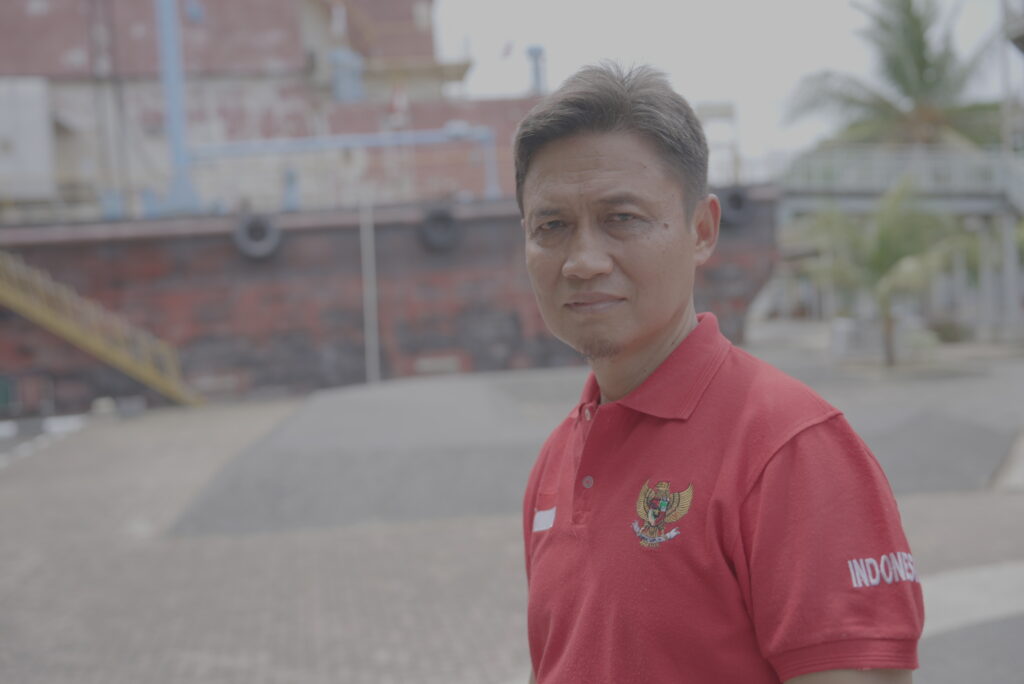
Professor Ede Surya Darmawan in Banda Aceh, 20 years after the tsunami and earthquake struck

Visiting Banda Aceh 20 Years Later After the Tsunami and Earthquake

It was pitch black when I first set foot in Banda Aceh. This was on 2 January 2005, exactly one week after tsunami hit. The difficulty of the journey – a normally 3-hour trip from Jakarta, which ended up taking almost 24 – hinted at the chaos that had engulfed the city and the wider Aceh province. After it was struck by one of the worst natural disasters in history.

I’d seen the news footage of the aftermath of the massive earthquake and tsunami. But nothing could’ve prepared me for what I saw myself in the following days, weeks, and months. 

When the sun rose the next day, I saw dead bodies everywhere. Islamic Relief’s office had been hastily set up in a partially-built house we’d managed to rent a few days earlier. It was just 200 metres from the area where victims’ bodies were being laid out for identification.

We went about our business, trying to support survivors however we could. All while surrounded by the harshest possible reminder of the loss this disaster had left behind.  

I’d responded to disasters before. They are an inevitable part of life in Indonesia. We have earthquakes, volcanic eruptions, floods, landslides and, as we now know, tsunamis. As a young boy I grew up in the shadow of Galunggung Volcano, which had deadly eruptions in the 1800s and 1980s.  

But I’d never seen anything like what happened in Aceh in 2004. No one had. The affected area looked as though it had been hit by a nuclear weapon.  

News of the Disaster Trickles Out of Aceh 

In 2004, Islamic Relief’s work in Indonesia was very small in scale compared to today. We had Ramadan and Qurban food distributions. As well as projects providing bags and books to schoolchildren.

But we didn’t work in Aceh at all. In fact, at that time, Aceh was a conflict zone. Where people from other parts of the country, as well as foreigners, were not allowed to enter. 

Partly because of this, it took a while for information about the disaster to reach us in Jakarta. The earthquake happened at around 8am on December 26, but it was the afternoon before we heard about it. Around 2am the next morning, I got a call from Islamic Relief headquarters, which had more complete information. They said the disaster had been very large and that we’d need to quickly prepare to respond. 

It was very challenging to get information from the ground in those first few days. Although we had no official links with Aceh, we had some local contacts there. But almost all of them had been affected by the disaster.

To find out what was going on, and how we could help, we sent our Programme Officer to Aceh immediately. 

Starting from Scratch 

Islamic Relief’s very early response involved providing food, water and first aid treatment – whatever we could – to try and address the massive needs of the affected people.  

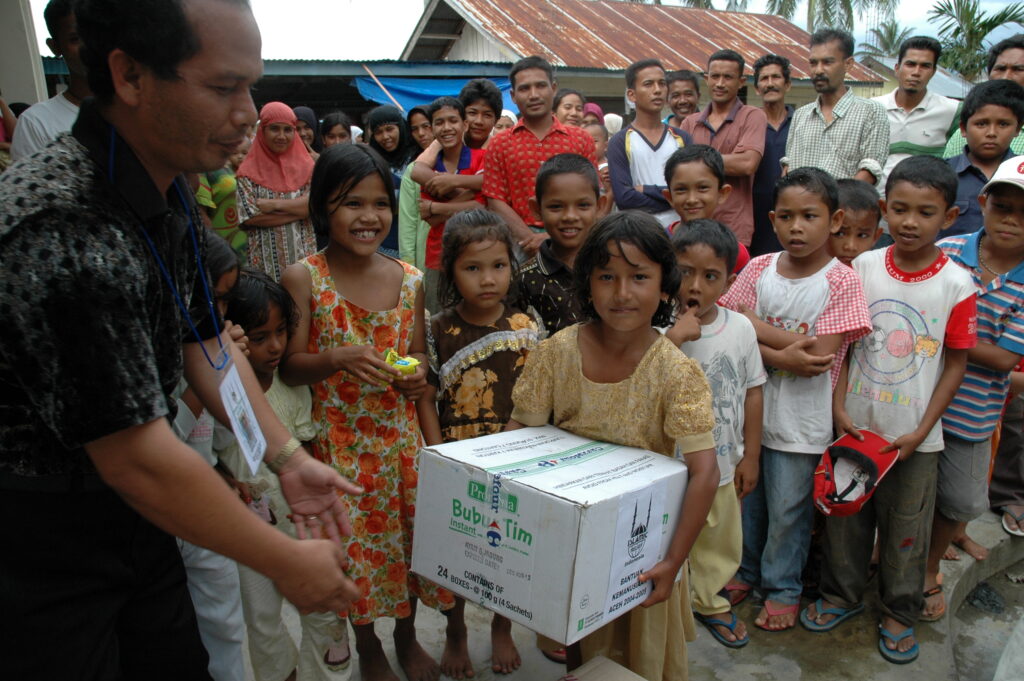
Ede, in Aceh 2005, delivering food to those devastated by the tsunami and earthquake.

When I arrived, a week after the disaster, my first job was to set up a bank account. This ensured that the huge number of donations Islamic Relief was receiving could reach Aceh.

Then I began connecting with government and local authorities, other non-governmental organisations (NGOs) and United Nations bodies to see how we could work together to help those in need. There was so much collaboration between international, national and local groups, it seemed like every hour there was another meeting. 

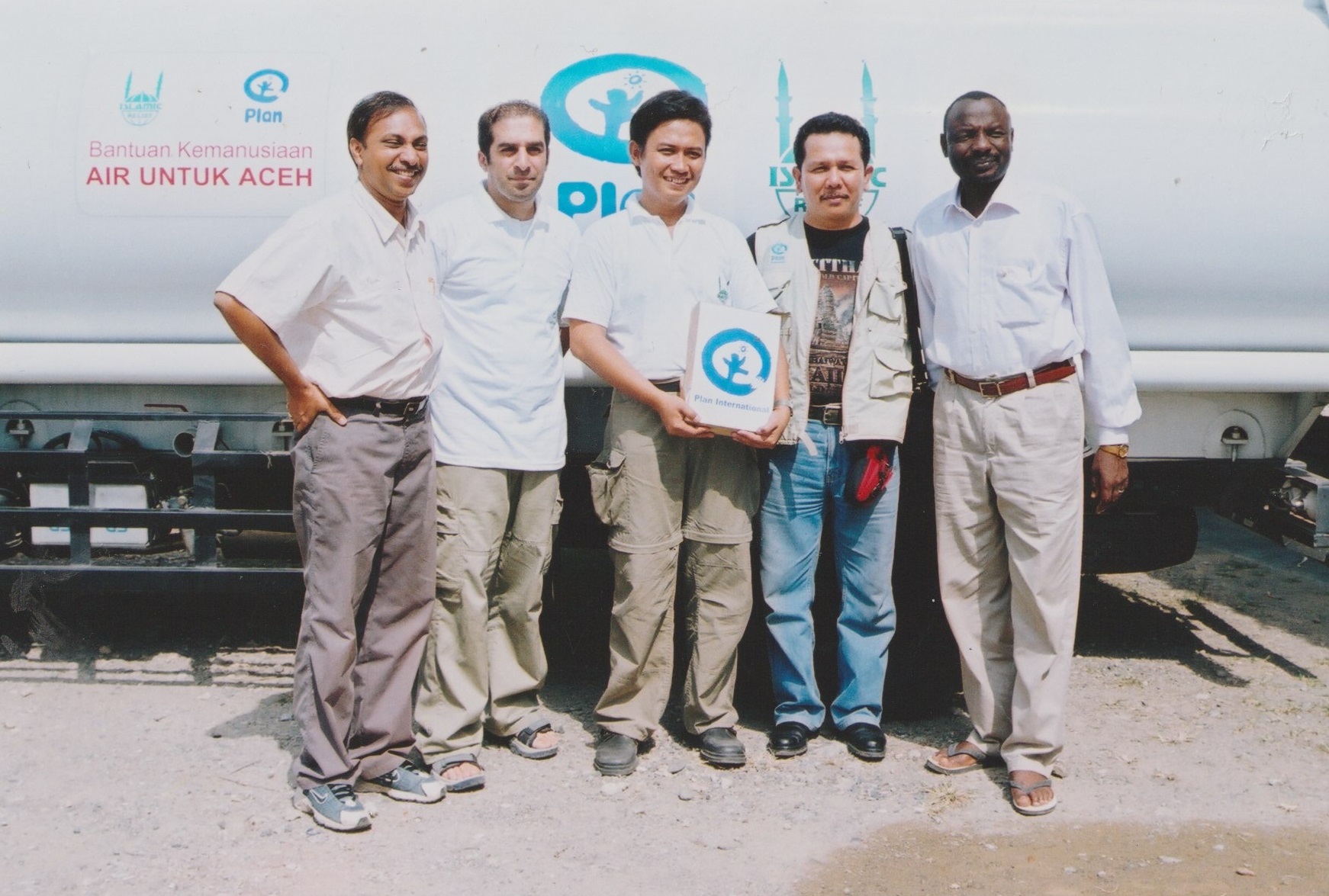
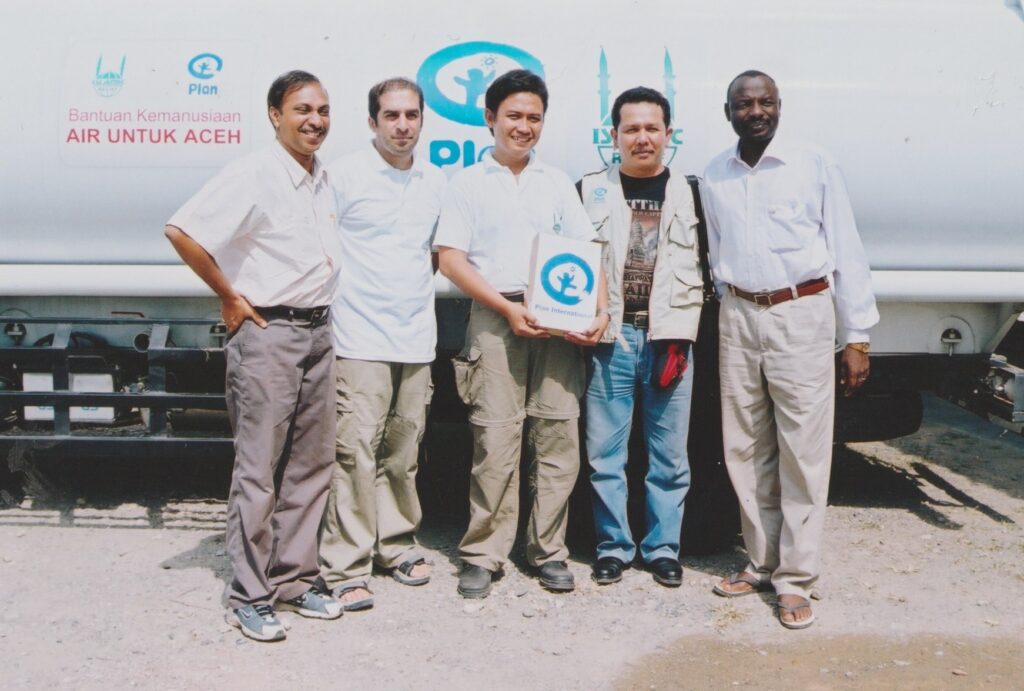
the partners Islamic Relief worked with to deliver aid in Banda Aceh in the wake of the 2004 tsunami and earthquak

With banking resolved, there were still so many obstacles. The city had very nearly been wiped off the map. The electricity and water supplies had been damaged, so many roads and bridges were impassable. We had to buy supplies from the surrounding districts, particularly Medan, the capital of the neighbouring province. But it had been hit by a flood and supplies that should’ve taken 1-2 days to arrive ended up taking a week. 

Recruiting people was another massive challenge. Almost everyone in Aceh was affected, so we had to recruit people from all over Indonesia, ensuring they had the skills we needed and were ready to travel to the disaster zone. The last question of every interview was: “If you accept this job today, tomorrow morning you will have to leave for Aceh. Are you ready or not?” If they said yes, we sent them and checked in 2 weeks later. If they were coping, they could stay. If not, they had to go home. 

Uniting to Recover from the Tsunami and Earthquake

What people needed most in the early days was housing. Finding enough tents for temporary shelters was a big challenge. But, because there was a large military presence in Aceh from the conflict, we had support from the military and access to their supply of tents.  

After those first overwhelming days and weeks, our response moved into addressing other needs in the affected communities.

We began running cash-for-work program, providing payment and meals to affected people who would in turn clear destroyed homes and roads. This was not only to give those who’d lost their livelihoods a way of earning some income, but also a means of beginning to address some of the psychological impacts of the disaster. By keeping people occupied, we hoped to distract them from feelings of hopelessness.  

Slowly, things began to improve, and Aceh today is a completely different place. Before the tsunami, the region was completely alienated because of the conflict and after the disaster, it was completely devastated.  

But so many people from all over the world – including from Islamic Relief – came to Aceh and we realised that we’re all the same and we must rebuild and overcome the impact of the tsunami together. Less than a year later, a peace treaty was signed and Indonesians tried to move forward together as one nation. This was the positive impact of the tsunami. 

Returning to Aceh after the Tsunami and Earthquake

In August this year, I went back to Aceh and took Islamic Relief colleagues to the house that had once been our office.

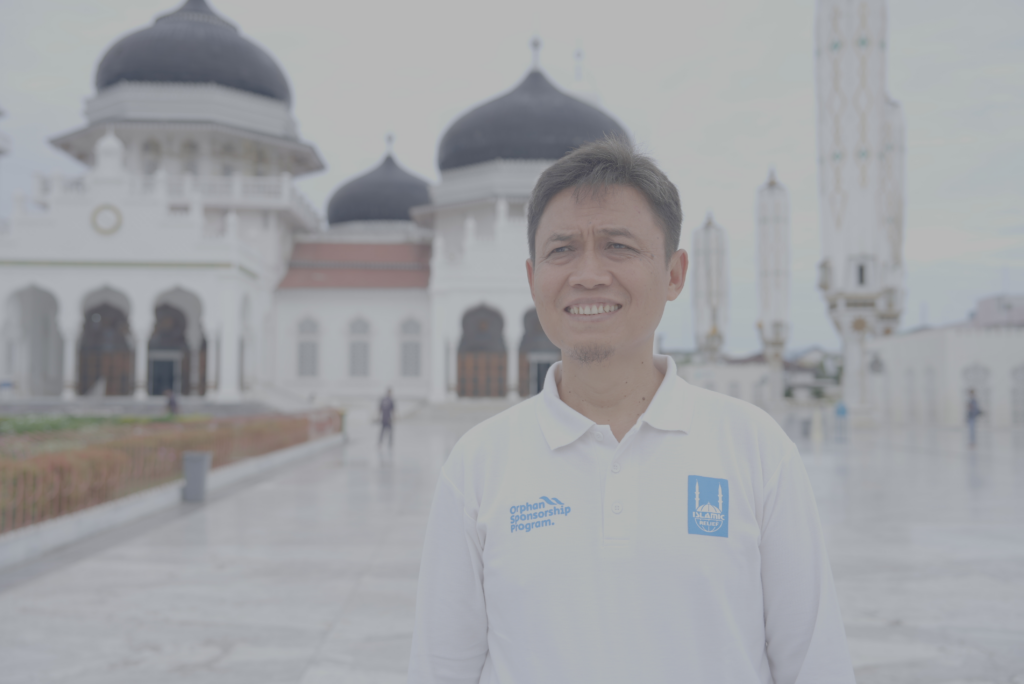
Ede returning to Banda Aceh, reflecting on his experiences there since the 2004 disaster

As we drove around the city, I pointed out where bodies had been. The mass graves that became their final resting place. The spot where the carcass of a dead cow had lain untouched for a month because everyone was so busy tending to survivors.  

It’s odd, the things that have stuck with me after all this time.  

It wasn’t my first time coming back to Aceh since the disaster. I’ve been before to see the programs Islamic Relief still runs in this province. But this time was particularly moving because the focus was on how Islamic Relief responded to the disaster and the legacy of our impact.

I had the chance to hear stories from survivors. The orphaned children who’d grown up to become teachers. The business owners and sources of inspiration in their communities as well as the government. The health officials who also told us their own personal stories while speaking about their areas of expertise.

I even got to hear the impressions of one colleague who was among the first people I recruited and sent to Aceh back in January 2005. He’s never left and is still there today delivering Islamic Relief’s programs. 

A New Horizon 

Many organisations grew up because of the tsunami and Islamic Relief is no different. It changed so much about our understanding of relief work and the possibilities that can come from organisations collaborating and helping one other.

At the time, it felt like a new horizon had opened up before us. We’d seen how humanity could work together to overcome many problems, including the disaster. 

Now, Indonesia has laws and national bodies governing disaster responses, whether it’s a natural disaster or something like the COVID-19 pandemic. We’ve learned how essential preparation and collaboration at the national, provincial, and district levels are. Disasters can happen at any time, and we need to be prepared for them.  

Doing what you can, whether it’s making a donation, or sharing your skills and knowledge to help others, brings us closer together as humans. Not only humanitarians, but everyone, can benefit from working together for the greater good.  

20 years on from the earthquake and tsunami, Islamic Relief is sharing the stories of survivors, staff and our steadfast support of affected communities in the decades that followed the disaster. Please support Islamic Relief to continue supporting communities through disasters.

Be a lifeline. Give relief.

Help us to continue our vital work supporting those in desperate need of aid where disasters strike


STAY INFORMED

  • This field is for validation purposes and should be left unchanged.

Quick Donate