In Islam, the Ka’aba is central to a large part of the faith. But how and why is the Ka’aba important to Islam? As the first House of Worship, it is fundamental to Hajj (pilgrimage). It’s also the qibla (direction) towards which we turn towards in prayer five times a day.
What is the Ka’aba?
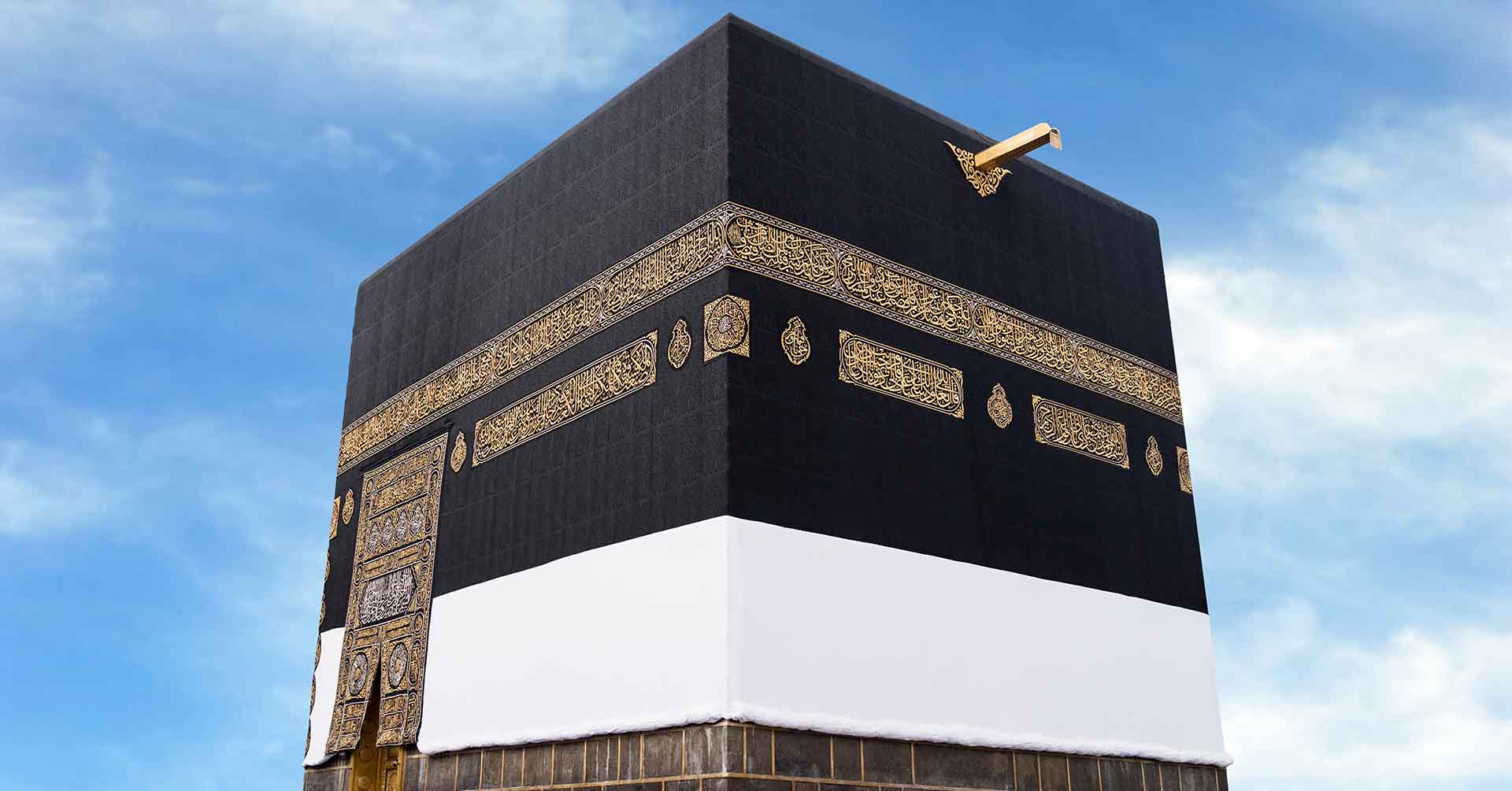
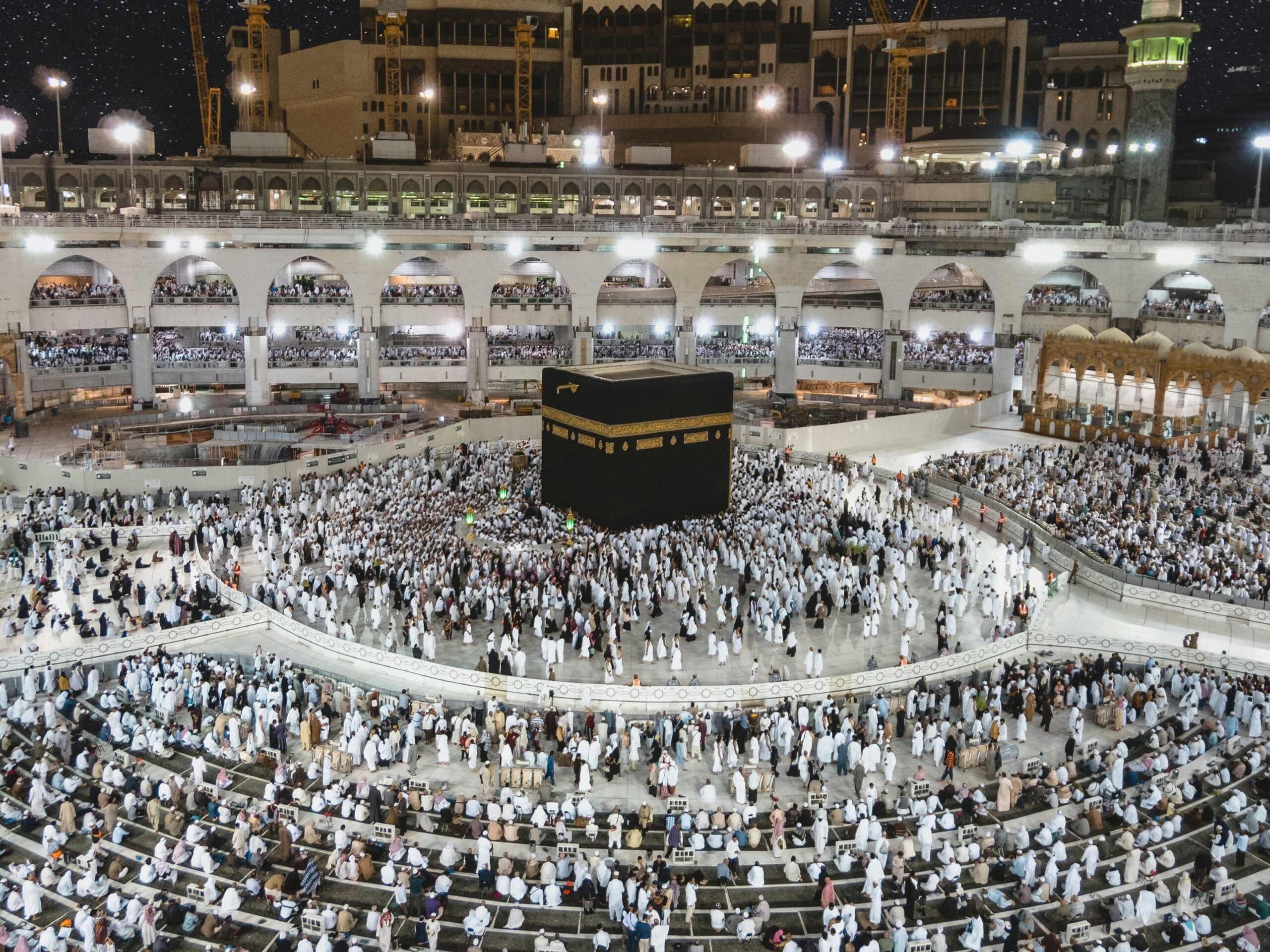
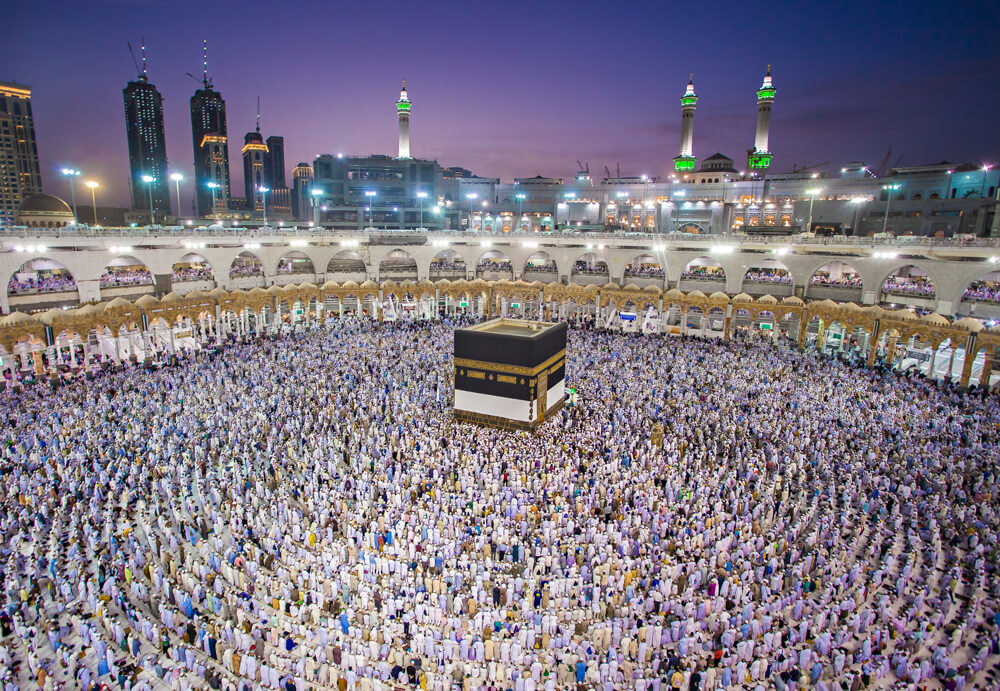
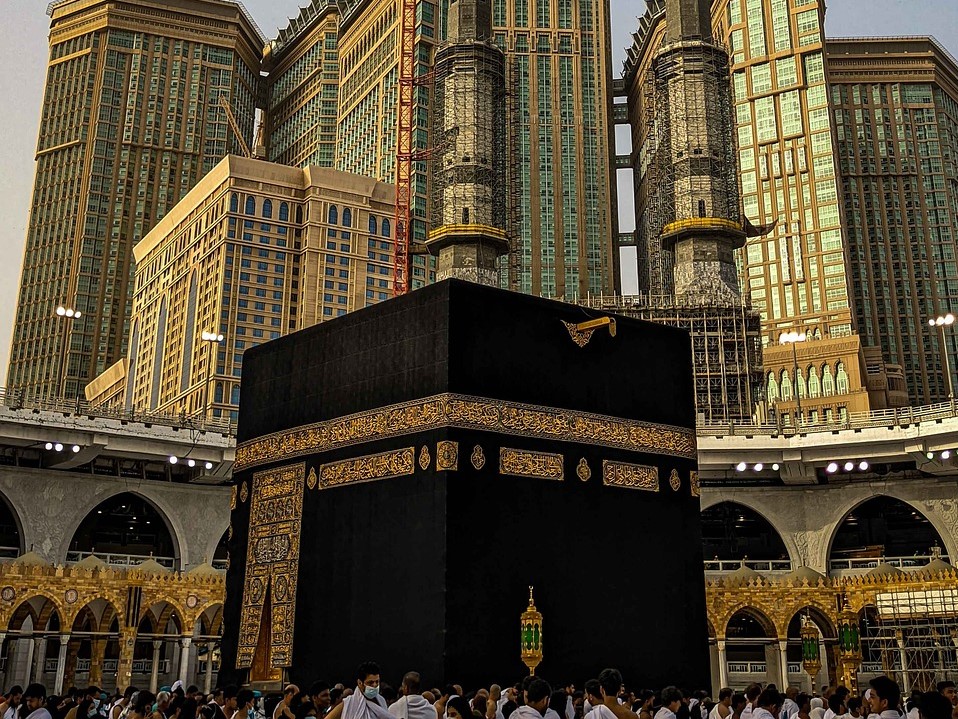
The Ka’aba (“cube”) is the most sacred site in Islam, known as the sacred bayt Allah (House of God). It is located at the heart of the sacred mosque Masjid al-Haram in Makkah (Mecca, Saudi Arabia).
Every day we pray facing the direction of Makkah. And, if we’re fortunate enough to undertake Hajj, we make tawaf around the Ka’aba.
History of the Qibla
In the early days of Islam, Muslims would pray facing Jerusalem. Now, we pray facing Makkah following the Qur’anic revelation to change direction.
And remember Ibrahim and Ismail raised the foundations of the House (With this prayer): “Our Lord! Accept (this service) from us: For Thou art the All-Hearing, the All-knowing.”
Quran | Al-Baqarah | 2:127
Who built the Ka’aba?
The Ka’aba was built by Prophet Ibrahim (AS) and his son Ismail (AS). As stated in the Quran:
And remember Ibrahim and Ismail raised the foundations of the House (With this prayer): “Our Lord! Accept (this service) from us: For Thou art the All-Hearing, the All-knowing.”
Quran | Al-Baqarah | 2:127
When it was first built, it was a simple rectangular structure with no roof.
The Quraysh tribe, who ruled Makkah, then rebuilt the Ka’aba in 608 CE with wood and stone.
Prophet Muhammad (SAW), Ka’aba and Hajj
Upon receiving the first revelation and sharing the message of Allah (SWT), Prophet Muhammad (ﷺ) faced ongoing persecution. Soon, he was forced to flee Makkah (Mecca) for Madina (Medina) in 622 CE.
After many years in Madina, following the call from Allah (SWT) to undertake Hajj,
Call all people to the pilgrimage. They will come to you on foot and on every lean camel from every distant path
Quran | Al-Hajj | 22:27
Prophet Muhammad (ﷺ) and his followers returned to Makkah in 629 CE. There, he back to the Ka’aba and removed the idols, declaring the Oneness of God:
Say, the Truth has come and falsehood gone. Verily falsehood is bound to vanish.
Quran | Al-Isra | 17:81
He, however, kept the Black Stone inside that was given to Prophet Ibrahim (AS) by the Angel Gabriel.
The Last Hajj of the Prophet (SAW)
In 632 CE, Prophet Muhammad (SAW) led his first and final Hajj. Realising this would be his last, he established the final steps of Hajj.

On the 9th of the month of Dhul Hijjah, Prophet Muhammad (SAW) delivered his final sermon on Mount Arafah.
Shortly after, aged 62/63, he then returned to our Creator, Allah (SWT).
During Eid al-Adha when we mark the end of Hajj and make our sacrifice (Qurban) for the sake of Allah (SWT), we replicate the sacrifice of Prophet Ibrahim (AS), ready to sacrifice his son Ismail (AS) for the sake of Allah.
By giving Qurban, we follow in the footsteps of Prophet Ibrahim (AS) and remember his devotion to Allah (SWT). Don’t forget to make your sacrifice and give your Qurban in time for Eid!
Dhul Hijjah marks the twelfth and final month of the Islamic calendar. It holds immense significance for Muslims worldwide, especially in the first ten days, when Hajj and Eid Al-Adha (as well as the sacred act of Qurban) take place.
This year, the first day of Dhul Hijjah is expected to begin on Wednesday, May 28, 2025, depending on the sighting of the moon. But why exactly are the first 10 days of Dhul Hijjah and its events so special?
In this article, we learn about the month’s transformative and spiritual experiences. This includes the profound meaning behind the rituals of Hajj and Eid al-Adha (festival of sacrifice).
The Significance of the First 10 Days of Dhul Hijjah
Similar to the Holy month of Ramadan, the first 10 days of Dhul Hijjah are an extremely blessed time. After Ramadan, we often miss the spiritual high we felt and wish we could’ve done more. But these blessed ten days offer us another chance for us to gain immense rewards. To have our sins forgiven and reach great levels of piety, Insha’Allah.
Benefits of the first 10 days of Dhul Hijjah
In one particular hadith, the Prophet Muhammad (ﷺ) specifically highlights the first 10 days of Dhul Hijjah as better than all the other days of the year. Even better than the days of Ramadan, SubhanAllah!
He (peace and blessings be upon him) said:
“There are no days on which righteous deeds are more beloved to Allah than these ten days”
Sahih Bukhari
In the Qur’an, Allah (SWT) also swears by these first ten days. In Surah Al-Fajr, He states:
“By the dawn; And [by] the ten nights.”
Quran 89:1-2
According to many scholars, these days are the first 10 days of Dhul-Hijjah.
What Happens on the First 10 Days of Dhul Hijjah?
In addition to being the best days to do good deeds, we witness two very special events in Dhul Hijjah: Hajj and Eid al-Adha.
Hajj
Hajj is the fifth and final pillar of Islam. It is a staple of Islamic belief, alongside the Shahada (the belief that there is no god but Allah (SWT) and Muhammad (ﷺ) is His Messenger), Salah (prayer), Zakat (almsgiving) and Sawm (fasting).
Hajj is the pilgrimage Muslims make to Makkah in Saudi Arabia. It takes place from the 8th to the 12th or 13th of Dhul Hijjah each Islamic year. The pilgrimage is obligatory for all able-bodied and financially capable Muslims to perform at least once in their lifetime.
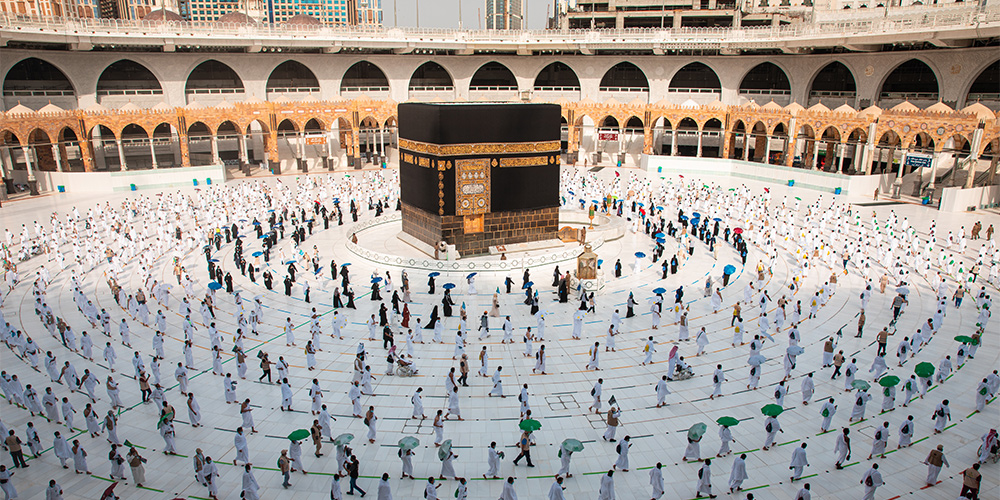
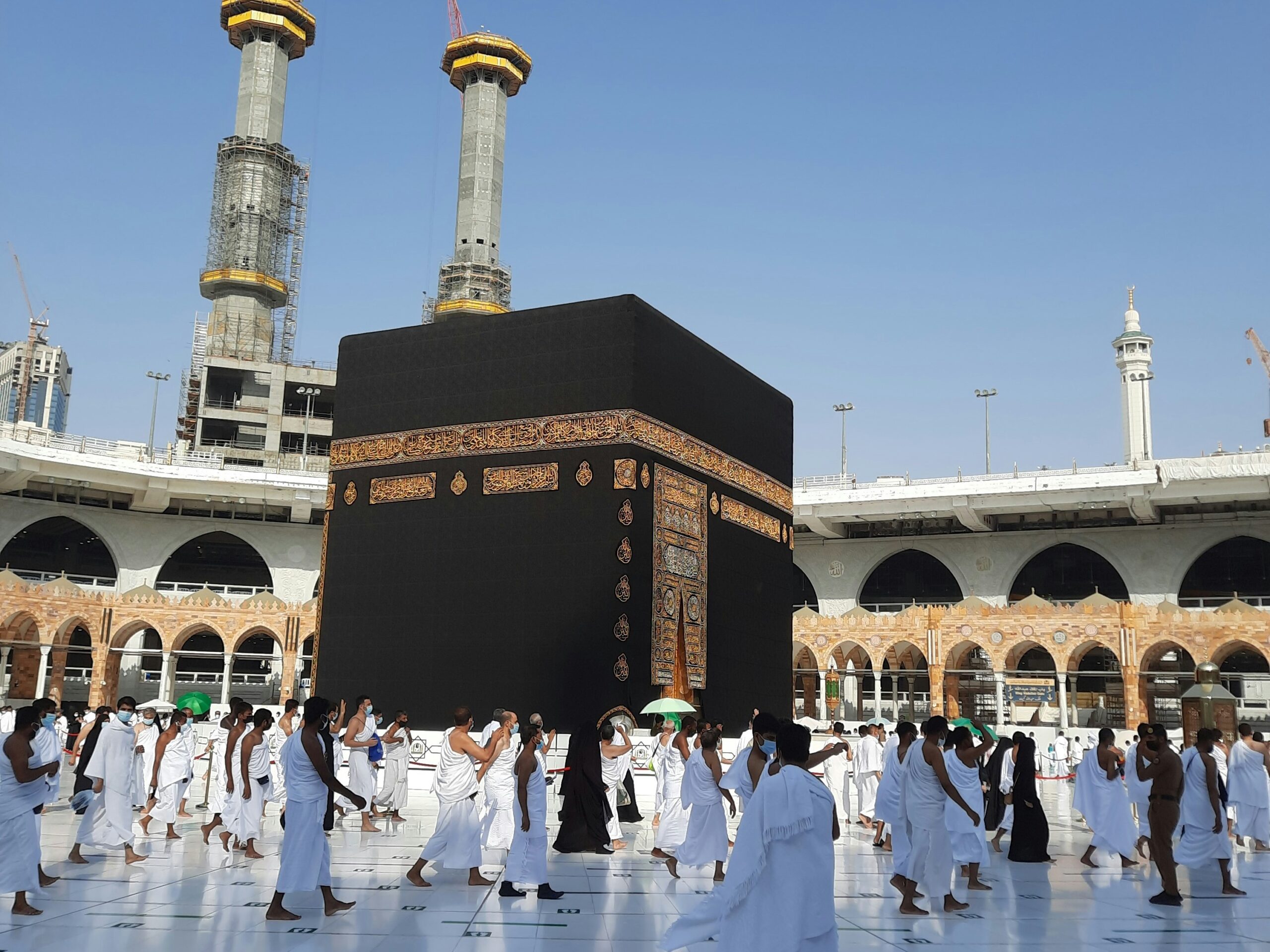
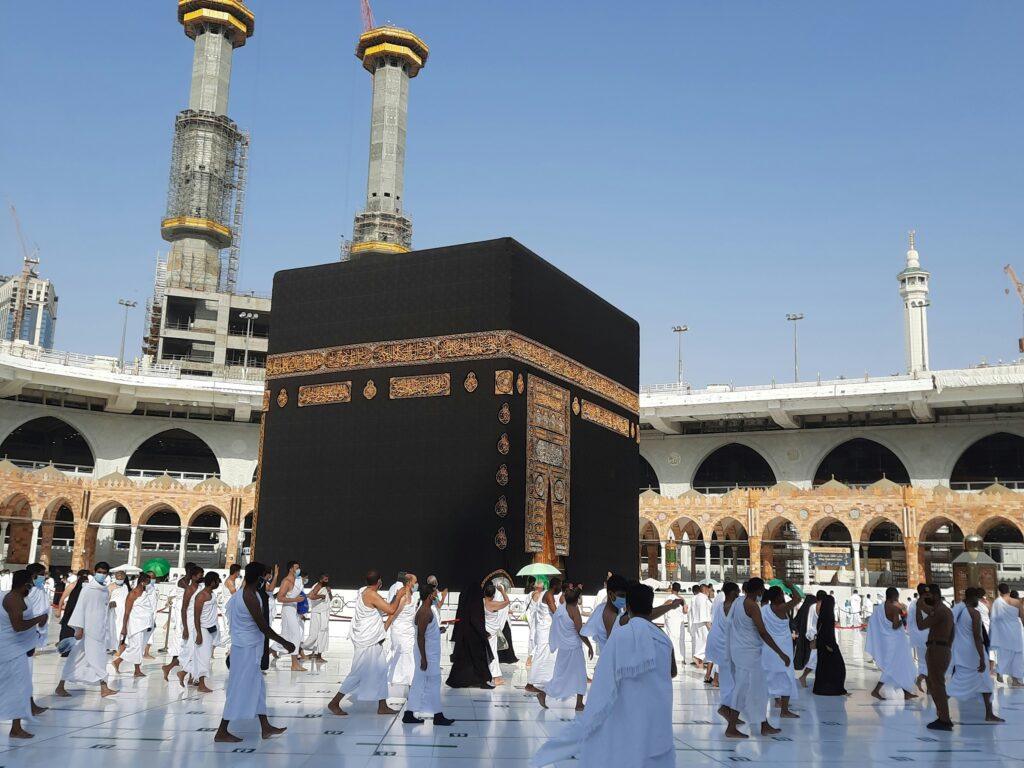
Photo: Muslims performing Tawaf during Hajj in Makkah, in the days of Dhul Hijjah
This year, Hajj is expected to take place between Wednesday, June 4, 2025, and Monday, June 9, 2025.
On the 9th of Dhul Hijjah, the blessed Day of Arafah (also Arafat) occurs. The Day of Arafah 2025 is expected to fall on the evening of Thursday, June 5, 2025.
Considered the most blessed day of the year, Arafah was the day when Allah (SWT) perfected Islam. The day He completed His favours upon His beloved Prophet Muhammad (ﷺ) and approved Islam as a way of life.
This day I have perfected for you your religion and completed My favour upon you and have approved for you Islam as religion.
Quran 5:3
On this day, pilgrims performing Hajj gather on the plain of Arafat, seeking forgiveness, supplicating to Allah and engaging in profound acts of worship.
Eid al-Adha
Eid al Adha (or Eid ul Adha), similar to Eid al Fitr (or Eid ul Fitr), is a joyous day Muslims celebrate with family and community. However, in addition to the rituals of Eid, Muslims, who are able to, also give Qurban on Eid Al-Adha.
Qurban (also known as Qurbani or Udhiyah) is an act of worship that involves the sacrifice of an animal, usually a sheep, goat, cow or camel, for the sake of Allah (SWT). The origins of this act of worship come from the story of Prophet Ibrahim (AS) and his willingness to sacrifice his son, Ismail (AS), as a demonstration of his faith, obedience, and trust in Allah (SWT).
What Else Can We Do on the First 10 Days of Dhul Hijjah?
Even for those of us not performing the Hajj pilgrimage this year, Dhul Hijjah is still a great time of blessing and immense reward.
Wherever we can, we should engage in good deeds such as giving charity, performing acts of kindness to family and community, fasting and remembrance of Allah (SWT)
Fasting
Fasting is especially encouraged during these first 10 days. The Prophet (ﷺ) used to fast on the first nine days of Dhul-Hijjah as one of his regular fasts.
He especially emphasised the importance of fasting on the 9th day, the Day of Arafah.
Fasting the day of `Arafah expiates the sins of two years: the past one and the coming one.
Sahih Muslim
Making Dhikr
Our Prophet (ﷺ) also said:
“There are no days that are greater before Allah or in which good deeds are more beloved to Him, than these ten days, so recite a great deal of tahleel, takbeer and tahmeed during them.”
Ahmad
When are the 10 days of Dhul Hijjah?
This year, the first day of Dhu al-Hijjah 1445 AH will fall on Wednesday, May 28, 2025, depending on the sighting of the moon. In turn, Eid al-Adha is expected to fall on Friday, June 6, 2025.
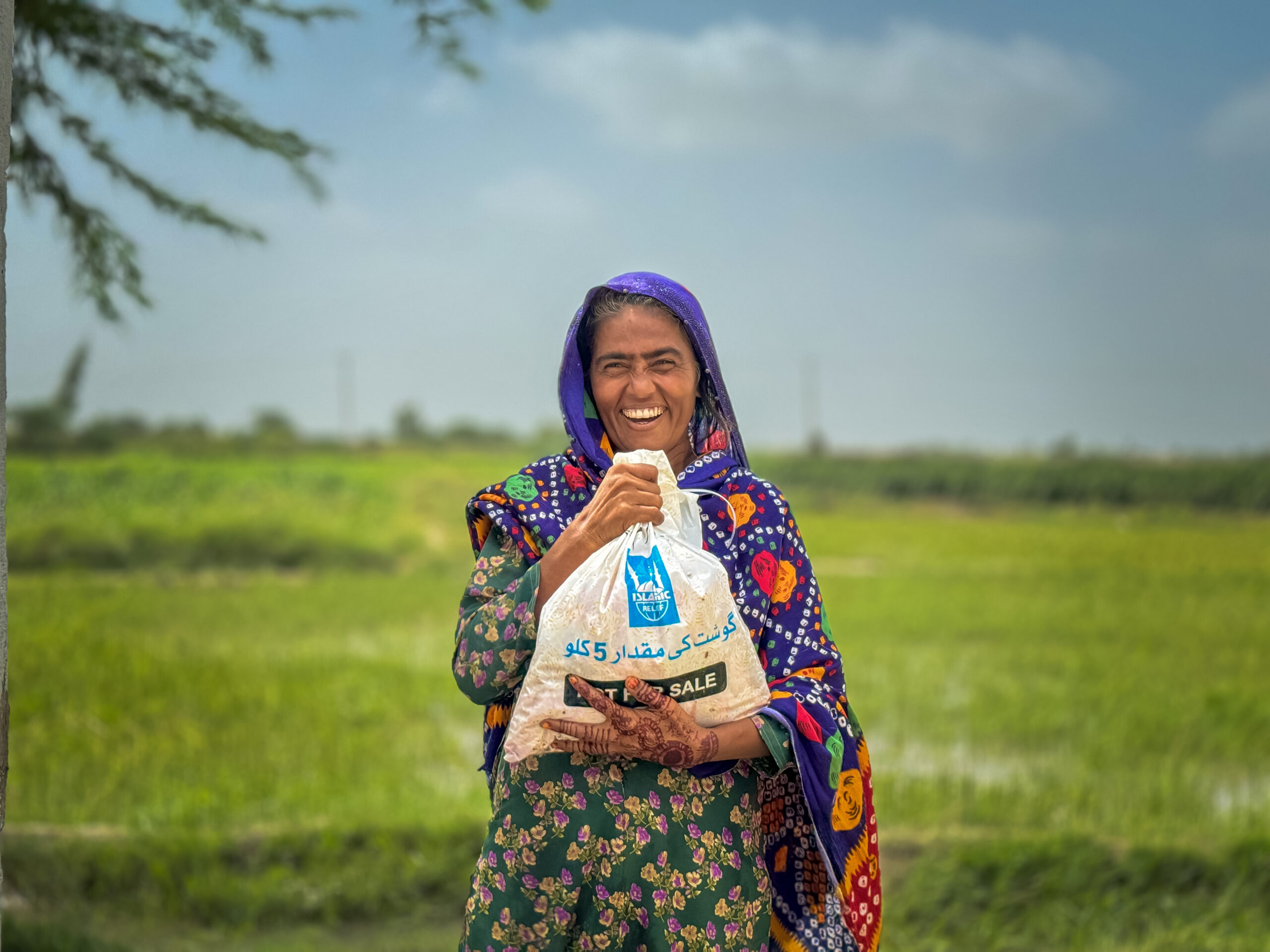
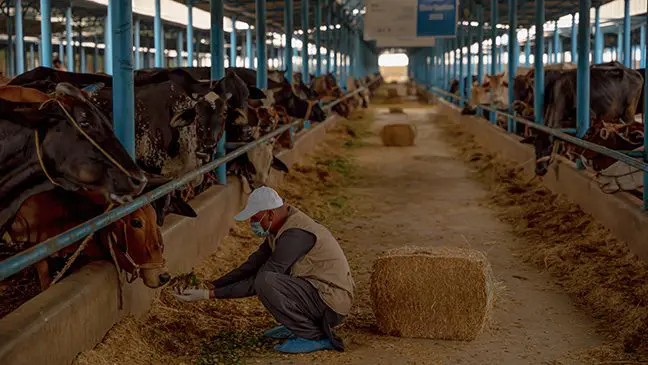
Photo: Your Qurban, helping the world’s most vulnerable thrive and build sustainable livelihoods.
Give Your Qurban On Time
At Islamic Relief, we work all year round to bring families relief and home. To combat food poverty and help communities build healthy and stable livelihoods.
Every Eid al-Adha, Islamic Relief is at the forefront of distributing Qurban. This year, we strive to deliver nutritious, high-quality meat to the world’s most vulnerable and disadvantaged communities. For many, this is the only time they will be able to eat meat in the entire year.
In over 30 countries worldwide, your Qurban donation will not only bring happiness to the less fortunate, but also empower vulnerable communities. To ensure they can enjoy Eid without worrying about how and what they will feed their families.
Donate during this blessed time and increase your rewards. Help enable families and entire communities to have a happy Eid al-Adha and beyond.
This Dhul Hijjah, Share Your Blessings
Help the world’s most vulnerable families enjoy their Eid when you give Qurban with Islamic Relief.
Each year, millions of Muslims from around the world travel to Makkah to perform the sacred pilgrimage of Hajj. As one of the five pillars of Islam, it is an important staple of the religion, alongside Shahada, Salah, Zakat and Sawm. Thus, every adult Muslim, if able, must perform it at least once in their lifetime.
The pilgrimage occurs during the same time each lunar year, in Dhul Hijjah, the twelfth month in the Islamic (Hijri) Calendar. It begins on the 8th of Dhul Hijjah and lasts approximately five to six days, depending on the sighting of the moon. The blessed days of Arafah and Eid al-Adha also occur during this period.
The year, the Hajj period is expected to fall between Wednesday, June 4, 2025, and Monday, June 9, 2025. Learn more about when Hajj is in 2025 here.
Why Do Muslims Go On Hajj?
Hajj is the fifth and final pillar of Islam. Being a pillar of the religion, it is a spiritual duty on every adult Muslim to perform Hajj. However, unlike the pillars of prayer (Salah), Zakat and fasting (Sawm), Muslims only have to perform the pilgrimage once in their lifetime, so long as they are physically, emotionally, and financially able.
The Importance of Hajj in Islam
In the Holy Qur’an, Allah (SWT) mentions the pilgrimage in Surah Al-Baqarah, in verse 197, where He states that its season falls within the “well-known months” of the Islamic Calendar. This includes Dhul Hijjah, when the main Hajj period takes place.
Allah (SWT) also commands Muslims to fulfil the sacred pilgrimage, as mentioned in Surah Ali Imran:
And [due] to Allah from the people is a pilgrimage to the House – for whoever is able to find thereto a way. But whoever disbelieves – then indeed, Allah is free from need of the worlds.”
Quran 3:97
The Prophet Muhammad (ﷺ) also stressed the many rewards of Hajj. He stated:
“Whoever performs Hajj for the sake of Allah and does not utter any obscene speech or do any evil deed, will go back (free of sin) as his mother bore him.”
Bukhari and Muslim
The Hajj pilgrimage is a test of patience and temperament, and can be spiritually, emotionally, and physically challenging. However, it is also a momentous occasion that delivers an experience like no other. An opportunity to draw closer to Allah (SWT) more than ever before.
That is why many Muslims around the world strive their whole lives for the opportunity to perform Hajj – sometimes even more than once!
What Happens During Hajj?
Each year, millions of Muslims travel by land, sea and air to Makkah, Saudi Arabia and perform Hajj. Approximately 2-3 million people attend Hajj each year, with each of them having to complete a series of rites and rituals.
Here are the 18 steps of Hajj at a glance:
Preparation and Intention
Enter state of Ihram
Tawaf x7
Safa and Marwa
Clip/Shave Hair (Umrah ends)
Resting and Praying
Enter state of Ihram
Arrive at Mina
Day of ‘Arafah
Muzdalifah (under the night sky)
Rami (stoning of the devil)
Qurbani
Shave Head
Tawaf al-Ifadha
Rami (stoning of the devil)
Spend night at Mina
Rami (stoning of the devil)
Farewell Tawaf al-Wida
Each action of Hajj has their spiritual, emotional, and physical challenges. During the five or six days of, pilgrims can expect to walk between 5km-15km per day, as there is some travel between locations. But much of the pilgrimage takes place at the Masjid al-Haram, where the Kaaba is located.
What is the Ka’aba?
The Ka’aba (meaning “cube” in Arabic) is the most sacred site in Islam. It is the sacred bayt Allah (House of God) and was first built by Prophet Ibrahim (AS) and his son Ismail (AS).
“And remember Ibrahim and Ismail raised the foundations of the House (With this prayer): “Our Lord! Accept (this service) from us: For Thou art the All-Hearing, the All-knowing.”
Quran 2:127
The Ka’aba is a fundamental part of the Tawaf ritual in Hajj. It also the qibla (direction) towards which Muslims turn towards in prayer five times a day. Previously, Muslims would pray facing Al-Aqsa in Jerusalem.
How Do You Prepare for Hajj?
Hajj is an act of worship that is also very physically demanding. For this reason, many Muslims try to prepare for it weeks in advance, so that the travel required between locations across the five-to-six-day pilgrimage does not come as a shock.
Being physically prepared helps pilgrims complete the emotionally and spiritually demanding aspects of Hajj. This allows them to focus on performing the actions of the pilgrimage to the best of their ability, doing the most for Allah (SWT)’s sake.
Other Times Muslims travel to Makkah
Hajj is not the only time Muslims can travel to Makkah. Umrah is a lesser pilgrimage that can be performed at any time of the year. While it is not obligatory, it also offers many rewards for Muslims who choose to take it. For Allah’s Messager (ﷺ) said,
“(The performance of) `Umra is an expiation for the sins committed (between it and the previous one). And the reward of Hajj Mabrur (the one accepted by Allah) is nothing except Paradise.”
Sahih al-Bukhari
There are also far fewer steps in Umrah when compared to Hajj. Hajj lasts approximately five to six days (depending on the sighting of the crescent moon), whereas Umrah can be performed within a much shorter period. However, one can perform either pilgrimage as many times as one likes in their lifetime, if one has the means to do so.
Conclusion
Hajj as we know it today was first performed in 628 CE, by the Prophet Muhammad (ﷺ) and the first Muslims. He (ﷺ) was instructed to re-establish the traditions started by the Prophet Ibrahim (AS) as instructed by Allah (SWT), millennia before.
Last year, 1.84 million Muslims from around the world travelled to Makkah for Hajj 2024. They, like many Muslims who performed the pilgrimage before them, have now become Hajji (Hajjah for women).
Best of luck to those who are going for the Hajj this year. May Allah (SWT) grant you safe travels! And may those who have not been one day embark on this momentous journey, insha’Allah!
This Dhul Hijjah, Share Your Blessings
Help the world’s most vulnerable families enjoy their Eid when you give Qurban with Islamic Relief.
Hajj is the sacred pilgrimage Muslims perform at the holy mosque of Masjid al-Haram in Makkah, Saudi Arabia. It takes place during Dhul Hijjah, which is the twelfth and final month in the Islamic (Hijri) Calendar.
The beginning of Hajj starts on the starts the 8th of Dhul Hijjah. It then ends on the 12th or 13th of Dhul Hijjah, depending on the sighting of the moon. In 2025, this period is expected to fall between Wednesday, June 4, 2025, and Monday, June 9, 2025.
What is Hajj?
Hajj is one of the five pillars of Islam, alongside Shahada (profession of faith), Salah (prayer), Zakat (almsgiving) and Sawm (fasting).
As such, undertaking Hajj holds great importance in Islam. It is a spiritual duty. Every Muslim is required to perform it at least once in their lifetime, so long as they have the means. This includes being not only financially able, but also physically and emotionally.
The Significance of Hajj
In the Holy Qur’an, Allah (SWT) commands Muslims to take this sacred journey:
You will enter the Sacred Masjid, God willing, perfectly secure, and you will cut your hair or shorten it (as you fulfil the pilgrimage rituals) there. You will not have any fear. Since He knew what you did not know, He has coupled this with an immediate victory.
Qur’an 48:27
Hajj also occurs in Dhul Hijjah during its first ten days, one of the most sacred periods of the entire Islamic calendar.
As such, performing the pilgrimage offers Muslims the opportunity to refresh their spiritual selves. To cleanse themselves of their sins and draw closer to Allah (SWT).
How Long Does Hajj Last?
The pilgrimage is performed over five to six days, from the 8th to the 12th or 13th of Dhul Hijjah. The Day of Arafah (9th Dhul Hijjah) and Eid Al-Adha (10th Dhul Hijjah) also fall between these days.
The pilgrimage includes a series of rites and rituals, some of which must be performed in order. It can be physically demanding, as pilgrims are required to travel between locations throughout. On average, one can expect to walk between 5km to 15km per day.
Performing Hajj is a test of patience and temperament. It is a spiritual, emotional, and physical challenge and can take some preparation. That is why, for many, it is often a once-in-a-lifetime event.
When Does Hajj Occur?
Hajj takes place between the 8th and the 12th or 13th of Dhul Hijjah each Islamic year, depending on the sighting of the moon.
Dates in the Islamic calendar appear to shift forward approximately 11-12 days as it corresponds to the Gregorian calendar, as the Islamic Calendar operates on the lunar cycle.
This year, the Hajj period is expected to fall between Wednesday, June 4, 2025, and Monday, June 9, 2025.
While Muslims are only required to perform Hajj at least once in their lifetimes, it can be performed multiple times, so long as they fall within the set dates. You can also perform Umrah, a voluntary pilgrimage to Makkah taken at any time of the year.
Where Does Hajj Take Place?
Hajj is performed in Makkah (also referred to as Mecca) in Saudi Arabia. The pilgrimage consists of a series of rites and rituals across five to six days and is performed across several locations within the vicinity of Makkah.
These locations include:
The city of Makkah
The tent settlement of Mina
Mount ‘Arafah
Muzdalifah
Who Is Excluded from Hajj?
It is required of every Muslim to perform Hajj at least once in their lifetime. However, the Hajj is not intended as a burden upon Muslims. Muslims are only required to perform Hajj so long as it is within their capacity.
Those who are exempt from Hajj are the following:
Children. While they may go to Hajj, only Muslim adults (male or female) are required to perform Hajj.
Very weak, sick, elderly, or otherwise physically incapable Muslims.
Muslims who are financially unable to perform Hajj. However, if one is in debt, they may still perform Hajj if the person they owe money to permits it, they have time to pay off the debt and Hajj does not affect their ability to pay it.
Brief History of Hajj
In 628 CE, the Prophet Muhammad (ﷺ) and the early Muslims embarked on the first Islamic Pilgrimage (Hajj), re-establishing the traditions started by the Prophet Ibrahim (AS), who first began the tradition of Hajj millennia before.
The Story of Hajar (AS) and Ismail (AS)
The story of Hajj begins with Prophet Ibrahim (AS) receiving a commandment from Allah (SWT). Allah (SWT) orders Prophet Ibrahim (AS) to travel to the barren desert of Makkah and leave his wife Hajar and infant son Ismail (AS). Despite the trials ahead, the family trusted in the Divine Wisdom of Allah (SWT) and set out to follow His commandment.
While in the desert, Hajar (AS) and Ismail (AS) quickly ran out of resources. In a desperate effort to find water, Hajar (AS) ran between the two neighbouring hills of Safa and Marwa in search of someone who could help or nearby water. She did this seven times, only to return to a crying Ismail (AS) empty-handed.
As the infant Ismail (AS) cried, he struck the ground with his leg and a stream of water burst forth at the commandment of Allah (SWT). This stream of water relieved the mother and son of their thirst and became a resource with which they traded for provisions of all kinds with travelling merchants. This stream of water is known today as the Well of Zam Zam.
Years later, Allah (SWT) commanded Ibrahim (AS) to return to his family, where he found the miracle of his family alive and indeed thriving. A barren desert that had started with only Hajar and Ismail (AS) was now transforming into a thriving settlement that would become known as Makkah.
Allah (SWT) then instructed Ibrahim (AS) to mark the space for a stone structure. This would be known as the Kaaba, which Ibrahim (AS) built with his son Ismail (AS).
The Significance of the Kaaba and Masjid al-Haram
The space surrounding the Kaaba was created for worshippers of the one God to gather. In fact, the Kaaba simply marks the spot where Muslims unite. It is not something that is worshipped, as idolatry is prohibited in Islam.
Over time, the Kaaba would be taken over by pagan Arabs, who filled it with idols. However, thousands of years later, when the Prophet Muhammad (ﷺ) was given revelation and the final message of Tawheed (monotheism), he was instructed to reinstate Ibrahim’s (AS) sacred tradition – the sacred pilgrimage we know as Hajj today.
This Dhul Hijjah, Share Your Blessings
Help the world’s most vulnerable families enjoy their Eid when you give Qurban with Islamic Relief.
The pilgrimage is performed over five to six days, from the 8th to the 12th or 13th of Dhul Hijjah. The Day of Arafah (9th Dhul Hijjah) and Eid Al-Adha (10th Dhul Hijjah) also fall between these days.
Those excused from Hajj are children (however, they can accompany their parents) the very weak, sick, elderly, or otherwise physically incapable and those who would be financially burdened if they make the pilgrimage.
Qurban (or Udhiyah) is an act of worship most beloved to Allah (SWT) in the days of Sacrifice. These are the days of Eid Al-Adha, which include days of Tashreeq (11th, 12th and 13th of Dhul Hijjah). Therefore, it is important to provide the best possible offering for sacrifice during this sacred period.
Islamic Relief Worldwide’s Quality Assured Qurban program upholds the Core Humanitarian Standard and Shariah compliance throughout its entire process. Used by all members of the Islamic Relief network, including Islamic Relief Australia, it ensures rightsholders receive quality, halal (permissible) and Tayyib (healthy, pure) Qurban meat.
With this program, Islamic Relief meets the needs of rightsholders. It also upholds the rules of Qurban, by ensuring Shariah compliance, regulatory standards and animal welfare standards.
Here are 6 reasons why giving Qurban with us means giving the best possible offering this Eid Al-Adha.
1. Specialised local team
One of our strengths is being close to our rightsholders. In every country where Islamic Relief distributes aid, we have field offices that allow us to be present on the ground. So we can act swiftly during times of crisis. We have dedicated staff employed in these countries who understand the local community. Often, especially during disasters, they also face the same struggles they do. This enables our teams to provide our rightsholders with the best possible support. And deliver this support with cultural sensitivity and care.
2. Meeting the needs of rightsholders.
For all our projects, our field teams conduct a comprehensive needs assessment, collaborating with rightsholders, community leaders, and local authorities. This assessment helps identify and prioritise the most vulnerable individuals or groups. We also coordinate with other organisations involved in Qurban distribution to avoid duplication. It also ensures that our interventions reach underserved areas effectively.
The Qurban meat is transported in refrigerated trucks with a maintained cold chain until it reaches our rightholders.
3. Upholding the rules of Qurban
Prior to slaughter, our livestock undergo rigorous inspections to ensure compliance with both veterinary and Shariah standards. These inspections guarantee that the animals meet the requirements for Qurbani according to Shariah principles. In turn, the inspection also ensures the resulting meat is of excellent quality and safe for human consumption.
Our approach for the Qurbani project is adaptable and tailored to the specific needs of each location. We prioritise collaboration with regulated slaughterhouses that uphold strict machinery and hygiene standards. Thus, ensuring the freshness and safety of the meat.
In the absence of regulated slaughterhouses, we adopt a community-led approach where trained volunteers and butchers actively engage the entire community under the close supervision of Islamic Relief staff.
To maximise the impact and serve a greater number of households, our preference is to select larger animals for Qurbani, taking into consideration their availability in each country. This approach leads to a higher meat yield, allowing more households to receive Qurbani meat packs and benefit from our distribution efforts.
4. Upholding Shariah compliance, regulatory standards and animal welfare with care and respect.
We prioritise adhering to the Core Humanitarian Standard and Shariah compliance throughout the entire Qurbani process. They conduct thorough inspections of the livestock and oversee the slaughter process. Our focus is to ensure the use of high-quality livestock suitable for this religious act, with supervision from veterinary doctors, local Imams, Ministry of Religious Affairs, Ulama, and other religious authorities.
We maintain the well-being of the livestock and strictly follow best practices and compliance guidelines. Furthermore, we store the meat in refrigerators or transport it in refrigerated vehicles, adhering to local hygiene and food safety regulations. This commitment guarantees that the Qurbani process is conducted with care and respect, upholding religious and regulatory standards.
5. Ensuring minimal waste, and safe delivery of Qurbani to rights-holders in a timely manner.
Our dedicated staff members complete Islamic Relief Qurbani checklist declarations to ensure adherence to all Qurbani requirements. Waste disposal is carried out responsibly, following local regulations. In countries where all parts of the animal are consumed, such as offal and skin, waste is minimised. In other countries where only specific organs and meat are consumed, waste materials are appropriately disposed of either at the slaughterhouse or buried in designated community slaughter sites.
To maintain efficiency and meet deadlines, we closely monitor the number of Qurbanis and the capacity of each field office. We establish contractual agreements with suppliers to accommodate any unexpected increase in Qurbani orders. With over 38 years of experience in conducting Qurbani, Islamic Relief Worldwide has cultivated strong relationships with local communities and suppliers, enabling us to fulfil Qurbanis promptly and efficiently.
The Qurbani meat is transported in refrigerated trucks with a maintained cold chain until it reaches our rightsholders.
6. Providing a high-quality service to our rightsholders.
Islamic Relief’s Qurbani prices may be slightly higher than those of other organisations, but this is because we prioritise providing a high-quality service to our right holders. We go the extra mile by purchasing healthy animals that yield more meat for our right holders.
For instance, in countries like Iraq, the cows we purchase have an average weight of 480kg, surpassing the weight of cows selected by our competitors. We strongly believe in investing in various components of the Qurbani project to ensure its effectiveness. This includes conducting needs assessments, collaborating with local authorities, sourcing higher-spec livestock, and implementing rigorous monitoring, evaluation, accountability, and learning (MEAL) processes. These additional efforts are reflected in our prices as they contribute to reaching the most vulnerable rightholders in the most effective way possible.
Our commitment is to serve right holders with dignity and respect, while also considering the well-being of the environment. When it comes to slaughter practices, we ensure that they are conducted in appropriate sites with proper drainage and waste disposal systems, avoiding the issue of leaving waste unattended.
This Dhul Hijjah, Share Your Blessings
Help the world’s most vulnerable families enjoy their Eid when you give Qurban with Islamic Relief.
Eid al-Adha is one of the two blessed celebrations Muslims obverse, the other being Eid al-Fitr. There are many observances unique to Eid Al-Adha (and Dhul Hijjah in general), including Qurban.
This year, Eid Al Adha 2025 is expected to fall on Friday, June 6, 2025, depending on the sighting of the moon.
What is Eid Al-Adha?
Eid al-Adha (meaning “festival of sacrifice”) is an Islamic celebration occurring in Dhul Hijjah, the twelfth and final month of the Islamic (Hijri) Calendar. Depending on the country and lunar cycle for the year, the celebration can last two to four days.
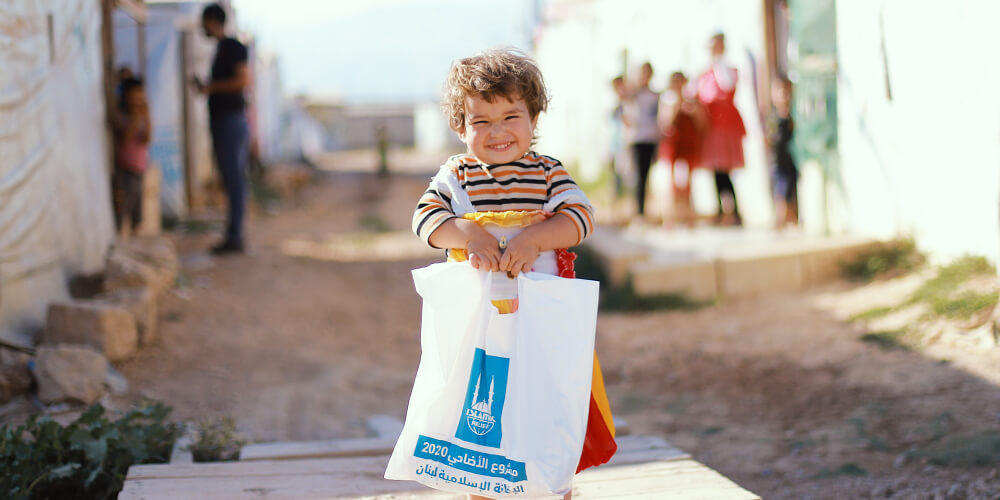
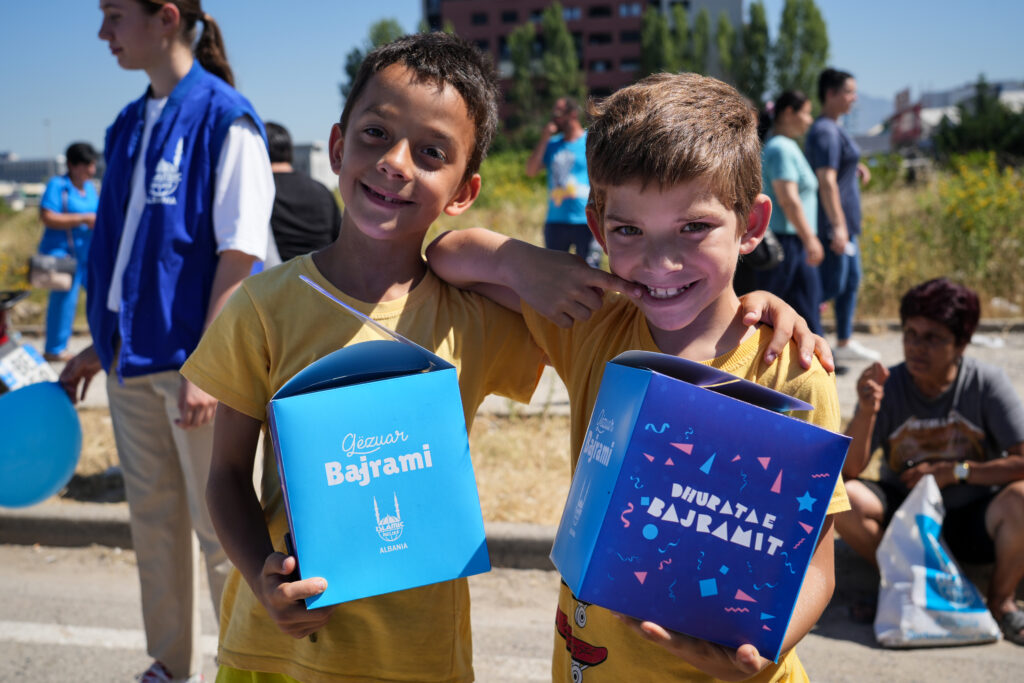
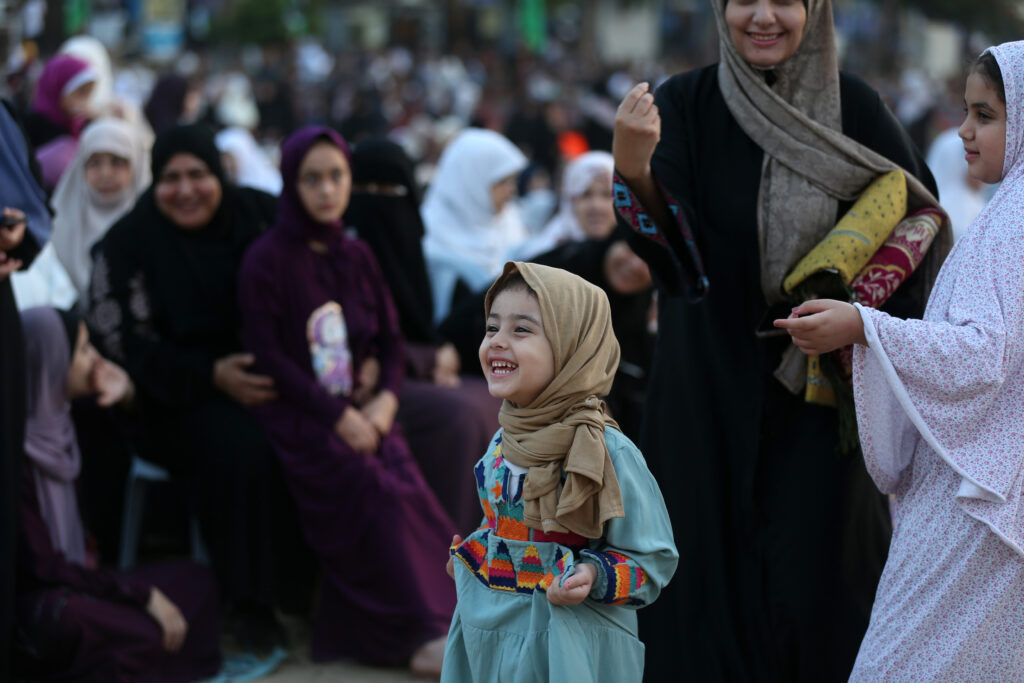
Photo: Children with Eid gifts
The Eid of Sacrifice commemorates the ultimate act of sacrifice performed by our beloved Prophet Ibrahim (AS). The submission he made in his willingness to give up what he loved most, his son, Ismail (AS), for the sake of Allah (SWT).
As such, Muslims, in turn, also offer a sacrifice, known as Qurban, on this day of celebration.
What is Qurban?
Qurban (also known as Qurbani or Udhiyah) means sacrifice. It is an act of worship unique to Eid al-Adha, commemorating the sacrifice Prophet Ibrahim (AS) made to Allah (SWT).
Following the Eid prayer on the first day of celebration, Muslims around the world slaughter an animal – typically a sheep, goat, camel or cow. The sacrificed animal is then divided into three equal portions. One-third shared goes to the needy, one-third goes to relatives and neighbours, and the remainder Muslims keep for their own families.
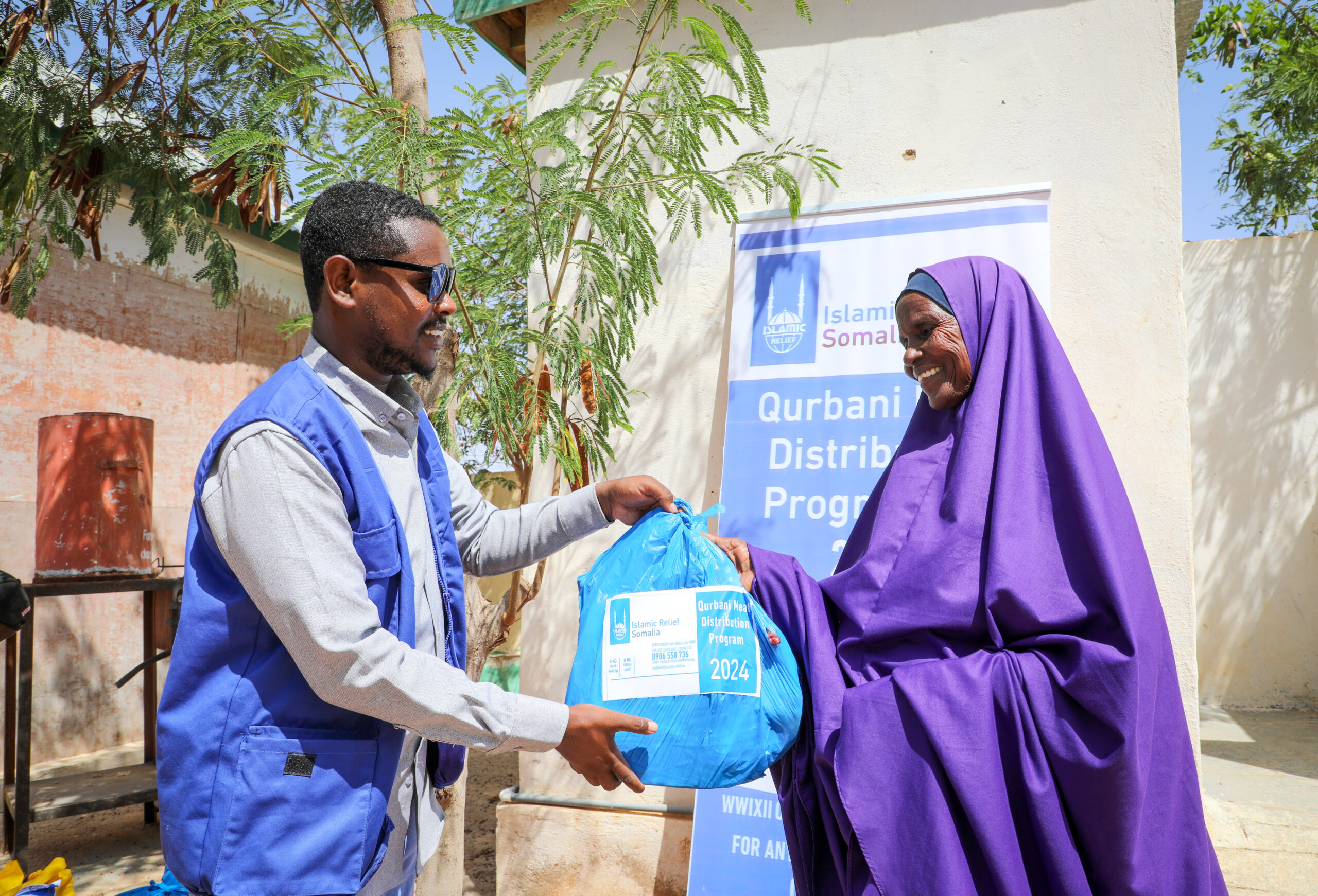
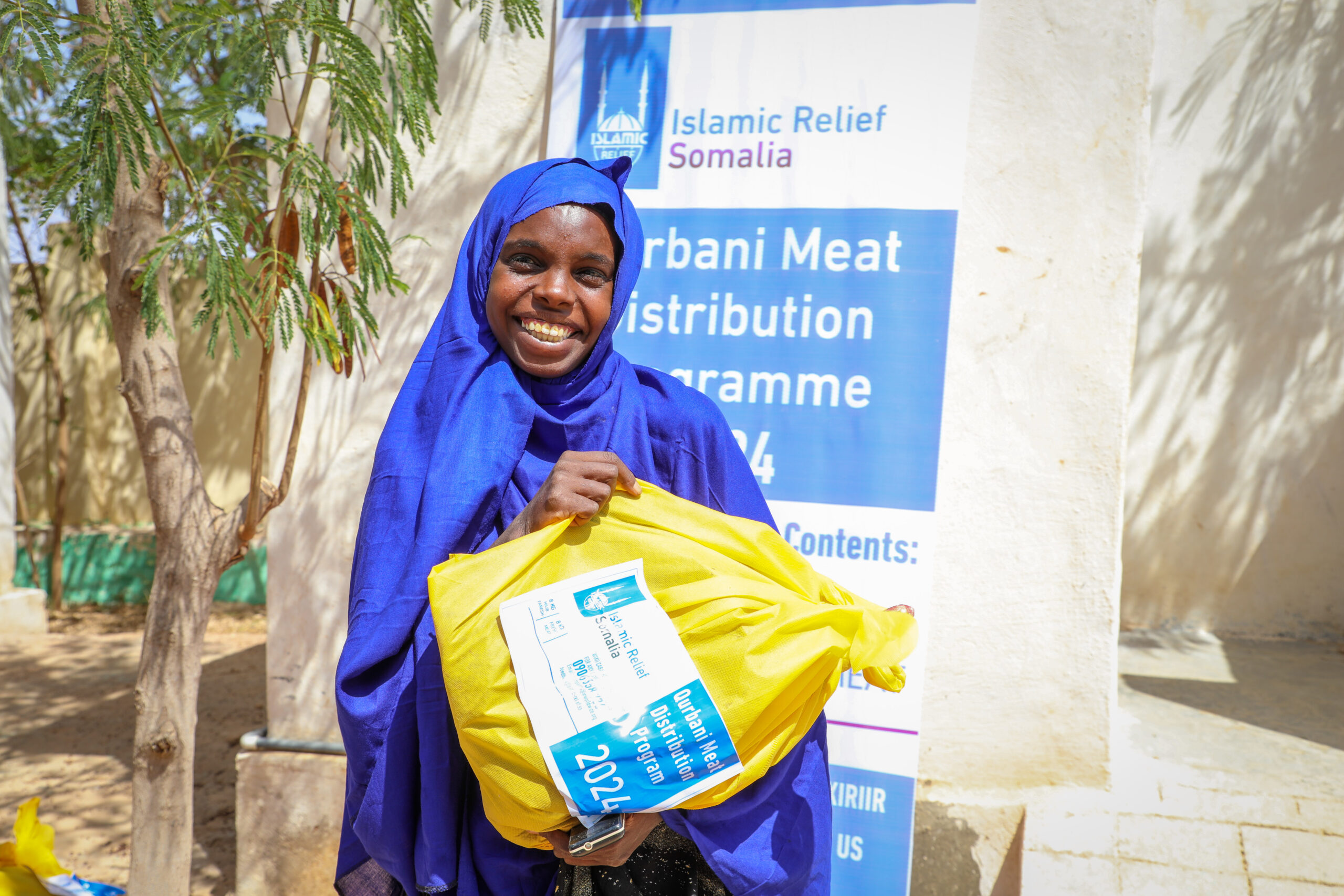
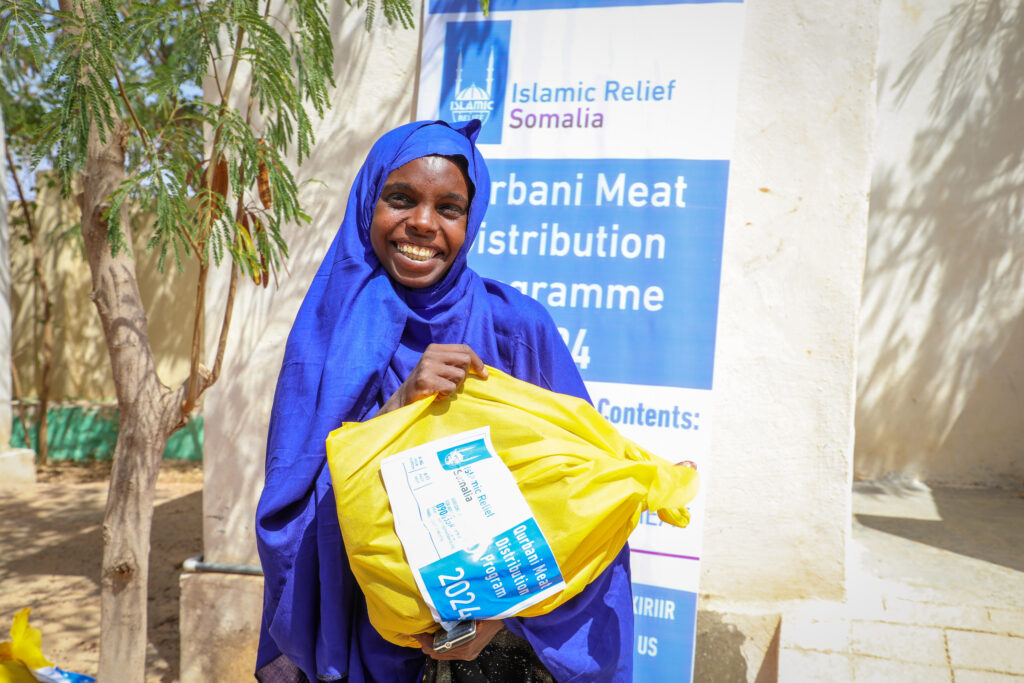
Photo: Qurban reaching those most in need in countries like Somalia during Eid Al-Adha.
Who should give Qurban?
Qurban is an important act of worship that every Muslim who has reached the age of puberty should do if they can afford it. Typically, Muslims who are eligible for Zakat should also give Qurban.
When should I give my Qurban?
It is best practice to purchase your Qurban as early as possible so that it can be performed on time. While one can carry out the sacrifice on any day of Eid al-Adha (from the 10th to the 13th of Dhul Hijjah), performing it on the first day is Sunnah.
The Prophet Muhammad (ﷺ) used to carry out the sacrifice immediately after the Eid prayer. In turn, his first meal on the day of Eid was meat from the sacrifice.
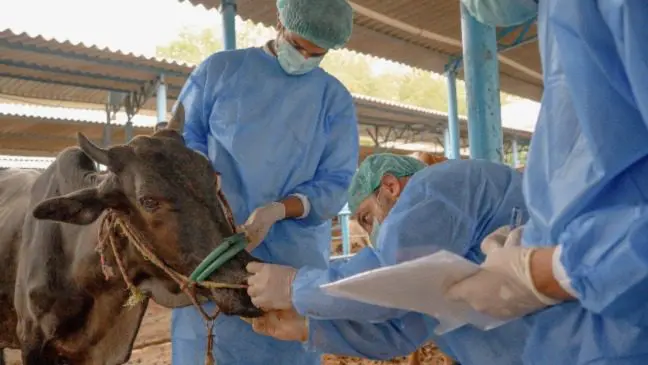
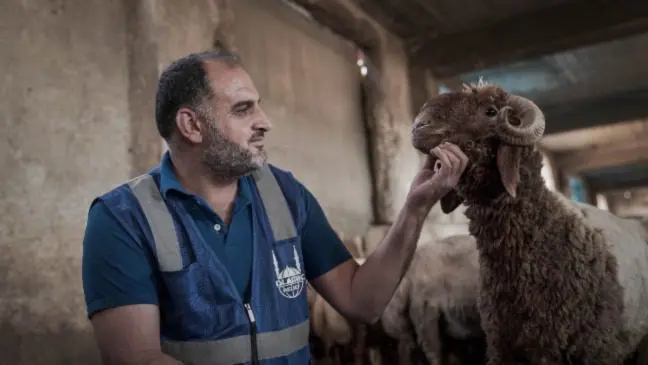
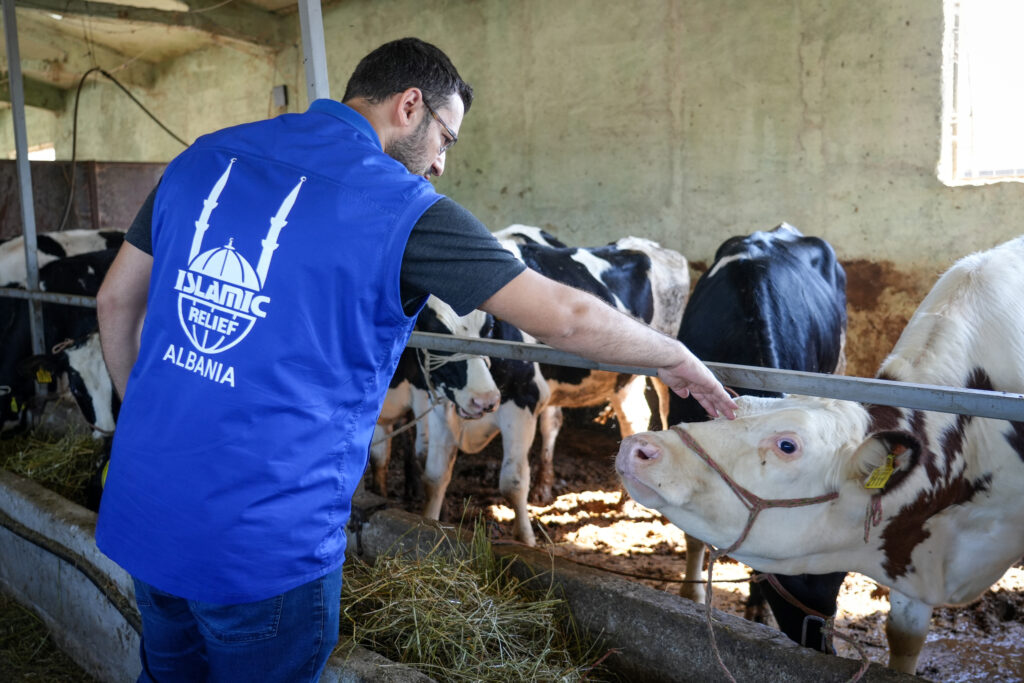
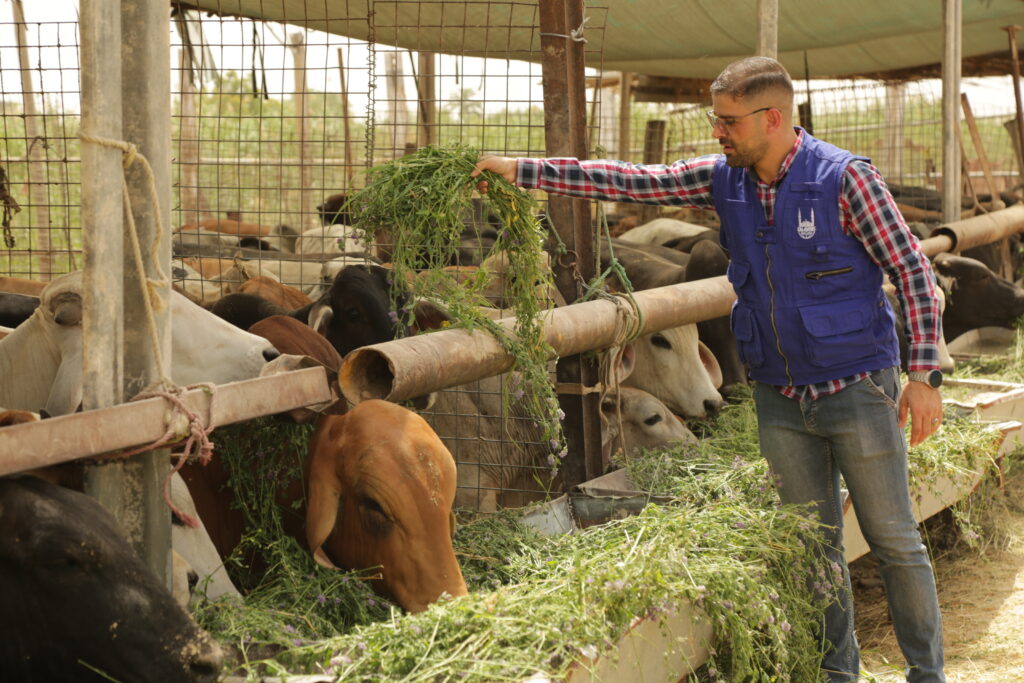
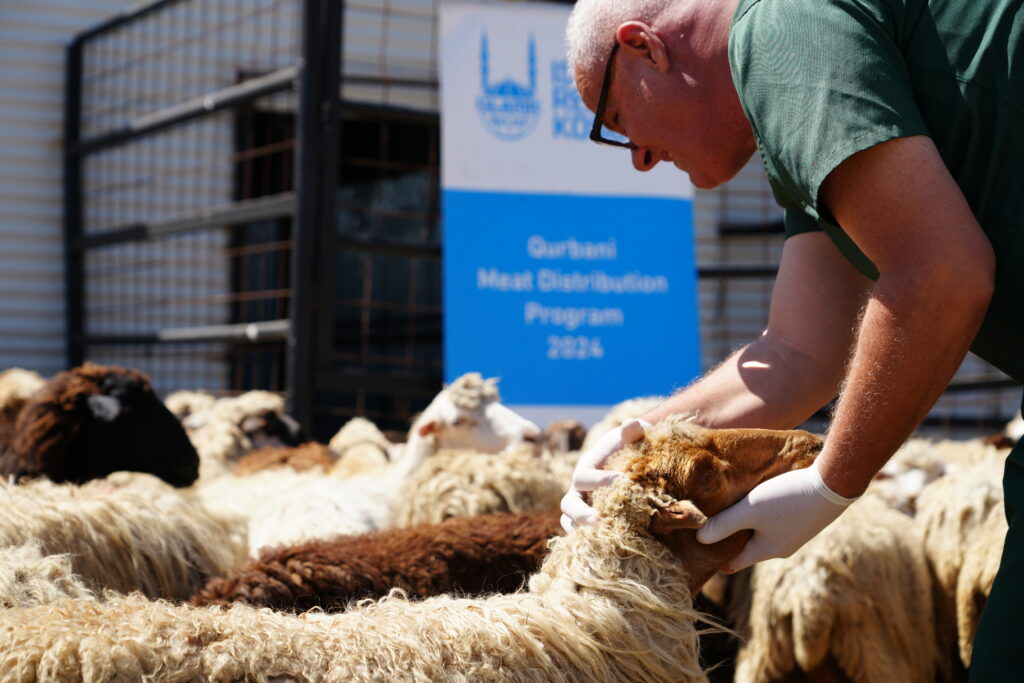
Photo: Islamic Relief staff inspecting animals for Qurban
Other Observances of Eid Al-Adha
As with any festival and important occasion, we follow the example of Prophet Muhammad (ﷺ). There are various Sunnah acts of worship you can do on the day of Eid. These include performing ghusl, wearing one’s best clothes, reciting takbeer and offering Eid greetings.
Similar to Eid al-Fitr, Eid prayer is also an important part of Eid al-Adha. Attending the Eid prayer and walking to the Eid prayer are also Sunan of the Prophet (ﷺ).
Why donate your Qurban to Islamic Relief?
When you donate your Qurban to Islamic Relief, we prioritise providing meat to the most vulnerable families across the world during the Holy season.
Our international teams work hard to get your donation to the hardest-to-reach regions and conflict-affected areas, including Myanmar, Palestine, and Yemen.
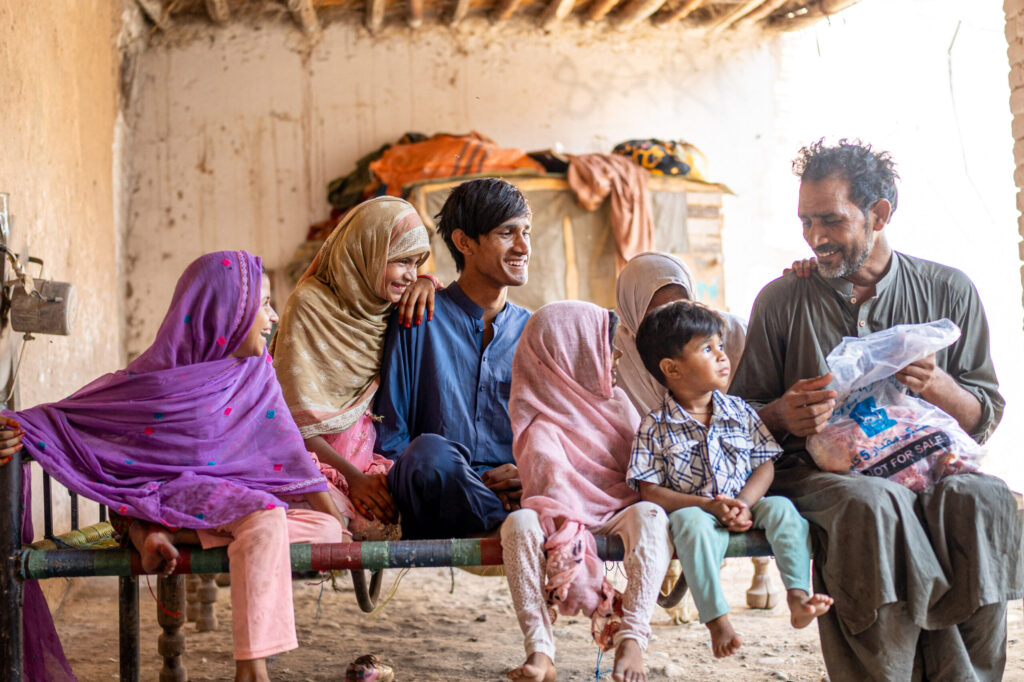
Meat is sourced locally to support the local economy and distributed fresh. All logistics—from sacrifice to transportation—are handled in accordance with Islamic principles and with the best hygienic practices possible. Each pack contains 2-5 kilograms of meat and feeds a family of approximately 4-8 people.
Five Pillars of Islam are core obligations that serve as a guide for every Muslim. Ones that nurtures their spiritual growth, self-discipline and devotion to Allah (SWT).
Together, these pillars form the foundation of Islamic belief and practice. It unites Muslims around the world in a shared commitment to the deen (faith).
What are the 5 pillars of Islam?
The five pillars of Islam include: Shahada (faith), Salah (prayer), Zakat (almsgiving), Sawm (fasting), and Hajj (pilgrimage).
Shahada (Faith)
The Shahada is the first and most fundamental pillar of Islam, serving as the very foundation of a Muslim’s faith. This is the declaration of faith in one God (Allah) and His messenger (ﷺ).
Ash-hadu an la ilaha illa Allah, Wa ash-hadu anna Muhammadan Rasulu-Allah
أشهد أن لا إله إلا الله وأشهد أن محمدًا رسول الله
“I bear witness that there is no god but God, and I bear witness that Muhammad is the Messenger of God”
This testimony affirms the core belief of Tawheed (the oneness of God), rejecting any association of partners with Him. It also acknowledges Prophet Muhammad (ﷺ) as the final messenger of Allah (SWT). As his legacy is one that follows a long line of prophets sent to guide humanity.
Salah (Prayer)
Salah is the second pillar of Islam and a fundamental act of worship. This is the ritual prayer every Muslim must perform five times a day (at fixed times) throughout their lifetime. It establishes a direct and personal connection between a Muslim and Allah (SWT).
The prescribed times for Salah are:
Fajr – Before dawn
Dhuhr – After midday
Asr – Afternoon
Maghrib – Just after sunset
Isha – Night
These prayers are a constant reminder of a Muslim’s faith, reinforcing discipline, humbleness, and mindfulness of Allah (SWT) throughout the day.
Zakat (Almsgiving)
Zakat, the third pillar of Islam, purifies a Muslim’s wealth and soul. It is an obligatory form of charity that requires Muslims who are of age, sound mind, and meet the Nisab (minimum wealth threshold) to give 2.5% of their savings annually to those in need.
The Quran outlines eight eligible recipients, as stated in Surah At-Tawbah, in this verse (ayat).
Alms-tax is only for the poor and the needy, for those employed to administer it, for those whose hearts are attracted ˹to the faith˺, for ˹freeing˺ slaves, for those in debt, for Allah’s cause, and for ˹needy˺ travellers. ˹This is˺ an obligation from Allah. And Allah is All-Knowing, All-Wise.
Quran 9:60
By fulfilling Zakat, Muslims uphold social responsibility and deepen their faith, ensuring that wealth benefits the entire community.
Sawm (Fasting)
Sawm, the fourth pillar of Islam, is a compulsory act of worship observed during Ramadan. It requires Muslims to abstain from food, drink, and other physical needs from dawn (Fajr) to sunset (Maghrib). As the blessed month of Ramadan is a time of spiritual purification, self-discipline, and devotion to Allah (SWT).
Key aspects of fasting include suhoor, the meal eaten before fajr prayer, and iftar, breaking the fast at sunset.
Every Muslim who are of age (i.e. has reached puberty) must fast during Ramadan. But there are also exemptions, such as those who are sick, elderly, travellers, and others with valid reasons (such as pregnancy or menstruation). However, they must also make up their fast once able to, if possible. If not, then they should pay compensation, called fidya, to the needy.
Beyond Ramadan, voluntary fasting on special days, such as Mondays and Thursdays or the Day of Arafah, is encouraged for extra rewards.
Hajj (Pilgrimage)
Hajj, the fifth and final pillar of Islam, is the sacred pilgrimage to Makkah (Mecca). It is required once in a lifetime for Muslims who are physically and financially able.
Taking place in Dhul Hijjah, it symbolises submission to Allah (SWT) and unity among believers. Key aspects of hajj include:
Ihram – Entering a state of purity and wearing simple white garments.
Tawaf – Circling the Kaaba seven times in devotion.
Sa’i – Walking between Safa and Marwah, honoring Hajar’s struggle.
Arafah – The most significant day, spent in deep prayer and repentance.
Rami al-Jamarat – Stoning the pillars representing Shaytan.
Qurban – Sacrificing an animal in remembrance of Prophet Ibrahim (AS).
What do the 5 pillars of Islam mean?
Overall, the five pillars of Islam are Shahada, Salah, Zakat, Sawm, and Hajj. They are the five key practices that all Muslims are obligated to fulfil throughout their lifetime. These practices are referred to as pillars because they form the foundation of Muslim life.
Why are the five pillars of Islam important?
Each of the five pillars works in tandem with one another to bring the essence of Islam into the lives of every Muslim:
Monotheism and the belief in Prophet Muhammad (peace be upon him) as the last messenger of God is the central tenet of Islam around which everything else revolves. Thus, reciting the Shahada (shahadah) in prayer each day serves to remind Muslims of this integral belief.
Salah (salat) occurs five times a day. This, hence, offers five different opportunities for remembrance of Allah (SWT) and our purpose in this life to worship Him.
The month of Ramadan requires every Muslim to abstain from their most basic needs and desires, like food, drink and physical relations for a period of time each day. Every year, the Sawm (fasting) gives Muslims the opportunity to gather control over their human needs. Without these distractions, Muslims can instead nurture good conduct and their connection to Allah (SWT).
While Sadaqah (charity) is greatly encouraged to be a part of everyday Muslim life, it is obligatory to offer Zakat (alms) once a year. This ensures that wealth is continuously redistributed to those who are in need of it.
During the Hajj (pilgrimage), Muslims must each wear the same simple garments and perform the same ritual acts of devotion to Allah. Stripped of worldly distinction, people are reminded that all are equal before God.
Knowing the Key Facts about the Five Pillars of Islam
The Five Pillars of Islam form the foundation of a Muslim’s faith and practice, guiding their spiritual and daily lives. While these obligations are essential, Islam also recognises individual circumstances, offering exemptions and alternatives for those unable to fulfil certain pillars due to health, financial, or other valid reasons.
By embracing these pillars, Muslims strengthen their connection with Allah (SWT), helping build a just and compassionate society.
The Prophet (ﷺ) said, “(Allah said), ‘Every good deed of Adam’s son is for him except fasting; it is for Me. and I shall reward (the fasting person) for it.’ Verily, the smell of the mouth of a fasting person is better to Allah than the smell of musk.”
Fasting (Sawm) is an important pillar of Islam. It’s a beloved act of worship, as it shows our gratitude towards Allah (SWT) for the provisions he’s given us.
Most of us know fasting is mandatory during Ramadan. But did you know there are other times when it’s highly recommended?
There are additional days in the year when it’s encouraged to fast. An opportunity to gain extra reward for following the Sunnah, the actions and words of our Prophet (ﷺ).
There are also days when we cannot fast, as it is haram (forbidden) or makruh (extremely disliked) to do so.
Hence, it’s important to know which days we can fast to prepare for them in advance.
Days of Fasting Outside of Ramadan
There are several days in the Islamic Calendar when it’s sunnah (highly recommended) to fast. As the Hijri year follows the moon’s cycle, the dates of these days on the conventional Western calendar change every year.
Mondays and Thursdays
The Prophet Muhammad (ﷺ) would fast on Mondays and Thursdays. The reasons for why can be found in several ahadith.
“O Messenger of Allah, why do you fast on Mondays and Thursdays?” He (ﷺ) said: “On Mondays and Thursdays Allah forgives every Muslim except two who have forsaken one another.”
There are also several health benefits that come with fasting two times a week. These include, but are not limited to, reduced levels of total cholesterol and lowered risk factors for heart disease.
Six Days in Shawwal
Shawwal is the 10th Islamic month. It is the month that follows Ramadan, as the first of Shawwal is Eid al-Fitr.
The rewards for fasting six days in Shawwal alongside Ramadan are great – as if one has fasted for the entire year!
The Messenger of Allah (ﷺ) said, “Whoever fasts the month of Ramadan and then follows it with six days of fasting in the month of Shawwal, it will be as if he has fasted for the entire year.”
Dhul Hijjah is the twelfth and final month of the Islamic Calendar. The first ten days of the month are extremely blessed, for “there are no days during which righteous deeds are more beloved to Allah than these days.” (Sunan Ibn Majah)
One of the best deeds to do is to fast. Hence, on the first 9 days (as one cannot fast on Eid Al-Adha) it is recommended for us to fast, alongside doing other good deeds, such as reading Qur’an, making dhikr, giving charity and performing nafl (voluntary) prayers.
Fasting in Dhul Hijjah is also sunnah, as the Messenger of Allah (ﷺ) used to fast the month’s first nine days. (Sunan Abi Dawud)
He (ﷺ) especially encouraged it on the Day of Arafah, the 9th of Dhul Hijjah. It is also the most blessed day of the year. This is because fasting on the day of Arafah “will expiate the sins of the previous and upcoming years.” (Sahih Muslim)
However, for those going on Hajj, it is fine for them to leave the sunnah fast of Arafah.
One of the companions of the Prophet (ﷺ), Ibn Umar, noted that, while performing the pilgrimage, the Prophet (ﷺ) did not fast during Arafat.
In turn, some of the closest companions of the Prophet (ﷺ) – Abu Bakr, Umar and Uthman (may peace be upon them all) – also did not fast on Arafat while on Hajj. (Tirmidhi)
Hence, fasting on the first 9 days of Dhul Hijjah, especially on Arafah, is a highly recommended act for those not on Hajj.
Ashura (and the Day Before or After it)
Ashura occurs on the 10th of Muharram, the first Islamic month. It is a blessed day that commemorates several significant events in Islamic history.
The origins of fasting on Ashura have been documented in this hadith collected by Al-Bukhari and Muslim and reported by Ibn ‘Abbas (RA). The narration goes as follows:
The Prophet (ﷺ) observed the Jewish people fasting on this day and asked why they did so. The Jews replied that this was the day Allah (SWT) granted victory to Musa (AS) and Bani Isra’il over Fir’aun (Pharaoh). Thus, they fasted on this day out of respect.
The Prophet (ﷺ) then said, “We are closer to Musa (AS) than you,” and enjoined in fasting on that day.
There are also great blessings for fasting on Ashura. When asked about fasting on the 10th of Muharram, the Prophet (ﷺ) said, “It will expiate the sins of the past year.” (Sahih Muslim)
It is also recommended to fast the day before Ashura (9th Muharram). Ibn ‘Abbas (RA) reported:
“When the Messenger of Allah (ﷺ) fasted on the day of ‘Ashura and told the people to fast, they said, “O Messenger of Allah, this is a day that is venerated by the Jews and Christians.” The Messenger of Allah (ﷺ) said, “Next year, if Allah wills, we will fast on the ninth day.” But by the time the following year came, the Messenger of Allah (ﷺ) had passed away.
Thus, to differentiate Muslims from other religions (who also celebrated this day), the Prophet (ﷺ) instructed us to fast on the 9th and 10th of Muharram.
If one fears they may miss Ashura because of the difference in moon sighting, then scholars also permit fasting on the 10th and 11th of Muharram.
Most of Sha’ban
As the 8th Islamic month, Sha’ban is the month before Ramadan. The Prophet fasted for the majority of this month, with accounts of it recorded in several ahadith. This includes a hadith where ‘Aisha (RA) said:
“The Messenger of Allah (ﷺ) would fast until we said he will never break his fast, and he would not fast until we said he would never fast. I did not see the Prophet complete an entire month of fasting except for Ramadan, and I did not see him complete more voluntary fasts than in the month of Sha’ban.”
In another hadith, ‘Aisha (RA) also said, “The most beloved month to the Messenger of Allah (ﷺ) for fasting was Sha’ban, then he would connect it with Ramadan.” (Sunan Abi Dawud)
Exceptions to Fasting in Sha’ban
In a hadith collected by Al-Bukhari and Muslim, ‘Aisha (RA) also reported that the Prophet (ﷺ) observed fasting during the whole month of Sha’ban except for a few days.
Abu Hurayrah (RA) similarly mentioned that the Messenger of Allah (ﷺ) said:
“Do not anticipate Ramadan by fasting one or two days before it begins, but if a man habitually fasts, then let him fast.”
Abu Hurayrah (RA) also reported that the Prophet (ﷺ) said to not fast if Sha’ban is half over. (Tirmidhi)
The exception to this would be someone who fasted regularly, such as the Prophet (ﷺ) and many of his companions. Thus, if you are someone who regularly observes the sunnah fast, then you may still observe them in the second half of Sha’ban.
It is also permissible to make up a Ramadan fast at this time, if necessary. ‘Aisha (RA), one of the wives of the Prophet (ﷺ), herself would make up her fast in Sha’ban. Regarding this, she said, “I had to make up some fasts I missed during the month of Ramadan, but I was unable to do so until the month of Sha’ban as I was busy with the Messenger of Allah (ﷺ).” (Bukhari and Muslim)
The White Days
The white days are the 13th, 14th and 15th of each Islamic month. They are called White Days (Ayam al Beedh) as the moon is most lit on these nights.
Qatadah Ibn Malhan al-Qaysi said that the Prophet (ﷺ) used to command them to fast the days of the White (nights). He (ﷺ) said that to fast these days “is like keeping perpetual fast.” (Sunan Abi Dawud)
In another hadith, Jarir bin ‘Abdullah recalled that the Prophet (ﷺ) said:
“Fasting three days of each month is fasting for a lifetime, and the shining days of Al-Bid, the thirteenth, fourteenth and fifteenth.”
Generally, most days of the year should be okay for you to fast. The exceptions are the two days of Eid and the days of Tashreeq. It is also severely disliked for one to fast on Fridays, Saturdays and towards the end of Sha’ban unless it falls on a day they regularly fast.
Days of Celebration
As mentioned before, it is forbidden to fast on Eid al-Fitr and Eid al-Adha. These Islamic celebrations have been designated for us to enjoy and feast with loved ones.
Similarly, it is also forbidden to fast on the days of Tashreeq, three days after Eid al-Adha. This is because these are “days of eating, drinking and remembering Allah.” (Sahih Muslim)
However, there is an exception. In one hadith, ‘Aisha (RA) and Ibn ‘Umar (RA) reported:
“No concession was granted allowing anyone to fast on the days of al-Tashreeq, except for the (pilgrim) who could not find a sacrificial animal.”
Hence, those on Hajj who are unable to perform the sacrifice for Eid Al-Adha are permitted to fast on the days of Tashreeq.
Fridays and Saturdays
It is severely disliked to fast on Friday alone. The Prophet (ﷺ) said, “No one of you should fast on Friday, unless he fasts (a day) before it or after it.” (Sahih Al Bukhari)
This is because Friday (called Jumuah or Jummah in Arabic) is a dedicated day of worship. As fasting can make one easily tired, it may prevent them from making the most of Jumuah.
Similarly, it is also discouraged to fast on a Saturday. The Prophet (ﷺ) said:
“Do not fast on Saturday except for what has been made obligatory upon you (by Allah). If one of you does not find but a grape peal or a tree’s twig, then let him chew it.”
Fasting on Saturday may also cause one to resemble the practice of the Jewish people, as they observe Saturday as a day of rest. Another reason why the Prophet (ﷺ) advised against it unless fasting was necessary.
Exceptions to Avoiding Fasting on Friday or Saturday
Obviously, one must fast on Friday and Saturday if it falls in the month of Ramadan. It is also permissible to fast on these days if it happens to fall on a day when it is sunnah to fast, such as Arafah, Ashura or one of the White Days.
You may also make up a fast from Ramadan on Friday or Saturday if this is the only time you can fast. But it is better to combine it with another day if you can.
Differences between Voluntary Fasting and Fastingin Ramadan
The rulings on what breaks a fast outside of Ramadan and during Ramadan are the same. However, there are two key differences.
When to Make the Intention
The Prophet (ﷺ) said, “Whoever does not have the intention to fast before dawn, there is no fasting for him.”
According to At-Tirmidhi, the hadith specifically refers to fasting in Ramadan. The fast is invalid if the intention is not made before sunrise in Ramadan. This also extends to when one is making up a Ramadan fast or fasting for a vow.
However, for voluntary fasting, it is permissible to make an intention after morning, in the opinion of Al-Shafi’i, Ahmad, and Ishaq.
Leaving the Fast
During Ramadan, you must remain fasting from dawn to dusk. Even if you have a valid excuse to break it, you must make up the full day you missed outside of Ramadan. Or, if you are unable to fast, pay compensation (fidyah) for it.
However, for a voluntary fast, you can break the fast if you wish without sin. As it is voluntary, you don’t need to make up the fast later or pay compensation if you miss it.
There was a time when the Prophet (ﷺ) received an invitation to a feast (outside of Ramadan) but one of the companions was fasting. The Prophet (ﷺ) then requested,
“Your brother has invited you and incurred expenses on your behalf, break your fast and fast another day in its place if you wish.”
May Your Sunnah Fasting Be Accepted by Allah (SWT)
All in all, there are several specific voluntary fasts recommended for Muslims to do outside of Ramadan. These are:
Mondays and Thursdays
Six days in Shawwal (except Eid Al-Fitr)
First 9 days of Dhul Hijjah (especially the 9th, Arafah)
Ashura (10th Muharram) – if possible, combined with either the 9th or 11th Muharram
Most of Shaban
The White Days (13th, 14th and 15th of each Islamic month)
If we can fast continually during Ramadan, then we already have the mental mindset to fast some or even all these voluntary days.
In this new Hijri year, let us make the intention to perform as many of these fast as possible! May Allah (SWT) grant us the strength to observe these days and accept our fasts, ameen!
Share
06.17.24
Your Impact this Dhul Hijjah: Bringing joy to over 2 million with Qurban and more!
Thank you for supporting our Qurban Program for Dhul Hijjah 2024!
During Eid Al-Adha, you helped Islamic Relief provide food to 2,824,393 people. By supporting our annual Qurban distributions, you brought relief to many affected by the world’s worst hunger crises and are on the verge of famine.
Eid al-Adha falls in Dhul Hijjah, the twelfth and final month of the Islamic (Hijri) Calendar. It involves the tradition of Qurban. An act of worship where Muslims perform a sacrificial slaughter of an animal – traditionally goats, sheep, cows or camels. This action reflects upon the Prophet Ibrahim (AS)’s willingness to sacrifice his son Ismail for the sake of Allah (SWT).
Following the sacrifice, the meat is then distributed to people in need. For many, it is also the only meat they will get to eat this year.
Where Islamic Relief Distributed Its Qurban Programs for 2024
Islamic Relief’s Qurban distributions this year took place in 27 countries. These include Sudan, Afghanistan, Niger, Bangladesh, Kenya, Pakistan and many more.
In Sudan, more than a year of brutal conflict has left the country on the verge of famine. Farmers have been unable to plant and harvest crops and markets have been looted. Islamic Relief distributed Qurban fresh meat packs to help 80,000 people there.
In Gaza, Israel’s ongoing attacks and restrictions on aid mean children and elderly people are starving to death. Islamic Relief’s team and partners in Gaza distributed thousands of meat packs, in addition to our ongoing daily distributions of cooked meals for tens of thousands of families.
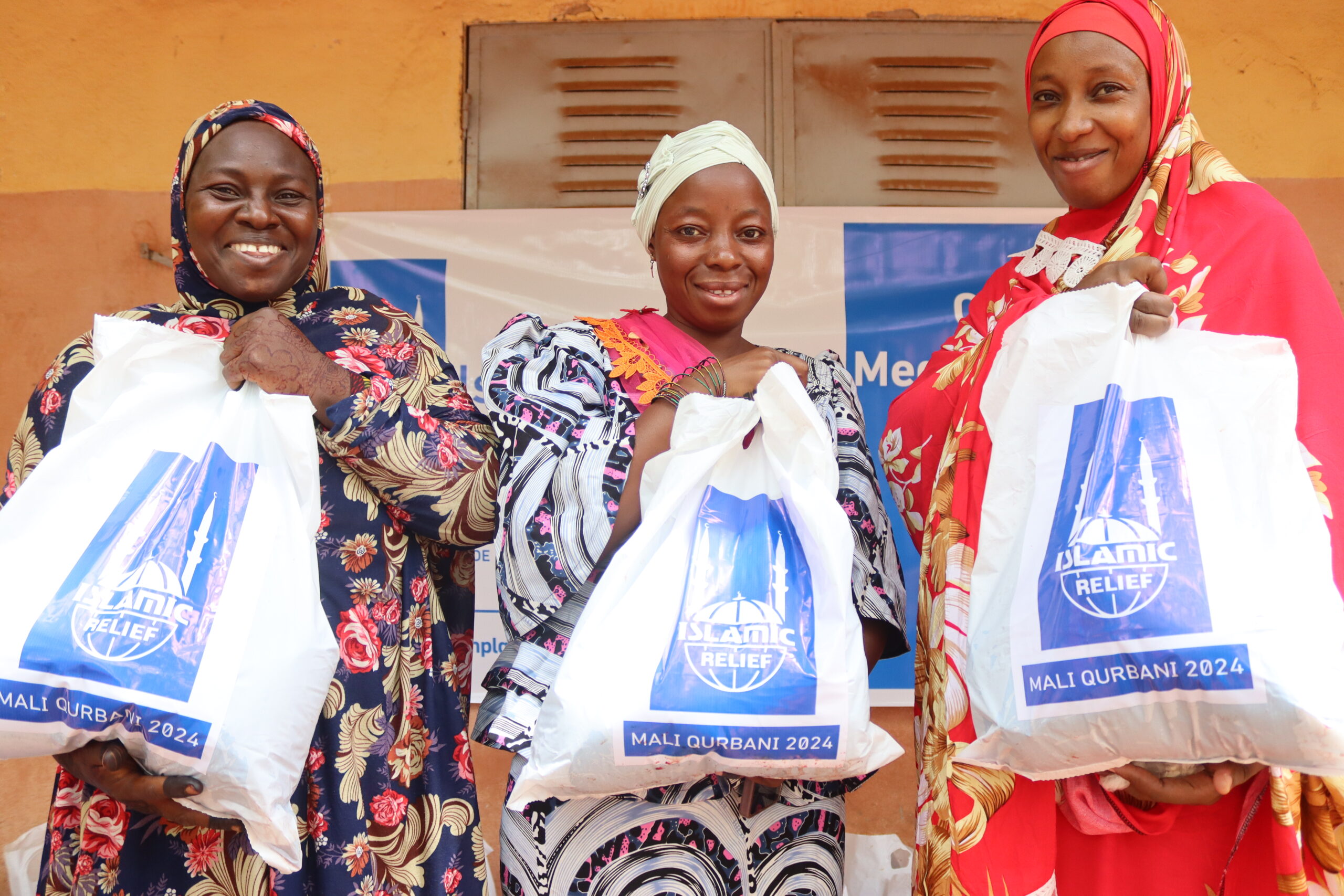
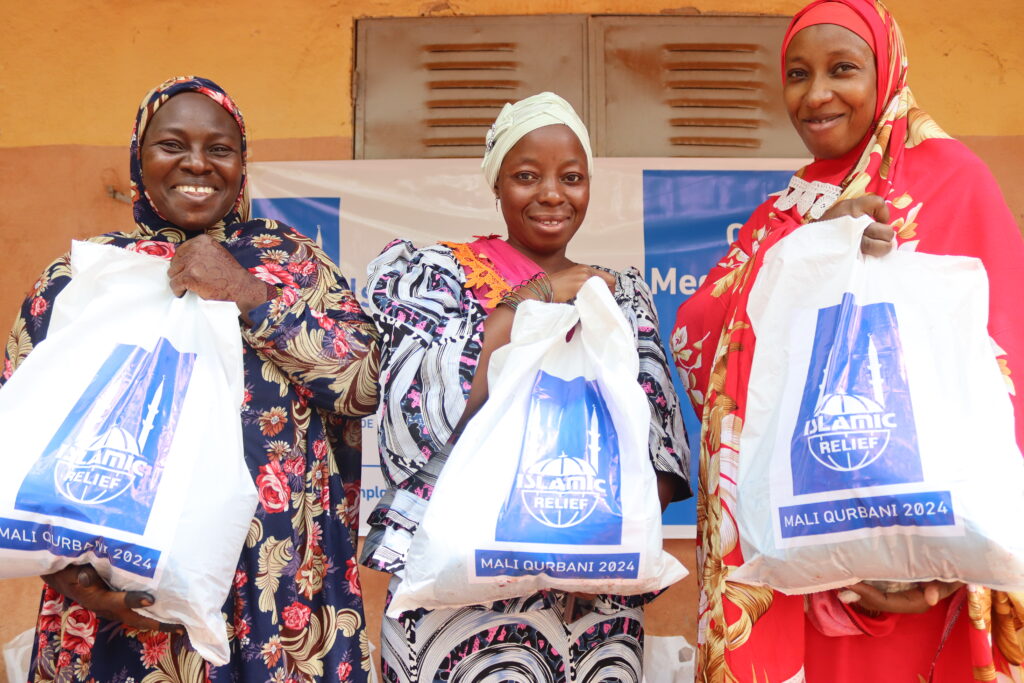
Some of the biggest Qurban distributions this year were in Mali and Niger, which are among the world’s most neglected crises, with rising numbers of children suffering from malnutrition. This year, we distributed more than 75,000 Qurban fresh meat packs in Mali and more than 70,000 in Niger.
In Bangladesh, Qurban distributions reached over 40,000 families – including both impoverished rural Bangladeshis and Rohingya communities who have fled violence in Myanmar.
More Eid al-Adha Giving
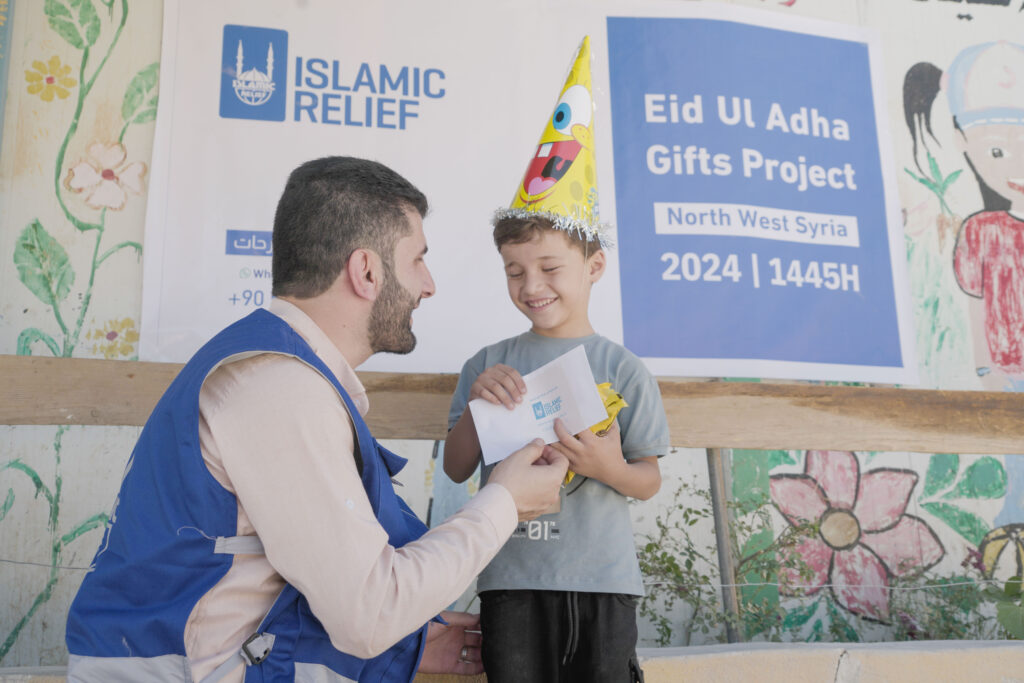
Eid al-Adha is also a time of joy and gift-giving. Islamic Relief teams also distributed over 18,000 Eid gifts such as clothes, shoes, school uniforms and school bags to children and families in 18 countries.
Zaheer Afzal, manager of Islamic Relief Worldwide’s Qurban and seasonal programs, says:
“Conflict, climate change and inequality are driving hunger worldwide. Thanks to generous donations from our supporters, Islamic Relief hopes to provide nutritious meat to at least 2 million vulnerable people in 27 countries during Eid al-Adha. This may be the only meat they get to eat this year.”
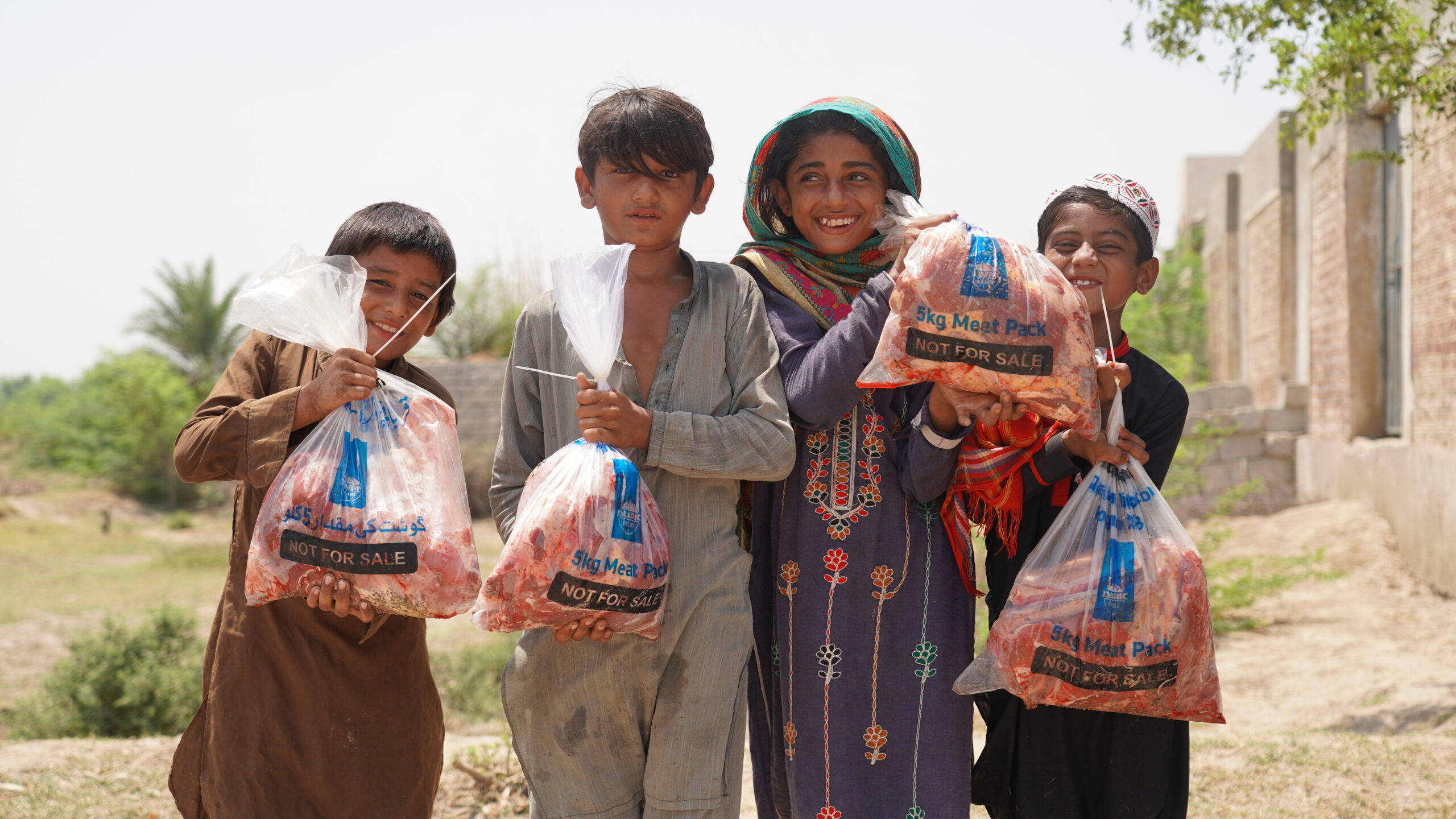
Each Qurban pack contains approximately 5kg of meat on average. Islamic Relief ensures that all distributions comply with Islamic guidelines and national laws, ensuring animal wellbeing and strict criteria on the age and health of animals.
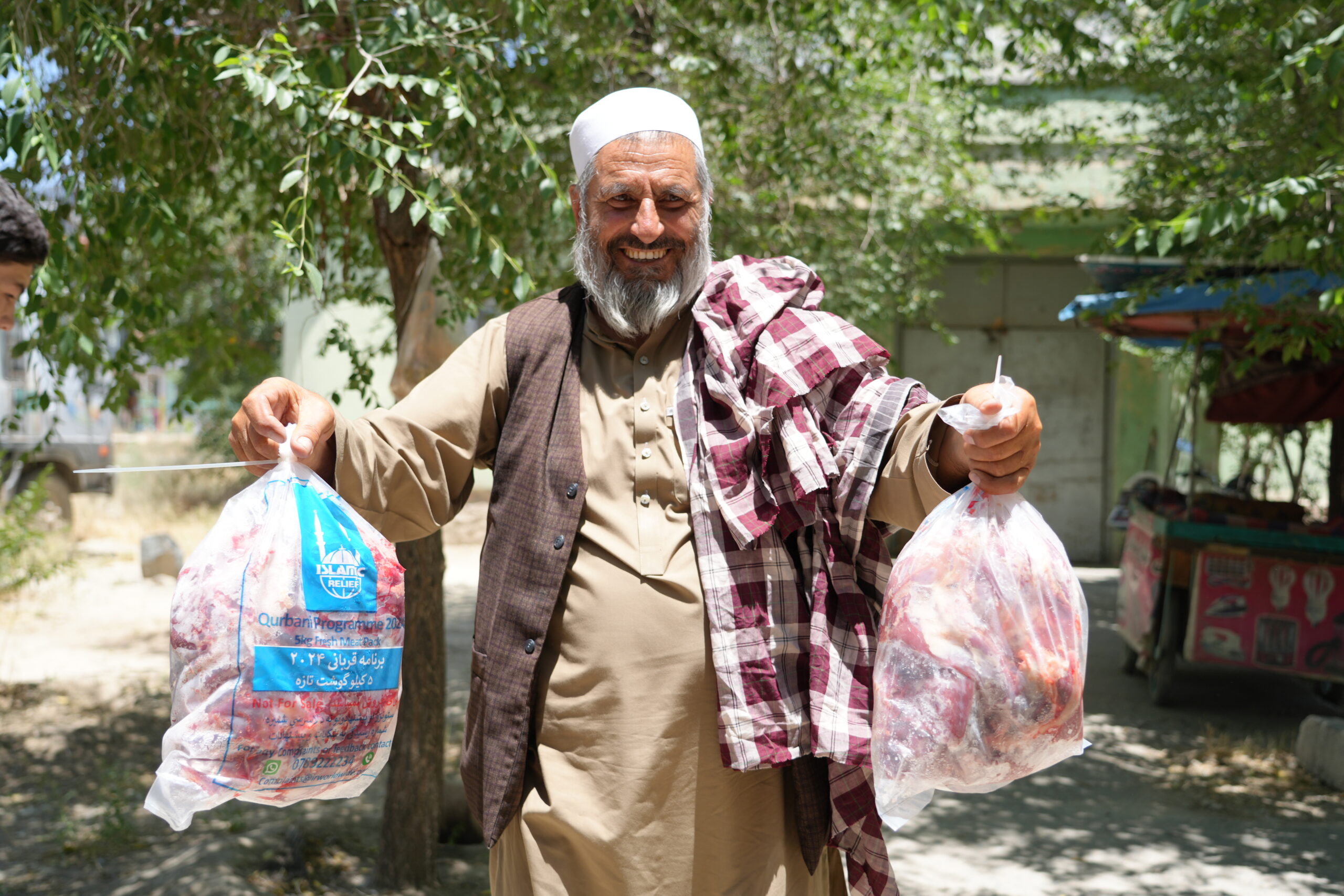
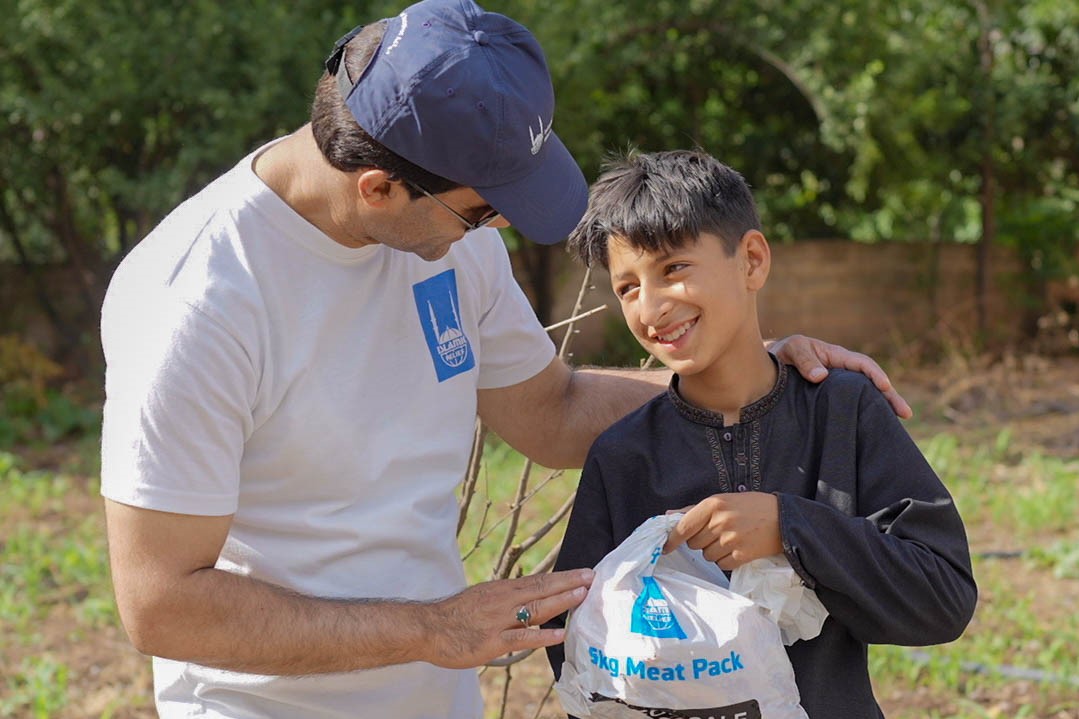
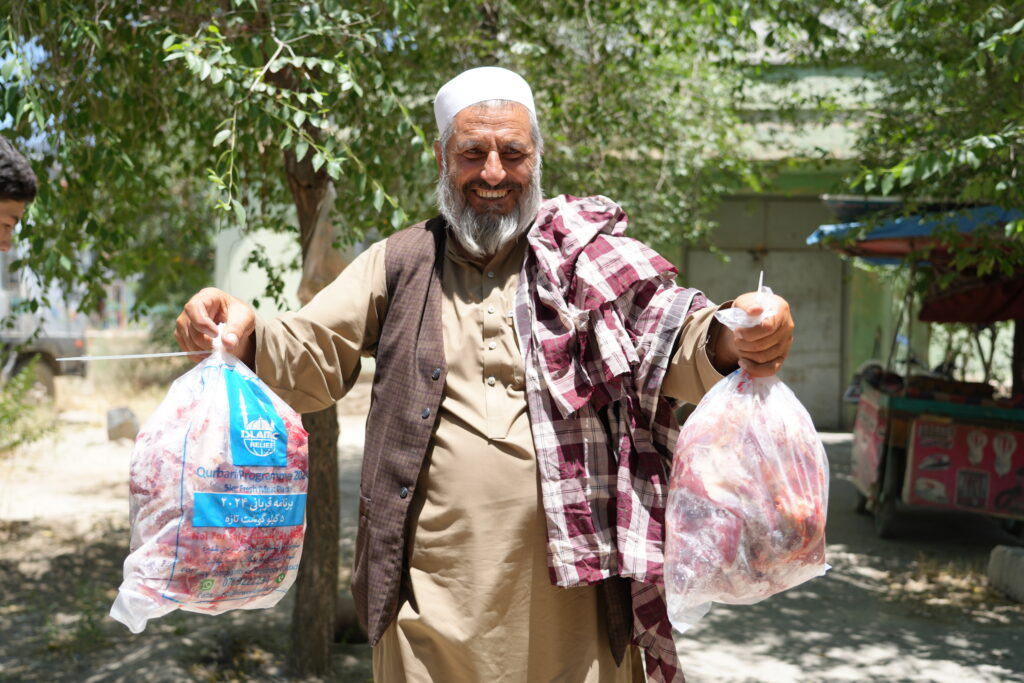
Islamic Relief Afghanistan distributed 10,676 fresh meat packs to 8 provinces of Afghanistan in Eid Ul-Adha 2024 for Orphans, Widows, and Elderly families.
Giving Qurban is one of our greatest opportunities, as Muslims, to empower those most in need. As an important duty for every able Muslim, fulfilling this great act of worship allows us to share our blessings with our brothers and sisters suffering the most. And give them the nutrition they need to enjoy Eid Al Adha without worry and look toward a better tomorrow.
As members of humanity, of one Ummah, we all want to empower one another. We all wish everyone in the world, especially our brothers and sisters in need in countries like Gaza and Sudan, to have fair access to basic rights and opportunities. Access to quality education, employment, food, healthcare and more.
That’s why, one of the greatest opportunities we have as Muslims, is to empower others through the power of giving. Especially through Qurban, in these blessed first 10 days of Dhul Hijjah.
What is Qurban?
Qurban is an Islamic tradition specific to Eid Al-Adha. It takes place annually on the Islamic (Hijri) Calendar, in the 12th and final month, Dhul Hijjah.
Performing Qurban means to sacrifice an animal, either a goat, sheep, cow (or buffalo) or camel, for the sake of Allah (SWT). This is done in commemoration of the sacrifice of the Prophet Ibrahim (AS). When Ibrahim (AS) showed his willingness to sacrifice his beloved son, Ismail (AS), for Allah (SWT)’s sake despite his heavy heart, Allah (SWT) rewarded them by replacing Ismail (AS) with a sheep to sacrifice instead.
Qurban is an important duty for anyone who has the means to do so. With how important this duty is to our supporters, we, at Islamic Relief Australia, take your Qurban as an Amanah. An Amanah to ensure it is given to those most in need with Ihsan and empowers their community for generations to come.
How Does Qurban Empower Communities?
Every year Islamic Relief’s Qurban program catches international recognition. Why? Because we work to ensure our program has the most impact.
Since the campaign began in 1986, it has been part of our greater mission to eradicate food insecurity from the world’s most needy.
Today, as many as 783 million people globally face chronic hunger. Conflict, spiralling economies, climate extremes and rising costs of living are combining to create an escalating food crisis. By distributing fresh, high-quality meat to millions of the world’s most vulnerable, we help relieve thousands of families from food insecurity, thereby reducing world hunger.
However, Qurban provides more than just immediate aid. In the long term, we also empower and develop communities with our Qurban projects so they no longer have to be dependent on direct aid, steering them towards a sustainable future.
Sustainable Development with Islamic Relief
Islamic Relief looks at Qurban as a way of supporting a local community. The meat product is just a part of a more significant process. It strengthens local economies and feeds its most vulnerable. It also empowers local livelihoods through employment.
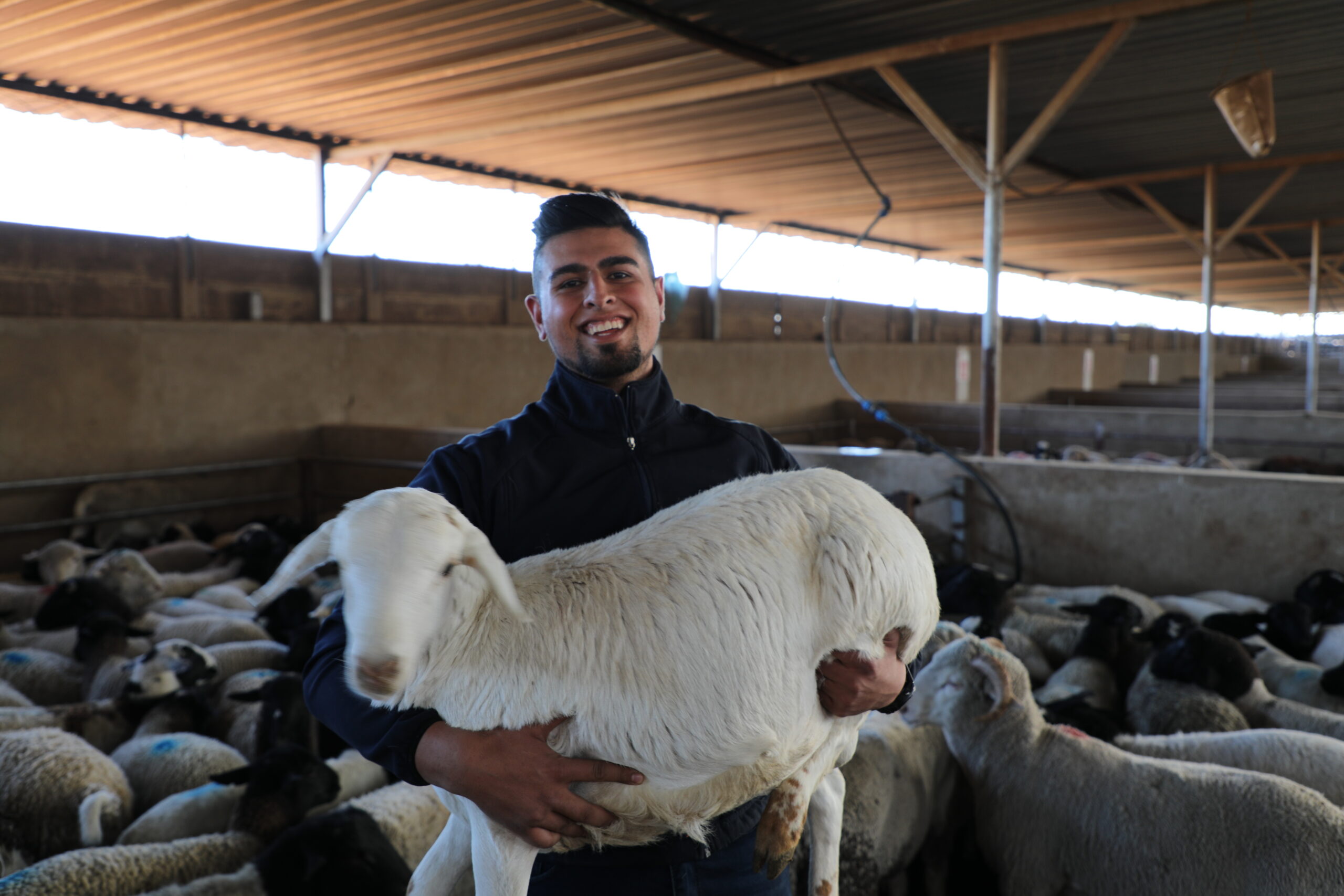
Qurban gathers and empowers local livelihoods. Farmers and locals prepare and raise the animals in advance, ensuring they meet the right criteria per prophetic tradition. Local butchers will assist in cleaning and packaging the meat. Transporters will distribute the meat to families in need.
Where, thanks to your support, last year, our global family was able to reach over 3.4 million vulnerable people with Qurban across over 28 countries. Allowing those in need to not only receive the nutrition they need to relieve their hunger, but also realise their full potential, paving their pathway to a brighter future.
This Dhul Hijjah, Share Your Blessings
Help the world’s most vulnerable families enjoy their Eid when you give Qurban with Islamic Relief.