02.06.19

Building for the future: A safe educational space in Indonesia    

  News

Since 2016, there have been 15 earthquakes in Indonesia that have killed almost 14,000 people and left hundreds of thousands displaced.  

How Earthquakes Destroy Communities

Building a community after a natural disaster cannot be achieved in weeks and it usually takes a few years for an entire community to recover to the standard they previously lived upon. This is because earthquakes damage more than shelters and homes. They destroy commercial buildings, healthcare facilities, shopping centers, roads, pipes for clean water and all forms of public services.  


Three Years Since the Earthquake and the Community Remains in Need for Support 

The 2016 earthquake in Pidie Jadya resulted in 103 deaths and caused 8,000 fatalities. 2,000 homes and buildings, as well as 31 schools, were destroyed. Pidie Jadya has the second highest poverty rate, 16.73%, in Indonesia which is lower than the national average poverty rate of 10,68%. 

At the time of the earthquake, we provided a general emergency response that involved donors supplying the affected community with food and non-food items. Assistive devices were also given to disabled people. Over time as the society was trying to recover, we supported poor farmers and small traders through the provision of working capital. In the lead up to Ramadan and Eid al-Adha, we stayed beside the community and ensured they received Ramadan Food Packs and Qurbani meats.  

However direct aid, in the form of food and replenishments, is limiting when wanting to take a community out of poverty. There are currently tens of thousands of people within the province who are living without shelter and do not have access to clean water.  

We asked ourselves, is this community ready should another earthquake occur within the province?  

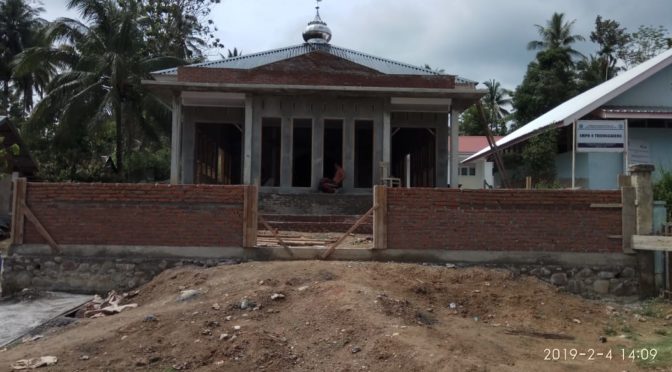
Since late 2018, we began supporting the building of a multipurpose safe-school facility in Pidie Jaya which is expected to launch in May 2019. 


What is This New Building About? 

The project will be supporting the building of a school, integrate WASH services and provide the community training in times of disaster. Through the establishment of a multipurpose building that encompasses teaching facilities and WASH services, the project improves the access of the community to infrastructure and knowledge. It will directly benefit students, teachers and employees.  

In the absence of disaster-preparedness training, a similar disaster in the future can result in a high number of causalities. The building will also educate beneficiaries on how to respond to future disasters. Awareness raising and training play a significant role in preparing communities in times of natural disasters.  

The project building is in line with the country priority in disaster risk reduction targeting for the school community. Islamic Relief aims to engage the local government to promote the safe school project educating them to best provide for their community. 
 

10.22.18

Islamic Relief Australia Attends Launch of World Bank’s 2019 Development Report

  News

Last Monday the 15th of October, Islamic Relief Australia (IRAUS) attended the launch event for the World Bank’s 2019 Development Report. The Australian launch came off the back of the annual meeting between World Bank Group and the International Monetary Fund on Thursday in Bali. The launch focused on the changing nature of work as technology continues to reshape the future. 

“How much human capital will a child born today expect to attain by age 18, given the risks to poor health and poor education that prevail in the country where they live?” 

We need to be ready to serve a changing global economy

The response of governments need to be directed into investing in people as the traditional nature of firms, jobs and employment contracts is rapidly changing. Technological innovation has created firms that no longer need a shop front, jobs that require higher skills and employees who are independently contracted.  

WDR 2019 Report Photo Cover

By investing in health and education, the next generation will be ready for a new global economy. The differences in learning between developing and developed countries are massive. As many as 60% of students in developing countries in the East Asia and Pacific region are disadvantaged because of poorer performing learning systems. 

Islamic Relief Bridging the Gap

Islamic Relief Australia is committed in bridging this gap in a way that will be sustained for the long term so that the children of the next generation will also be able to reap the benefits from our development projects. In 2018, we have launched two development projects in Indonesia and Niger that are centered on primary education for children. 

In Niger, we are expanding our Orphan Sponsorship Program so that they are set up for today and tomorrow. We have set up two community-based organisations that will earn regular income from animal husbandry and preserving cereals. Through this project, orphans and their families will become financially independent and resilient. We have also committed to train 45 primary school teachers, and distributed 700 school kits to promote interest in school. 

We hope to continue our development projects to be in line with the World Bank findings and approach. 

Find out more on their ‘Human Capital Project’ – http://www.worldbank.org/en/publication/human-capital 

10.09.18

Empowering Kenyan Women in Business and Climate Change

  News

Kenyan Women are directly experiencing the consequences of poverty and climate change. In Kenya Islamic Relief has trained women so they can live a fulfilling and sustainable livelihood. At least 200 women have benefited from the project. 

Wajir County is the region the project took place. Wajir County is an area drastically impacted by constant droughts and flash floods, leaving communities suffering significant loss of livelihoods and poverty.

Women in Wajir County have particularly suffered the effects of poverty, particularly income and food insecurity. This has been due to unfavourable gender dynamics within these vulnerable communities.

While women are expected to care for family with no compensation, men are the main decision makers. When men take the lead role managing household assets and resources it is leaving women with little to no say over issues that directly affect them and their children.

How Our Program Empowers Women

How is Training Women in Business Useful in Combatting Climate Change? 

Kenya has been experiencing a drought which has caused severe shock to the agricultural industry since the onset of the drought in 2015. The drought has affected families and limited lifestyle in Kenya. Due to agricultural damage, the most affected groups have been women and children due to the food and income insecurity. 

Existing gender roles in Kenya which perceive women in roles of motherhood limit their access to educational, health and economic resources. 

By creating opportunities and accessible resources for women to become an influence in alleviating poverty and becoming key voices in their close-knit communities, women alongside men can be participators in implementing and investing in sustainable development and poverty alleviation. 

‘Educate Women and Their Community will Prosper’

When Islamic Relief launched the community-based program for the social and economic empowerment of women, over 200 women received life-changing skills training for the betterment of their day to day lives.

These life-changing skills included:

  • Life and business skills training, resulting in many of these women becoming micro entrepreneurs, opening small businesses to generate income, as well as engaging in an otherwise male dominated agribusiness, through vegetable production and sales. This allows women to make meaningful contributions to their households.
  • Group savings and loans training – which has empowered women to form financial support networks by jointly saving, loaning and investing.
  • Linking 200 women with sharia compliant financial institutions to improve their access to financial services, where they can open bank accounts to accumulate their savings.
  • Engaging women in local government platforms, where they can address issues specific to women including economic empowerment of women, gender equality at work, and the eradication of child labour.

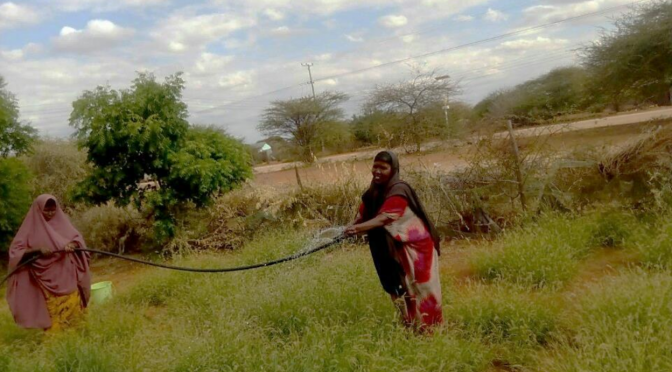
An IR Kenya staff evaluates the solarization of the ‘Wagalla Mother to Mother Support’ Group Shallow well at their farm

This project is a part of Islamic Relief’s Sustainable Solutions campaign and has greatly impacted the lives of these women in the vulnerable community of Wajir County to grow and prosper through socio-economic empowerment.

10.04.18

Partnering with Australian NGO to deliver safe water solutions

  News

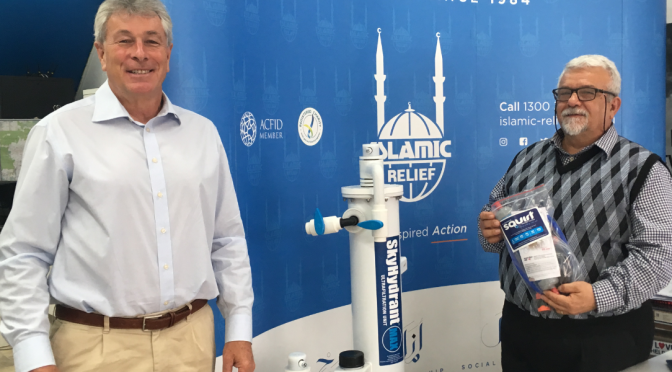
Islamic Relief Australia is partnering with Australian NGO, SkyJuice to deliver sustainable and safe water solutions for vulnerable communities

Islamic Relief Australia is aiming to work with the SkyJuice Foundation, a Sydney based NGO, internationally recognized for developing ultra-water filtration pump for developing communities.

SkyJuice supplies affordable and sustainable water treatment systems for humanitarian projects and emergency and disaster relief based on passive membrane technology.

Rhett Butler is a professional mechanical engineer, as well as an active social entrepreneur and public speaker on water issues who is the founder and CEO of SkyJuice.  

Rhett has over 30 years senior management and strategy experience in the global water industry as well as significant exposure in manufacturing, small business and industrial development. 

The water sanitation units are designed and manufactured by the foundation whose aim is to “provide low cost, sustainable water treatment solutions humanitarian programs in developing and third world nations including emergency and disaster relief.”

The ultrafiltration membrane provides complete physical filtration including disinfection removing bacteria, protozoa and pathogens greater than .04 micron. SkyHydrants are lightweight and easy to transport, require no power to operate and can be setup and run by non-technical persons. Safe, clean water for less than $1 per person per year.

Without access to clean water people cannot live. If their water comes from a faraway source, they have to spend their days carrying it instead of going to school or earning an income—this affects women and girls the most. 

Closely linked to clean water is sanitation. More than one-third of the world’s population—2.5 billion people—do not have improved sanitation facilities, and 1 billion of them still practice open defecation. Too often, this contaminates the community’s water source, threatening people’s health and lives. 

Integrating adaptable and World Health Organization (WHO) approved water technologies, Islamic Relief Australia aims to develop long term sustainable projects that aim on generating income for women and children.

10.02.18

Meet Chivan a Toddler Benefiting from the Disability Centre

  News

When Islamic Relief launched the Community Based Rehabilitation Centre addressing and treating people with disability, we were confronted with a community lacking information on accepting people with disabilities.

Lack of Disability Education Isolates People With Disability From Society

In 2000, Lebanon passed a law guaranteeing everyone with a disability the right to access education and other services. However, only a few  facilities in Lebanon have changed to accommodate for people with disabilities. 

Despite the demand for special-need services, the community negligence on disability rights has affected integration, education access and opportunity for many individuals with special needs.  

Human Rights Watch released a 75 page report earlier this year on Schools in Lebanon Discriminating Against Children with Disabilities. Few schools in Lebanon have taken steps to address the public issue, with recent policies going underway in 2018 to provide the children right of education.  

Single Mother in Lebanon Abandoned Due to Son with Disability 

Chivan was born with severe muscle paralysis, a health condition that limits his body movement. His mother, Asiya, was beaten during her pregnancy resulting in trauma that caused Chivan to develop epilepsy.  

When Chivans’ father, Yousef, discovered his son had muscle paralysis, he refused the reality that his family “been hit by epilepsy” and did not take responsibility to take care of them. As a result Yousef left his family behind.

“He left us in this situation and didn’t even think about us” Asiya said. 

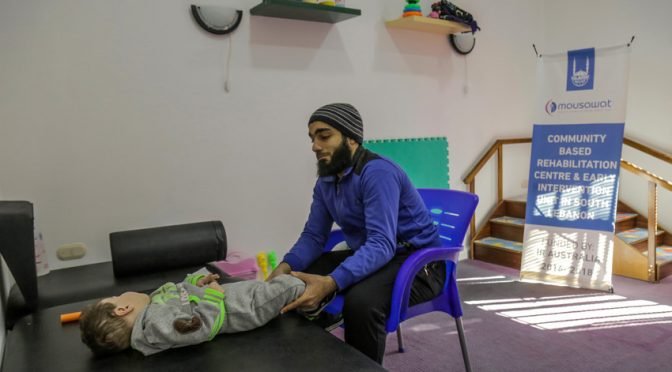
Chivan, two years of age, benefits from regular physiotherapy sessions at the community based rehabilitation and early intervention centre. [/caption]

Islamic Relief Australia launched and has implemented a Community Based Rehabilitation Centre in South Lebanon. The Centre’s Specialists work with Chivan by providing services special to his needs. Chivan  is dependent on chronic medications and ongoing physiotherapy sessions which hopefully may improve his situation.

Chivan lacks the ability to move at all. His muscles are almost fully inactive and his case requires consistent follow up and treatment. He has been benefiting from sessions in the Early Intervention Unit since May 2017 and the specialists continue to support him to be able to stand. 


Chivan is 2-years of age, and currently receives chronic medications and ongoing physiotherapy sessions that address his disability hopefully improving his situation.


The centre is supporting disabled children residing in the Saida area through providing them with physiotherapy, speech therapy and occupational therapy services in addition to sessions in special education and psychotherapy.

Inviting Locals to Take Part in Activities with People of Disability

The project holds recreational activities to tackle current anti-disability sentiments.  We invite parents of the children, community members and older people with disabilities to take part in recreational activities.

The project interacts with the South Lebanese community. People with disability should not be excluded from public space and everyday life. In the long term, we aim to deliver acceptance and integration of PWDs in Lebanon.

Islamic Relief also conducts workshops for PWD. Workshops cover a variety of topics which assist in facilitating community integration such as life skills and independent support.

Since the onset of the project over 1,000 people have benefited from the specialised services provided by these programs. 

More information on the Community Based Rehabilitation Centre can be found here.


Supporting disabled Palestinian refugee children residing in the Saida area through providing them with physiotherapy, speech therapy and occupational therapy services in addition to sessions in special education and psychotherapy


STAY INFORMED

  • This field is for validation purposes and should be left unchanged.

Quick Donate