04.03.25

Quality Assured Qurban: Why Give with Islamic Relief

  Dhul Hijjah     Publications

Qurban (or Udhiyah) is an act of worship most beloved to Allah (SWT) in the days of Sacrifice. These are the days of Eid Al-Adha, which include days of Tashreeq (11th, 12th and 13th of Dhul Hijjah). Therefore, it is important to provide the best possible offering for sacrifice during this sacred period. 

Islamic Relief Worldwide’s Quality Assured Qurban program upholds the Core Humanitarian Standard and Shariah compliance throughout its entire process. Used by all members of the Islamic Relief network, including Islamic Relief Australia, it ensures rightsholders receive quality, halal (permissible) and Tayyib (healthy, pure) Qurban meat.

With this program, Islamic Relief meets the needs of rightsholders. It also upholds the rules of Qurban, by ensuring Shariah compliance, regulatory standards and animal welfare standards.

Here are 6 reasons why giving Qurban with us means giving the best possible offering this Eid Al-Adha.

1. Specialised local team

One of our strengths is being close to our rightsholders. In every country where Islamic Relief distributes aid, we have field offices that allow us to be present on the ground. So we can act swiftly during times of crisis. We have dedicated staff employed in these countries who understand the local community. Often, especially during disasters, they also face the same struggles they do. This enables our teams to provide our rightsholders with the best possible support. And deliver this support with cultural sensitivity and care. 

back of islamic relief staff in yemen preparing for qurban distribution

2. Meeting the needs of rightsholders.

For all our projects, our field teams conduct a comprehensive needs assessment, collaborating with rightsholders, community leaders, and local authorities. This assessment helps identify and prioritise the most vulnerable individuals or groups. We also coordinate with other organisations involved in Qurban distribution to avoid duplication. It also ensures that our interventions reach underserved areas effectively. 

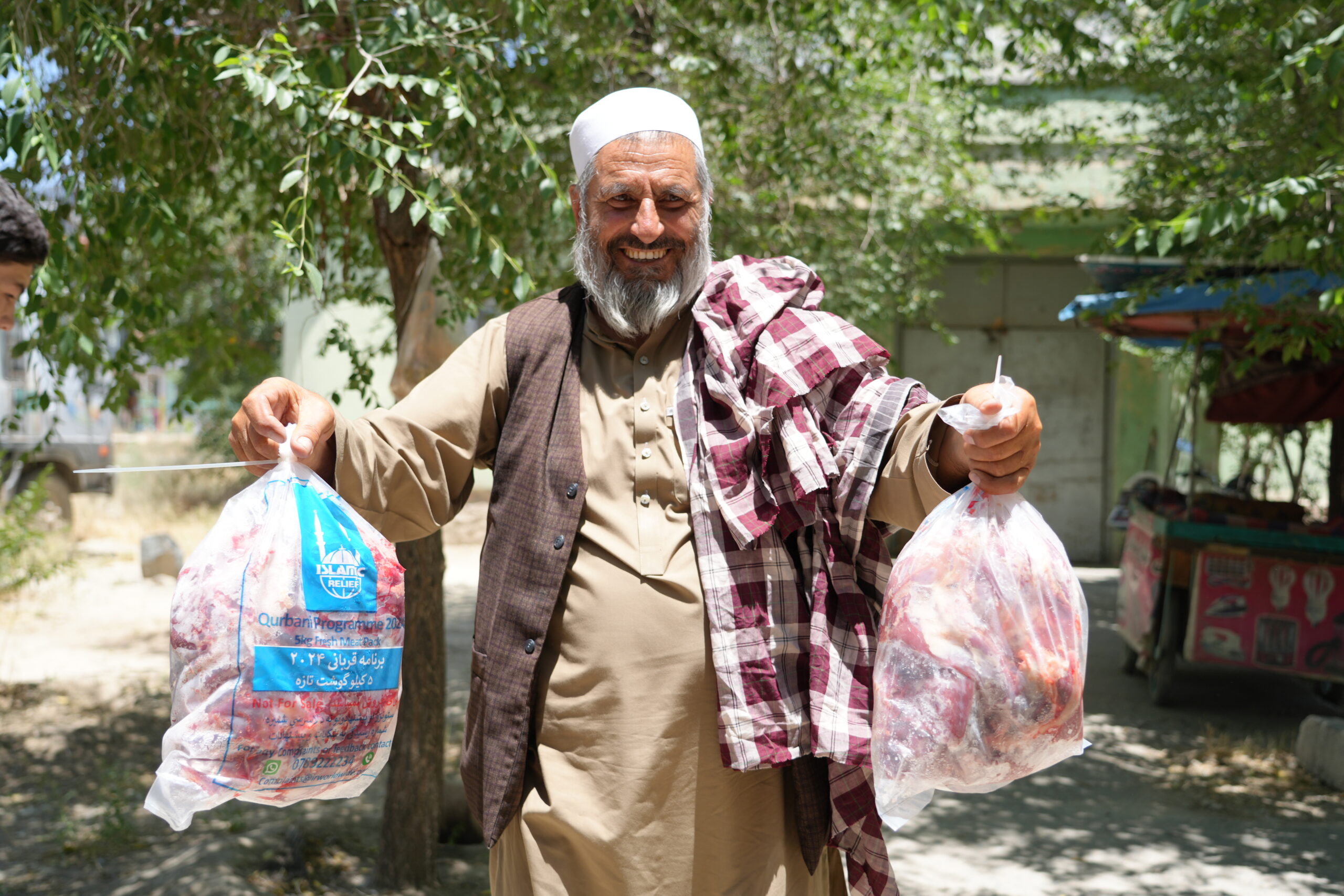
islamic relief staff in jordan helping a man walk while holding a bag of qurban meat local teams

The Qurban meat is transported in refrigerated trucks with a maintained cold chain until it reaches our rightholders. 

3. Upholding the rules of Qurban

Prior to slaughter, our livestock undergo rigorous inspections to ensure compliance with both veterinary and Shariah standards. These inspections guarantee that the animals meet the requirements for Qurbani according to Shariah principles. In turn, the inspection also ensures the resulting meat is of excellent quality and safe for human consumption. 

islamic relief staff preparing an animal (cow) for qurban inspection

Our approach for the Qurbani project is adaptable and tailored to the specific needs of each location. We prioritise collaboration with regulated slaughterhouses that uphold strict machinery and hygiene standards. Thus, ensuring the freshness and safety of the meat.

In the absence of regulated slaughterhouses, we adopt a community-led approach where trained volunteers and butchers actively engage the entire community under the close supervision of Islamic Relief staff.  

To maximise the impact and serve a greater number of households, our preference is to select larger animals for Qurbani, taking into consideration their availability in each country. This approach leads to a higher meat yield, allowing more households to receive Qurbani meat packs and benefit from our distribution efforts. 

4. Upholding Shariah compliance, regulatory standards and animal welfare with care and respect.

We prioritise adhering to the Core Humanitarian Standard and Shariah compliance throughout the entire Qurbani process. They conduct thorough inspections of the livestock and oversee the slaughter process. Our focus is to ensure the use of high-quality livestock suitable for this religious act, with supervision from veterinary doctors, local Imams, Ministry of Religious Affairs, Ulama, and other religious authorities.  
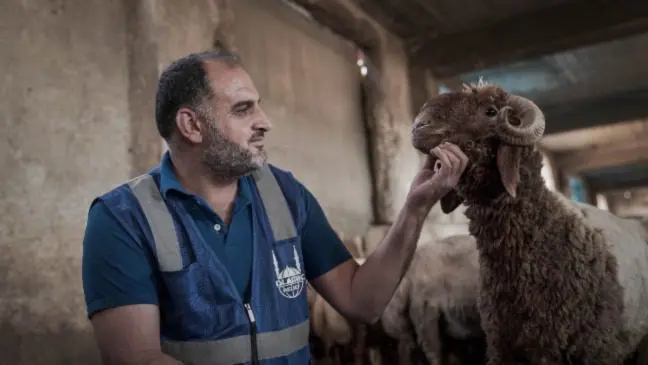
islamic relief staff preparing an animal (sheep) for qurban inspection

We maintain the well-being of the livestock and strictly follow best practices and compliance guidelines. Furthermore, we store the meat in refrigerators or transport it in refrigerated vehicles, adhering to local hygiene and food safety regulations. This commitment guarantees that the Qurbani process is conducted with care and respect, upholding religious and regulatory standards.

5. Ensuring minimal waste, and safe delivery of Qurbani to rights-holders in a timely manner.

Our dedicated staff members complete Islamic Relief Qurbani checklist declarations to ensure adherence to all Qurbani requirements. Waste disposal is carried out responsibly, following local regulations. In countries where all parts of the animal are consumed, such as offal and skin, waste is minimised. In other countries where only specific organs and meat are consumed, waste materials are appropriately disposed of either at the slaughterhouse or buried in designated community slaughter sites. 

Islamic Relief staff packing meat for qurban

To maintain efficiency and meet deadlines, we closely monitor the number of Qurbanis and the capacity of each field office. We establish contractual agreements with suppliers to accommodate any unexpected increase in Qurbani orders. With over 38 years of experience in conducting Qurbani, Islamic Relief Worldwide has cultivated strong relationships with local communities and suppliers, enabling us to fulfil Qurbanis promptly and efficiently. 

The Qurbani meat is transported in refrigerated trucks with a maintained cold chain until it reaches our rightsholders. 

6. Providing a high-quality service to our rightsholders.

Islamic Relief’s Qurbani prices may be slightly higher than those of other organisations, but this is because we prioritise providing a high-quality service to our right holders. We go the extra mile by purchasing healthy animals that yield more meat for our right holders.
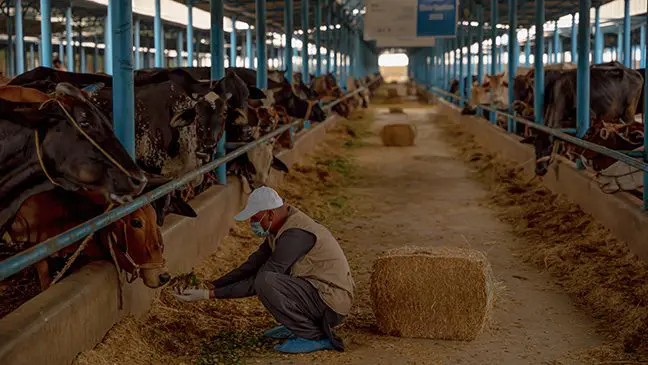
islamic relief staff feeding an animal for qurban

For instance, in countries like Iraq, the cows we purchase have an average weight of 480kg, surpassing the weight of cows selected by our competitors. We strongly believe in investing in various components of the Qurbani project to ensure its effectiveness. This includes conducting needs assessments, collaborating with local authorities, sourcing higher-spec livestock, and implementing rigorous monitoring, evaluation, accountability, and learning (MEAL) processes. These additional efforts are reflected in our prices as they contribute to reaching the most vulnerable rightholders in the most effective way possible.

Our commitment is to serve right holders with dignity and respect, while also considering the well-being of the environment. When it comes to slaughter practices, we ensure that they are conducted in appropriate sites with proper drainage and waste disposal systems, avoiding the issue of leaving waste unattended. 

This Dhul Hijjah, Share Your Blessings

Help the world’s most vulnerable families enjoy their Eid when you give Qurban with Islamic Relief.
04.03.25

When is Eid Al-Adha 2025 in Australia?

  Dhul Hijjah     News

Eid al-Adha is one of the two blessed celebrations Muslims obverse, the other being Eid al-Fitr. There are many observances unique to Eid Al-Adha (and Dhul Hijjah in general), including Qurban.

This year, Eid Al Adha 2025 is expected to fall on Friday, June 6, 2025, depending on the sighting of the moon.

What is Eid Al-Adha?

Eid al-Adha (meaning “festival of sacrifice”) is an Islamic celebration occurring in Dhul Hijjah, the twelfth and final month of the Islamic (Hijri) Calendar. Depending on the country and lunar cycle for the year, the celebration can last two to four days.

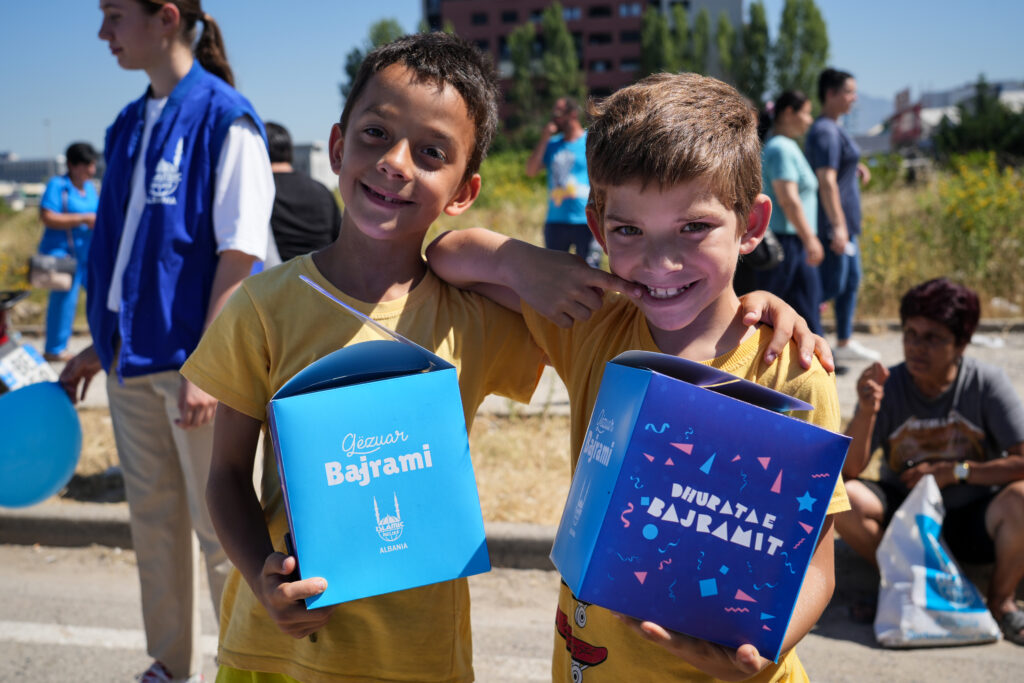
Children with Eid gifts for Eid Al-Adha

Photo: Children with Eid gifts

The Eid of Sacrifice commemorates the ultimate act of sacrifice performed by our beloved Prophet Ibrahim (AS). The submission he made in his willingness to give up what he loved most, his son, Ismail (AS), for the sake of Allah (SWT). 

As such, Muslims, in turn, also offer a sacrifice, known as Qurban, on this day of celebration.

What is Qurban?

Qurban (also known as Qurbani or Udhiyah) means sacrifice. It is an act of worship unique to Eid al-Adha, commemorating the sacrifice Prophet Ibrahim (AS) made to Allah (SWT).

Following the Eid prayer on the first day of celebration, Muslims around the world slaughter an animal – typically a sheep, goat, camel or cow. The sacrificed animal is then divided into three equal portions. One-third shared goes to the needy, one-third goes to relatives and neighbours, and the remainder Muslims keep for their own families. 

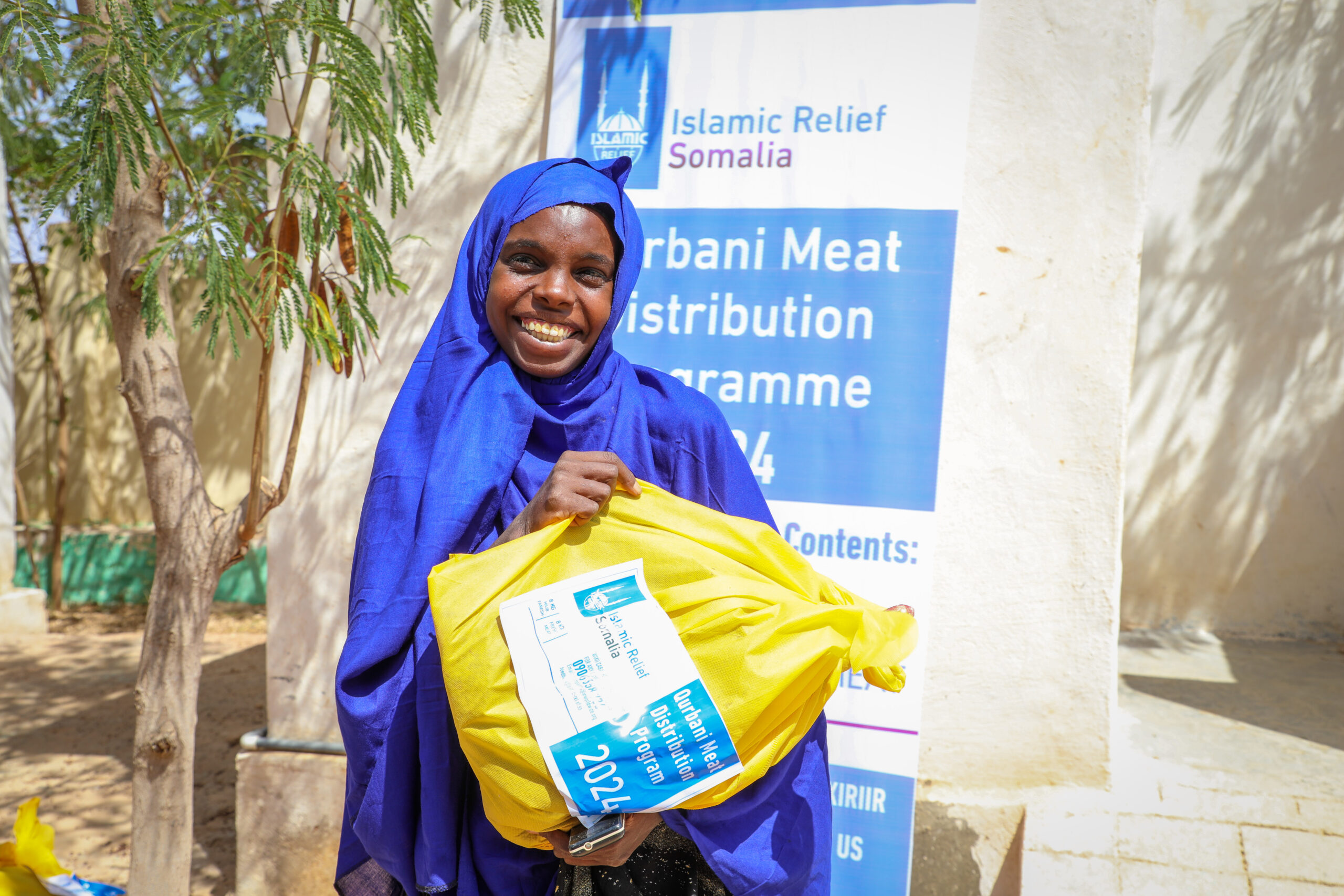
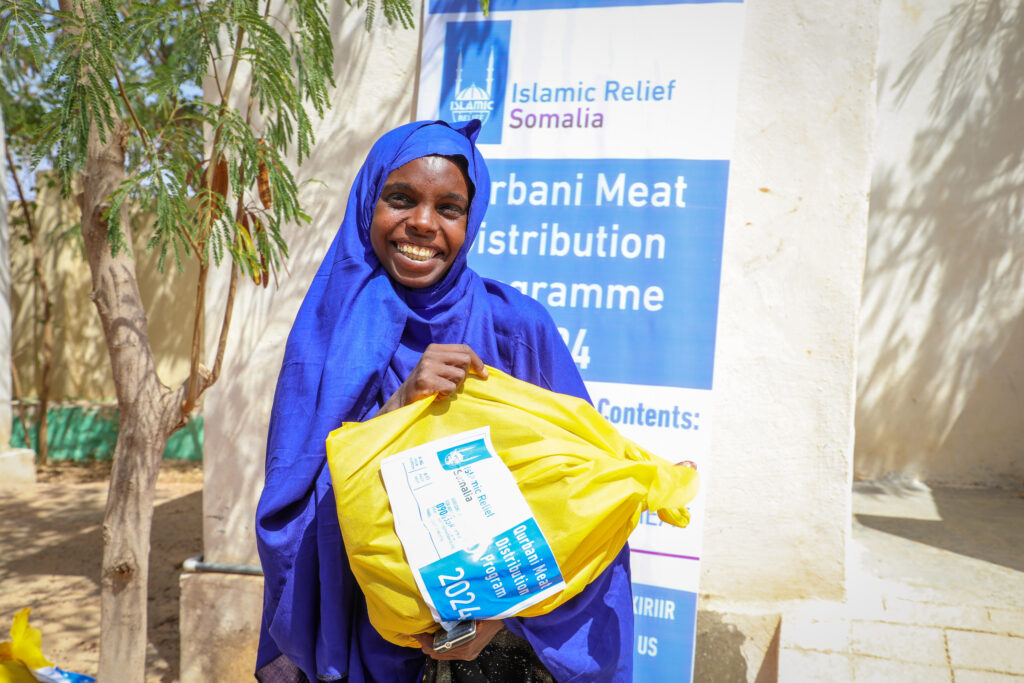
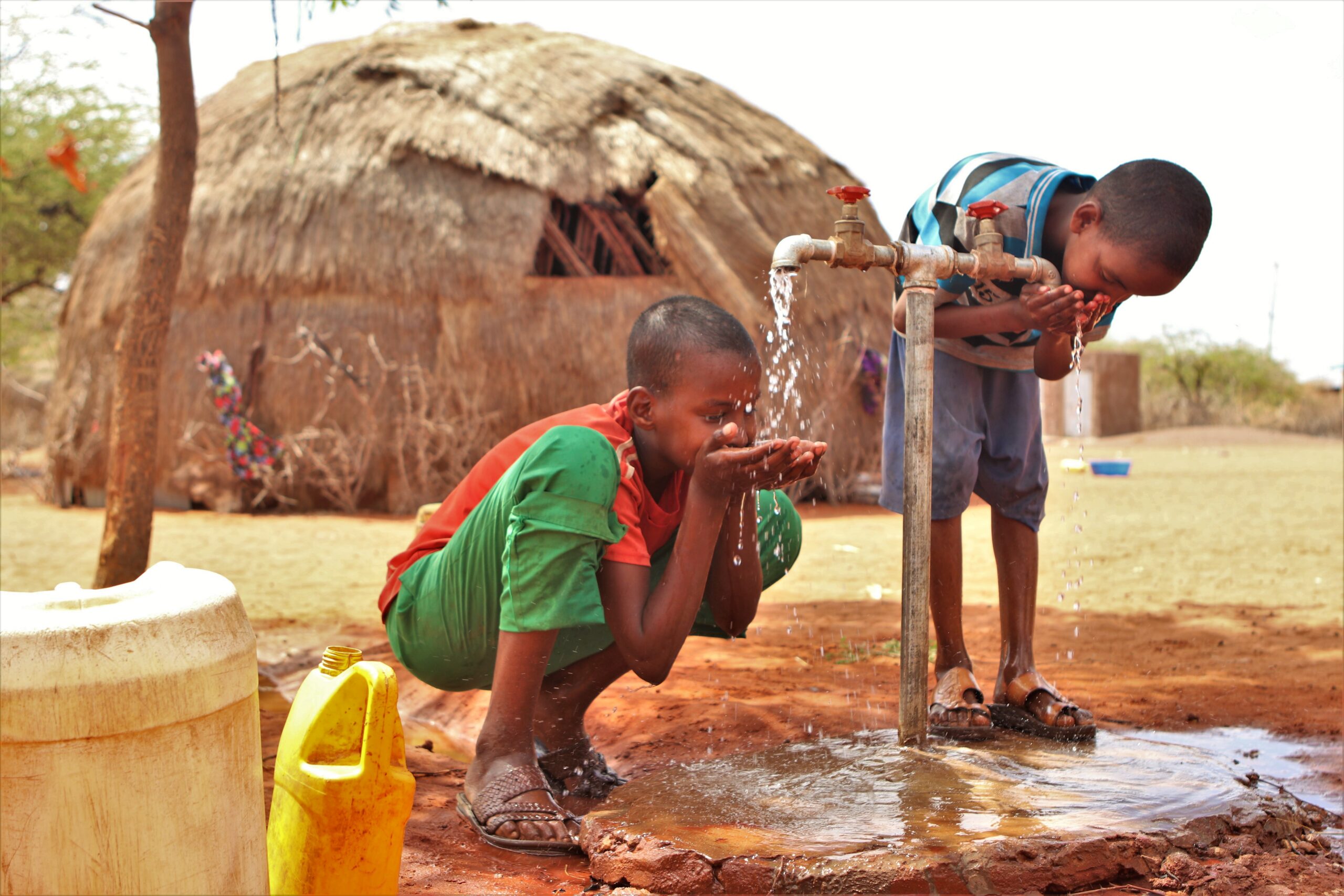
Qurban reaching those most in need in countries like this young child in Somalia during Eid Al-Adha.
Photo: Qurban reaching those most in need in countries like Somalia during Eid Al-Adha.  

Who should give Qurban?

Qurban is an important act of worship that every Muslim who has reached the age of puberty should do if they can afford it. Typically, Muslims who are eligible for Zakat should also give Qurban.

When should I give my Qurban?

It is best practice to purchase your Qurban as early as possible so that it can be performed on time. While one can carry out the sacrifice on any day of Eid al-Adha (from the 10th to the 13th of Dhul Hijjah), performing it on the first day is Sunnah.

The Prophet Muhammad (ﷺ) used to carry out the sacrifice immediately after the Eid prayer. In turn, his first meal on the day of Eid was meat from the sacrifice. 

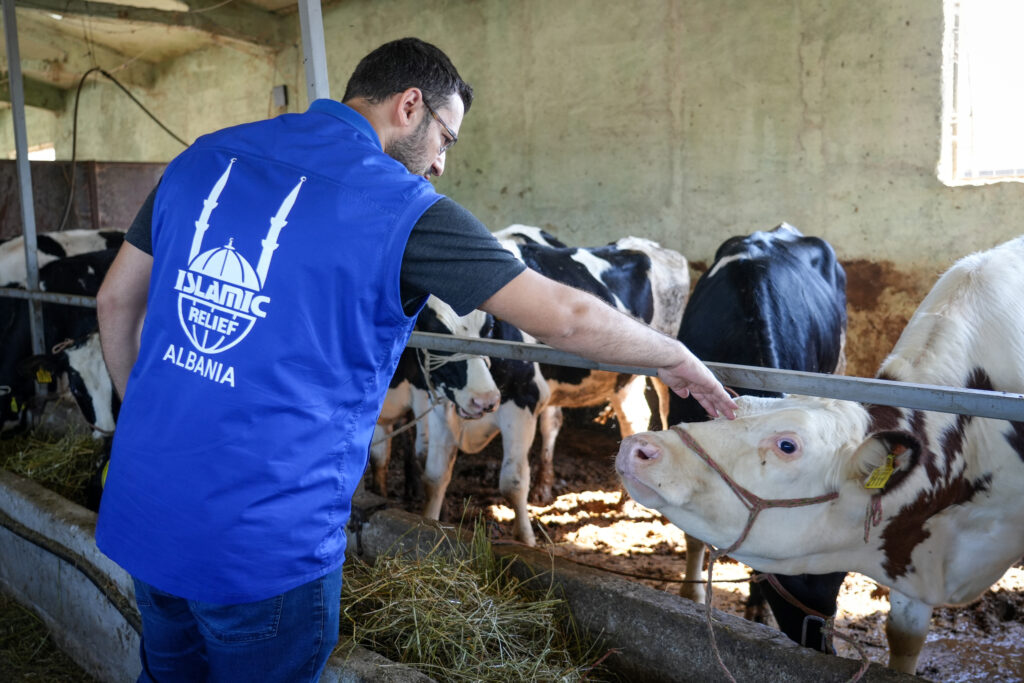
Islamic Relief staff inspecting animals for Qurban, to be sacrificed during Eid Al-Adha
Photo: Islamic Relief staff inspecting animals for Qurban

Other Observances of Eid Al-Adha

As with any festival and important occasion, we follow the example of Prophet Muhammad (ﷺ). There are various Sunnah acts of worship you can do on the day of Eid. These include performing ghusl, wearing one’s best clothes, reciting takbeer and offering Eid greetings.

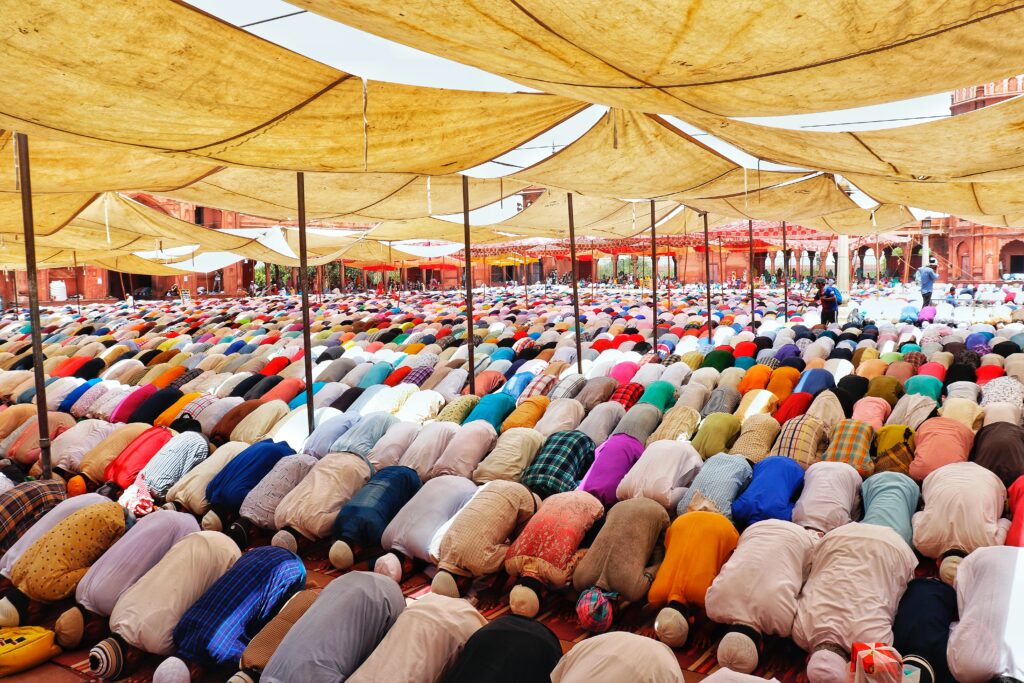
Similar to Eid al-Fitr, Eid prayer is also an important part of Eid al-Adha. Attending the Eid prayer and walking to the Eid prayer are also Sunan of the Prophet (ﷺ).

Why donate your Qurban to Islamic Relief?

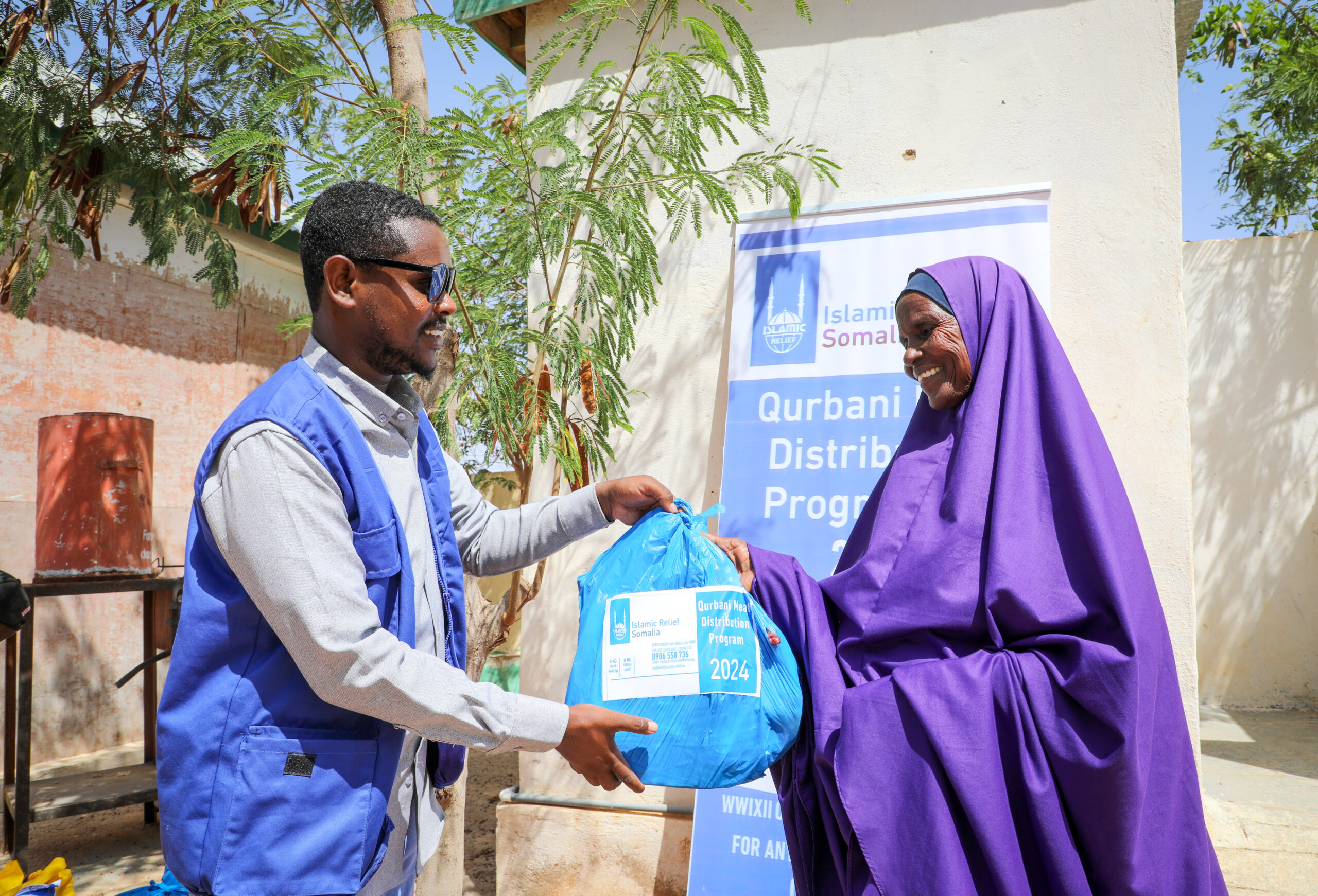
When you donate your Qurban to Islamic Relief, we prioritise providing meat to the most vulnerable families across the world during the Holy season. 

Our international teams work hard to get your donation to the hardest-to-reach regions and conflict-affected areas, including Myanmar, Palestine, and Yemen. 

Meat is sourced locally to support the local economy and distributed fresh. All logistics—from sacrifice to transportation—are handled in accordance with Islamic principles and with the best hygienic practices possible. Each pack contains 2-5 kilograms of meat and feeds a family of approximately 4-8 people.

Donate Qurban now and make your sacrifice. 

03.27.25

How to Pray Taraweeh

  Publications     Ramadan

Taraweeh (Tarawih) is a night prayer performed during Ramadan. It is prayed in sets of 2 until completion, which can be at 8, 12 or 20 raka’at. The act of worship can also pardon the past sins of a believer.

The Prophet Muhammad (ﷺ) said:

Here’s one variation, with a simple step-by-step breakdown of how to pray Tarawih:

  1. Pray 4 raka’at Fardh of Isha
  2. Pray 2 raka’at Sunnah of Isha.
  3. Set intention to start praying Tarawih/qiyam.
  4. Pray the first 4 raka’at of Tarawih, 2 raka’at at a time.
  5. Take a short break after each interval of 4 raka’at.
  6. Pray another 4 raka’at of Tarawih.
  7. Rest.
  8. Either end Tarawih here or pray the remainder until 8, 12 or 20 total raka’at are reached.
  9. End the night with Witr prayer.
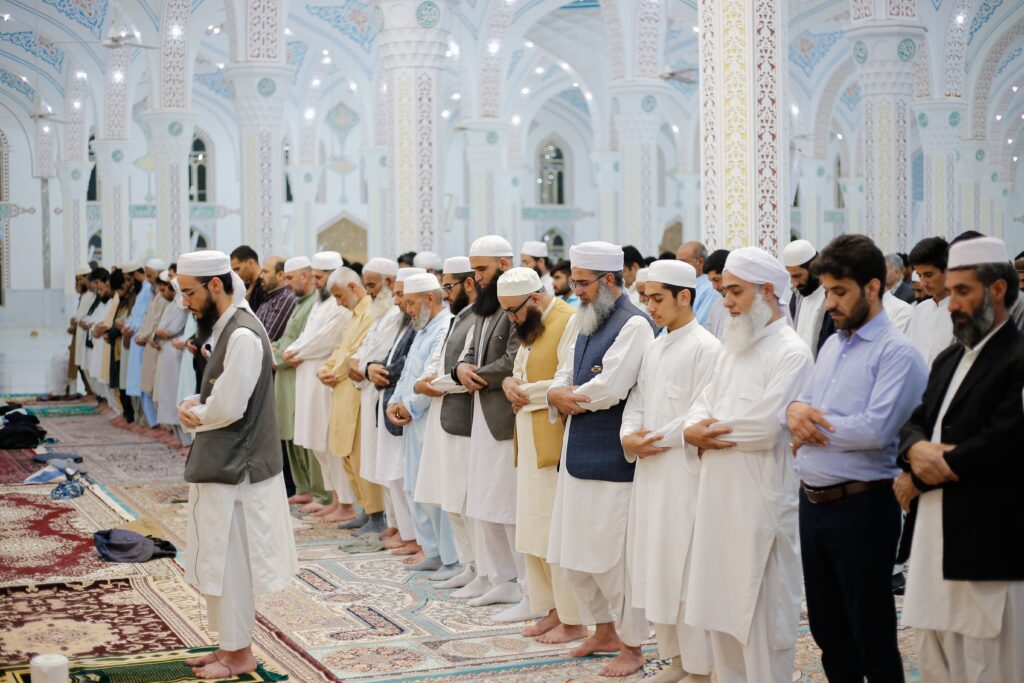
Taraweeh prayer is a staple of Ramadan.

What is Taraweeh (Tarawih)?

Meaning rest or relaxation, Tarawih is a voluntary prayer performed after the evening prayer, Isha, every single night during Ramadan.

As it is a highly recommended Sunnah, mosques across the world hold congregational Tarawih prayers for men and women every night of this blessed month.

The Messenger of Allah (ﷺ) said:

How many raka’at are in Tarawih?

Taraweeh, like other voluntary prayers, is prayed in sets of 2 raka’at at a time with the ability to rest after every 4 raka’at.

When attending Taraweeh at a masjid, the most important aspect is to finish praying with the Imam regardless of the number of raka’at he prays and not leaving early. The number of raka’at prayed can differ from mosque to mosque. So it’s best to check beforehand to better prepare yourself.

When is Taraweeh performed?

Taraweeh prayer is observed at night. It can be prayed anytime after the obligatory Isha prayer but before Witr, as the Witr prayer is the last prayer of the night.

Can Taraweeh be performed at home?

Yes, Taraweeh can be performed at home. In fact, the Prophet Muhammad (ﷺ) performed most of his Taraweeh prayers at home. However, it is highly encouraged to be performed at the mosque for men as the reward is higher.

Du’a to recite during Tarawih

It’s encouraged to increase your supplications and remembrance of Allah (SWT) during Taraweeh. There isn’t a specific du’a that must be recited, but you can use this opportunity to ask Allah for forgiveness, guidance, and blessings. A commonly recited du’a for seeking forgiveness is:

‘Allahumma innaka afuwwun tuhibbul afwa fa’fu anni’

اللَّهُمَّ إِنَّكَ عَفُوٌّ تُحِبُّ العَفْوَ فَاعْفُ عَنِّي

O Allah, You are all Forgiving and love forgiveness, so forgive me.

This du’a is particularly powerful during Ramadan, as it is a month of mercy and forgiveness. You can also make personal du’as in your own language to connect with Allah sincerely.

Reciting the Qur’an during Taraweeh

Taraweeh is a wonderful opportunity to connect deeply with the Qur’an during Ramadan. Some mosques and homes follow the tradition of completing one Juz (chapter) each night, inspired by the practice of the Prophet Muhammad (ﷺ).

It was narrated from ‘A’isha that Fatimah, the daughter of Prophet Muhammad (ﷺ), said:

He [the Messenger of Allah (blessings and peace of Allah be upon him)] told me: Jibreel used to review the Qur’an every year with him once or twice, but this year he reviewed it with him twice. He said: “I think that my death has drawn near, so fear Allah and be patient, for what a good example I am for you.”

Hadith | Muslim

While completing the Qur’an during Taraweeh is a great goal, it is not compulsory. You can recite any surahs you know, whether long or short. If needed, you may also hold a Qur’an (mushaf) to read during prayer, according to the Hanbali, Maliki and Shafi’i schools of thought.

Ramadan is the month of the Qur’an, so focus on sincere recitation and reflection. Whether you recite a little or a lot, each effort brings you closer to Allah (SWT).

Find out more about the holy month of Ramadan here.

03.27.25

Tahajjud Duas: What You Can Recite During the Prayer

  Publications

The Tahajjud prayer is a Nafl (voluntary) but deeply rewarding night prayer to connect with Allah (SWT) during the peaceful hours of the night. There are also several tahajjud duas you can recite to enhance your experience and make the most of the prayer.

The Signficance of Reciting Dua During Tahajjud Prayer

Reciting dua during Tahajjud is a significant act of worship. For it allows us to present our deepest hopes and concerns to Allah in the stillness of the night.

woman making dua, making dua is a way to elevate your tahajjud

The sincerity of these supplications is amplified during this time, making it a powerful moment for seeking guidance, forgiveness, and divine blessings.

The Prophet Muhammad (ﷺ) emphasised the importance of dua during Tahajjud, encouraging believers to call upon Allah using both prescribed supplications and personal prayers. Whether recited during bowing, prostration, or between movements, it serves as a means of drawing closer to the Almighty and attaining His mercy and favour.

Tahajjud Duas to Recite During Prayer

Beyond general worship, Tahajjud duas can be tailored to specific needs, such as seeking success, knowledge, or marriage. The duas themselves also focus on seeking forgiveness, guidance, and blessings from Allah (SWT).

Here are some duas relating to various aspects of life to recite during Tahajjud, as derived from authentic Islamic sources.

General Tahajjud Dua

This dua is a comprehensive supplication that covers submission to Allah, seeking His protection, and asking for His guidance:

Allahumma laka aslamna, wa bika amanna, wa ‘alayka tawakkalna, wa ilayka anabna, wa bika khasamna. Allahumma inna na’udhu bi ‘izzatika la ilaha illa anta an tudillana, anta al-hayyu alladhi la yamutu, wal-jinnu wal-insu yamutun.

اللهم لك أسْلَمْنا، وبك آمَنَّا، وعليك تَوَكَّلنا، وإليك أَنَبْنَا، وبك خَاصَمْنَا. اللهم إنَّا نعوذُ بِعِزَّتِكَ لا إلهَ إلا أنتَ أن تُضِلَّنا، أنْتَ الحيُّ الذي لا يموتُ، والجِنُّ والإِنْسُ يَمُوتُون.

“O Allah, to You we have submitted, in You we have believed, upon You we have relied, to You we have turned, and with Your help we have disputed. O Allah, we seek refuge in Your might—there is no deity except You—that You do not lead us astray. You are the Ever-Living who does not die, while the jinn and mankind die.”

Dua for Seeking Good and Protection from Evil

This dua is a beautiful way to ask Allah for all forms of good and to seek refuge from all forms of evil:

Allahumma inna nas’aluka min al-khayri kullihi ‘ajilihi wa ajilihi ma ‘alimna minhu wa ma lam na’lam, wa na’udhu bika min ash-sharri kullihi ‘ajilihi wa ajilihi ma ‘alimna minhu wa ma lam na’lam. Wa nas’aluka al-jannata wa ma qarraba ilayha min qawlin aw ‘amal, wa na’udhu bika min an-nari wa ma qarraba ilayha min qawlin aw ‘amal.

اللهم إنا نَسأَلُكَ من الخيرِ كُلِّهِ عاجِلِهِ وآجِلِهِ ما عَلِمْنَا منه وما لم نَعْلَمْ، ونعوذُ بك من الشر كله عاجِلِهِ وآجِلِهِ ما عَلِمْنَا من وما لم نَعْلَمْ.. ونسألكَ الجَنَّة وما قَرَّبَ إليها مِنْ قولٍ أو عمل، ونعوذ بك من النارِ وما قَرَّب إليها مِنْ قولٍ أو عمل.

“O Allah, we ask You for all that is good, in this world and the next, what we know of it and what we do not know. We seek refuge in You from all that is evil, in this world and the next, what we know of it and what we do not know. We ask You for Paradise and for that which brings one closer to it, in word and deed. And we seek refuge in You from Hellfire and from that which brings one closer to it, in word and deed.”

Dua for Forgiveness, Well-Being, and Protection

This dua is a powerful supplication for seeking forgiveness, well-being, and protection from hardships:

Allahumma inna nas’aluka min khayri ma sa’alaka ‘abduka wa nabiyyuka, wa na’udhu bika min sharri ma ista’adhaka minhu ‘abduka wa nabiyyuka. Wa nas’aluka an taj’ala kulla qada’in qadaytahu lana khayran. Allahumma inna nas’aluka al-‘afwa wal-‘afiyata wal-mu’afata fid-dunya wal-akhirah, ya dhal-jalali wal-ikram, ya hayyu ya qayyum. Allahumma inna na’udhu bika min jahdi al-bala’, wa daraki ash-shaqa’, wa su’i al-qada’, wa shamatati al-a’da’.

اللهم إنا نسألك من خيرِ ما سألكَ عَبْدُكَ ونَبِيُّكَ، ونعوذُ بك من شر ما استعاذك منه عبدُكَ ونبيكُ، ونسألكَ أن تجعلَ كُلَّ قضاءٍ قَضَيْتَهُ لنا خيرًا.. اللهم إنا نسألكَ العَفْوَ والعافيةَ والمُعَافاةَ في الدنيا والآخرةِ، يا ذا الجَلالِ والإِكْرامِ، يا حيُّ يا قيوم، اللهم إنا نعوذُ بك من جَهْدِ البَلاءِ، ودَرَكِ الشَّقَاءِ، وسُوءِ القَضَاءِ، وشَمَاتَةِ الأعْدَاءِ.

“O Allah, we ask You for the good that Your servant and Prophet has asked of You, and we seek refuge in You from the evil from which Your servant and Prophet sought refuge. We ask You to make every decree You have ordained for us good. O Allah, we ask You for forgiveness, well-being, and protection in this world and the Hereafter. O Possessor of Majesty and Honor, O Ever-Living, O Self-Sustaining. O Allah, we seek refuge in You from the hardship of trials, the depths of misery, the evil of decrees, and the gloating of enemies.”

Dua for Help, Guidance, and Strength

This dua is a heartfelt plea for Allah’s assistance, guidance, and victory over challenges:

Rabbi a’inni wa la ta’in ‘alayya, wansurni wa la tansur ‘alayya, wamkur li wa la tamkur ‘alayya, wahdini wa yassir al-huda li, wansurni ‘ala man bagha ‘alayya. Rabbi ij’alni laka shakiran, laka dhakiran, laka rahiban, laka mitwa’an, ilayka mukhbitan aw muniban. Taqabbal tawbati, waghsil hawbati, wa ajib da’wati, wa thabbit hujjati, wahdi qalbi, wa saddid lisani, waslul sakhimata qalbi.

رَبّ أعني ولا تعن عَليَّ، وَانْصُرْنِي وَلا تَنْصُرْ عَلَيَّ، وَامْكُرْ لي وَلا تَمْكُرْ علي، واهدني ويسر الهدي لي، وَانْصُرْنِي على مَنْ بَغَى عَليَّ، رَبّ اجْعَلْنِي لَكَ شاكِرًا، لَكَ ذَاكِرًا، لَكَ رَاهِبًا، لَكَ مِطْوَاعًا، إليك مخبتا أوْ مُنيبًا، تَقَبَّلْ تَوْبَتِي، وَاغْسِلْ حَوْبَتي، وَأجِبْ دَعْوَتي، وَثَبِّتْ حُجَّتِي، وَاهْدِ قَلْبِي، وَسَدّدْ لِساني، وَاسْلُلْ سَخِيمَةَ قَلْبِي.

“My Lord, help me and do not help anyone against me. Grant me victory and do not grant victory to anyone over me. Plan for me and do not plan against me. Guide me and make guidance easy for me. Grant me victory over those who wrong me. My Lord, make me grateful to You, remembering You, fearing You, obedient to You, humble before You, and turning to You in repentance. Accept my repentance, wash away my sins, answer my supplication, strengthen my argument, guide my heart, make my tongue firm, and remove the malice from my heart.”

Tahajjud Duas from the Sunnah

Central to Tahajjud prayer is the act of dua, or supplication. Muslims use this intimate time to converse with Allah, seeking guidance, forgiveness, and blessings.

Let’s explore some of the supplications the Prophet (ﷺ) recited during prayer.

Remembrances of Bowing (Ruku’)

As believers bow before their Lord in humility and submission, they glorify Allah with profound reverence. Prophetic traditions encourage the recitation of phrases such as “Subhana Rabbiyal Azeem” (Glory be to my Lord, the Great) or “Subhana Rabbiyal Azeem wa bihamdih” (Glory be to my Lord, the Great, and praise be to Him). 

Additionally, heartfelt expressions of submission and trust in Allah’s sovereignty are recommended, such as :

اللهمَّ لك ركعتُ، وبك آمنتُ، ولك أسلمتُ، خشع لك سمعي، وبصري، ومُخِّي، وعظمي، وعَصَبي

O Allah, it is for You that I bowed, it is in You that I believed, and it is to You that I submitted. Humbled to You are my hearing, my eyesight, my mind, my bones, and my tendons.” 

Muslim

Remembrances After Rising from Bowing (Rising from Ruku’)

Upon rising from bowing, believers express gratitude and praise to Allah, acknowledging His infinite mercy and blessings. Prophetic traditions suggest reciting phrases like “Rabbana wa lakal hamd” (Our Lord, praise be to You) or “Subhana Rabbiyal A’la” (Glory be to my Lord, the Most High).

And you may add: 

اللَّهُم ربَّنا لك الحَمد، مِلْءَ السَّماوات ومِلْءَ الأرض، ومِلْءَ ما شِئت من شَيء بعد، أهْل الثَّناء والمَجد، لا مانع لما أعْطَيت، ولا مُعْطِي لما مَنعت، ولا يَنفع ذَا الجَدِّ مِنْك الجَدِّ

“O Allah, our Lord, praise is due to You, (praise) that fills the heavens and the earth, that fills what exists between them, and that fills anything You desire afterward. All praise and glory belong to You. No one can withhold what You have given and no one can give what You have withheld. And the good fortune of a person will not avail him before You.” 

Muslim

Remembrances of Prostration (Sujood)

Prostration is a moment of profound closeness to Allah, where believers humble themselves before their Creator. Prophetic teachings emphasise the importance of frequent supplication during prostration, as it is a time when prayers are readily accepted. 

اللَّهُم ربَّنا لك الحَمد، مِلْءَ السَّماوات ومِلْءَ الأرض، ومِلْءَ ما شِئت من شَيء بعد، أهْل الثَّناء والمَجد، لا مانع لما أعْطَيت، ولا مُعْطِي لما مَنعت، ولا يَنفع ذَا الجَدِّ مِنْك الجَدِّ

“O Allah, our Lord, praise is due to You, (praise) that fills the heavens and the earth, that fills what exists between them, and that fills anything You desire afterward. All praise and glory belong to You. No one can withhold what You have given and no one can give what You have withheld. And the good fortune of a person will not avail him before You.” 

Muslim

Abu Hurayrah (RA) reported that the Messenger of Allah (ﷺ) said:

Believers may recite phrases like “Subhana Rabbiyal A’la” (Glory be to my Lord, the Most High) or “Rabbighfir li” (O Lord, forgive me), expressing their devotion and seeking Allah’s forgiveness and mercy.

The Prophet (ﷺ) would add:

اللهم لك سجدتُ، وبك آمنتُ، ولك أسلمتُ، سجد وجهي للذي خلقه، وصوَّره، وشقَّ سمعَه وبصرَه، تبارك الله أحسنُ الخالقين

“O Allah, it is to You that I prostrated myself, it is in You that I affirmed my faith, and it is to You that I submitted. My face has prostrated to the One who created it and shaped it and split open its faculties of hearing and seeing. Blessed is Allah, the best of Creators.” [Sahih]

Muslim

Remembrances for Sitting Between Two Prostrations

In the brief moment between the two prostrations, believers seize the opportunity to seek Allah’s forgiveness and mercy.

Prophetic traditions recommend reciting phrases like “Rabbighfir li” (O Lord, forgive me) or “Allahumma inni a’udhu bika min ‘adhabika” (O Allah, I seek refuge in You from Your punishment), expressing repentance and reliance on Allah’s infinite compassion.

Tahajjud Duas for Success

For those striving for success in worldly endeavors or seeking fulfillment in personal aspirations, Tahajjud prayer serves as a potent means of seeking Allah’s assistance.

Through earnest supplication and devotion in the stillness of the night, believers entrust their aspirations and dreams to the mercy and guidance of the Most Merciful.

Here are Quranic verses that you can use as Tahajjud Duas for Success:

Rabbana atina fid-dunya hasanatan wa fil ‘akhirati hasanatan waqina ‘adhaban-nar.

رَبَّنَآ ءَاتِنَا فِى ٱلدُّنْيَا حَسَنَةًۭ وَفِى ٱلْـَٔاخِرَةِ حَسَنَةًۭ وَقِنَا عَذَابَ ٱلنَّارِ

“Our Lord, give us in this world [that which is] good and in the Hereafter [that which is] good and protect us from the punishment of the Fire.”

Qur’an | Al-Baqarah | 2:201

Rabbana afrigh ‘alayna sabran wa thabbit aqdamana wansurna ‘alal-qawmil-kafirin.

رَبَّنَآ أَفْرِغْ عَلَيْنَا صَبْرًۭا وَثَبِّتْ أَقْدَامَنَا وَٱنصُرْنَا عَلَى ٱلْقَوْمِ ٱلْكَـٰفِرِينَ

“Our Lord, pour upon us patience and plant firmly our feet and give us victory over the disbelieving people.”

Qur’an | Al-Baqarah | 2:250

Rabbi zidni ‘ilma.

رَّبِّ زِدْنِى عِلْمًۭا

“My Lord, increase me in knowledge.”

Qur’an | Ta-ha | 20:114

Tahajjud Duas for Marriage

Marriage is a sacred bond in Islam. For those seeking righteous spouses or strengthening their marriage, making dua during Tahajjud prayer holds profound significance. Here are some duas to recite:

Rabbana hablana min azwajina wa dhurriyatina qurrata ‘ayunin waj’alna lil-muttaqina imama

رَبَّنَا هَبْ لَنَا مِنْ أَزْوَٰجِنَا وَذُرِّيَّـٰتِنَا قُرَّةَ أَعْيُنٍۢ وَٱجْعَلْنَا لِلْمُتَّقِينَ إِمَامًا

Our Lord, grant us from among our wives and offspring comfort to our eyes and make us an example for the righteous.

Qur’an | Al-Furqan | 25:74

Rabbi inni lima anzalta ilayya min khairin faqeer.

 رَبِّ إِنِّى لِمَآ أَنزَلْتَ إِلَىَّ مِنْ خَيْرٍ فَقِيرٌۭ

“My Lord, indeed I am, for whatever good You would send down to me, in need.”

Qur’an | Al-Qasas | 28:24

Rabbi habli mina assaliheen

رَبِّ هَبْ لِى مِنَ ٱلصَّـٰلِحِينَ

“My Lord, grant me [a child] from among the righteous.”

Qur’an | Al-Saffat | 37:100

Rabbi la tadharni fardan wa anta khayrul-warithin.

رَبَّهُۥ رَبِّ لَا تَذَرْنِى فَرْدًۭا وَأَنتَ خَيْرُ ٱلْوَٰرِثِينَ

“My Lord, do not leave me alone [with no heir], while You are the best of inheritors.”

Qur’an | Al-Anbiya | 21:89

Elevate Your Tahajjud with Many Duas

In conclusion, the Tahajjud prayer is a profound means of strengthening one’s connection with Allah (SWT), offering an intimate space for supplication and spiritual reflection.

Reciting dua during Tahajjud amplifies the sincerity of one’s prayers, making it a powerful moment for seeking guidance, forgiveness, and blessings.

May Allah (SWT) grant us the strength to establish Tahajjud and recite heartfelt duas within it as a consistent part of our worship, Ameen!

03.27.25

Tahajjud Prayer: What it is and How to Pray It

  Publications

The Tahajjud prayer (Salatul Tahajjud) is a voluntary night prayer to attain mental strength and peace. It is a spiritual act of worship that allows Muslims to connect with Allah during the tranquil hours of the night. 

It is a Nafl (voluntary) prayer that holds immense blessings and is highly recommended for people who are seeking closeness to Allah and inner peace. 

Here, we explore the significance of Tahajjud, the best time to perform it, and a step-by-step guide on how to pray.

What is Tahajjud?

Performed during the last third of the night—after the Isha prayer and before Fajr—Tahajjud, or qiyām lay, is an act of devotion that allows us to connect deeply with Allah.

While it is not an obligatory prayer, Tahajjud holds immense significance. Allah says in the Qur’an:

Tahajjud was consistently performed by the Prophet Muhammad (ﷺ).

He (ﷺ) said:

Hold on tight to the night prayer. Indeed it is the habit of the righteous who came before you. It brings you close to your Lord, wipes away your sins, prevents you from sinning and repels sickness from the body.

Hadith |Tirmidhī

This prayer embodies humility and dedication, fostering a sense of closeness to Allah that strengthens faith and patience.

When to pray Tahajjud

Tahajjud can be prayed anytime after Isha and before Fajr. However, the most rewarding time is during the last third of the night. 

Allah says in the Qur’an:

The Prophet Muhammad (ﷺ) also said:

Our Lord descends every night to the lowest heaven when one-third of the night remains, and He says: ‘Who will call upon Me, that I may answer him? Who will ask of Me, that I may give him? Who will seek My forgiveness, that I may forgive him?’

Hadith | Bukhari & Muslim

What is the Difference between Tahajjud and Other Night Prayers?

Tahajjud prayer stands apart from Taraweeh and Qiyam al-Layl, each holding its distinct significance within Islamic worship. 

  • Taraweeh refers specifically to the night prayers offered during Ramadan, often at the beginning of the night. 
  • Qiyam al-Layl encompasses various acts of worship throughout the night. 
  • Tahajjud on the other hand, specifically denotes the act of praying after sleep, emphasising a unique aspect of night vigil and spiritual devotion.

How to pray Tahajjud

Before beginning the Tahajjud prayer, it’s important to prepare yourself by performing Wudu (ablution), finding a quiet and clean space for prayer, and deciding the number of Rakats (units of prayer) you’d like to pray.

Tahajjud is prayed in sets of two rakats, and there is no fixed number as to how many to pray.

Here is a quick step-by-step on how to read Tahajjud:

Step 1

Stand facing the Qibla with your feet shoulder-width apart.

Step 2

You should then make a sincere intention to pray Tahajjud to seek Allah’s pleasure. 

Step 3

Raise your hands and say “Allahu Akbar” (Allah is the greatest) to begin the prayer. Place your right hand over your left above your chest.

Step 4

Recite Surah Al-Fatihah (the opening chapter of the Quran), followed by another Surah or at least three verses from the Quran.

Step 5

Bow (Rukoo’) by saying “Allahu Akbar” and place your hands on your knees. Say “Subhana Rabbiy-al-Adheem” (Glory be to my Lord Almighty) at least three times.

Step 6

Rise from the bowing position and stand upright while saying, “Sami’ Allahu liman hamidah” (Allah hears those who praise Him) followed by “Rabbana lakal hamd” (O our Lord, to You is the praise).

Step 7

Prostrate (Sujood) by saying “Allahu Akbar” and place your forehead, nose, palms, knees, and toes on the ground. Say “Subhaana Rabbiy-al-A‘laa” (Glory is to my Lord, the Most High) at least three times.

Step 8

Sit up briefly while saying “Allahu Akbar.” Then return to Sujood, repeating “Subhaana Rabbiy-al-A‘laa” at least three times.

Step 9

Rise from the prostration and stand up saying “Allahu Akbar.” This concludes one Rak’ah.

Step 10

Begin the second Rak’ah and repeat steps 4–8.

Step 11

After completing two Rak’ahs, sit and recite the Tashahhud (At-tahiyyatu lillah, was-salawaatu wat-tayyibaat. As-salaamu ’alayka ayyuhan-Nabiyyu wa rahmat-Ullahi wa barakaatu. As-salaamu ’alayna, wa ’alaa ‘ibaadi-llahis saaliheen. Ashhadu alla ilaha illallah wa ashhadu anna muhammadan ‘abduhu wa rasuluhu).

Step 12

Send Salawat upon the Prophet Muhammad (ﷺ) by reciting: “Allahumma Salli ‘ala Muhammadin wa ‘ala aali Muhammadin, kama sallaita ‘ala Ibrahima wa ‘ala aali Ibrahima innaka Hamidum-Majeed. Allahumma barik ‘ala Muhammadin wa ‘ala aali Muhammadin kama barakta ‘ala Ibrahima wa ‘ala aali Ibrahima innaka Hameedum-Majeed”.

Step 13

It is highly recommended to recite some Sunnah du’as (supplications) at this point.

Step 14

Conclude the prayer by turning your head to the right and then to the left, saying “Assalamu alaikum wa rahmatullah” each time.

Step 15

After completing your prayer, make heartfelt supplications to Allah. This is a powerful time for Du’a, as the Prophet Muhammad (ﷺ) said:

“The closest that a servant comes to his Lord is during the last part of the night, so if you can be among those who remember Allah at that time, then do so.”

Hadith | Tirmidhi

Du’as for Tahajjud

Reciting dua during Tahajjud is a significant act of worship. For it allows us to present our deepest hopes and concerns to Allah in the stillness of the night.

The sincerity of these supplications is amplified during this time, making it a powerful moment for seeking guidance, forgiveness, and divine blessings.

The Prophet Muhammad (ﷺ) emphasised the importance of dua during Tahajjud, encouraging believers to call upon Allah using both prescribed supplications and personal prayers. Whether recited during bowing, prostration, or between movements, it serves as a means of drawing closer to the Almighty and attaining His mercy and favour.

making du'a is a beloved act of worship for tahajjud and in general

Rooted in prophetic teachings, these duas begin with praise, followed by gratitude and sincere requests, reflecting deep faith and trust in Allah (SWT). 

Dua for Starting Tahajjud

اللهم لك الحمد أنت قيم السماوات والأرض ومن فيهن، ولك الحمد، لك ملك السماوات والأرض ومن فيهن، ولك الحمد أنت نور السماوات والأرض ومن فيهن، ولك الحمد أنت ملك السماوات والأرض ومن فيهن، ولك الحمد أنت الحق، ووعدك حق، ولقاؤك حق، وقولك حق، والجنة حق، والنار حق، لك أسلمت، وبك آمنت، وعليك توكلت، وإليك أنبت، وبك خاصمت، وإليك حاكمت، فاغفر لي ما قدمت وما أخرت، وما أسررت وما أعلنت، أنت المقدم وأنت المؤخر، لا إله إلا أنت، أو لا إله غيرك، ولا حول ولا قوة إلا بالله.

“O Allah, to You is all praise. You are the Sustainer of the heavens and the earth and all that is within them. To You is all praise. Yours is the dominion of the heavens and the earth and all that is within them. To You is all praise. You are the Light of the heavens and the earth and all that is within them. To You is all praise. You are the King of the heavens and the earth and all that is within them. To You is all praise. You are the Truth, Your promise is true, the meeting with You is true, Your word is true, Paradise is true, Hell is true. To You I have submitted, in You I have believed, upon You I have relied, to You I have turned, with Your help I have disputed, and to You I have brought my case. Forgive me for what I have sent ahead and what I have left behind, what I have concealed and what I have declared. You are the One who brings forward and delays. There is no deity except You, or there is no deity besides You. There is no power or strength except by Allah.”

Dua During Sujood (Prostration)

اللهم اغفر لي ذنبي كله، دقه وجله، وأوله وآخره، وعلانيته وسره.

“O Allah, forgive me all my sins, the minor and the major, the first and the last, the open and the hidden.”

Dua After Tahajjud

اللهم إني أسألك رحمة من عندك تهدي بها قلبي، وتجمع بها شملي، وتلم بها شعثي، وترد بها ألفتي، وتصلح بها ديني، وتحفظ بها غائبي، وترفع بها شاهدي، وتزكي بها عملي، وتبيض بها وجهي، وتلهمني بها رشدي، وتعصمني بها من كل سوء.

“O Allah, I ask You for mercy from You by which You guide my heart, gather my affairs, mend my flaws, return my estrangement, rectify my religion, protect my absence, elevate my presence, purify my deeds, brighten my face, inspire me with guidance, and protect me from all evil.”

You can view more duas to read for Tahajjud here.

The benefits of Tahajjud

Praying Tahajjud is a beautiful way to nurture your connection with Allah (SWT).

By dedicating a portion of your night to this voluntary act of worship, you open your heart to Allah’s mercy and blessings. 

Tahajjud is also a powerful time for Du’a, with greater chances of your prayers being accepted during these quiet hours.

Even if you start with just two raka’at, aim to pray Tahajjud regularly. The key is consistency. The Prophet (ﷺ) said:

The most beloved deeds to Allah are those that are consistent, even if they are small.

Hadith | Bukhari & Muslim

During Ramadan, Tahajjud holds even greater significance for many believers, as the rewards for worship and prayer are multiplied, making it an ideal time to strengthen our bond with Allah.

Tahajjud is not about the quantity of your prayer but the sincerity and effort you put into it. Whether you are seeking forgiveness, guidance, or a deeper connection with Allah, this special prayer is a profound way to achieve it.

Find out more about the importance of Salah here.

03.27.25

What is Salah (Salat)?

  Publications

Salah, also known as Salat or Prayer, is one of the five pillars of Islam and is a fundamental act of worship for Muslims. It involves the obligatory act of praying 5 times a day at set times, and is a direct means of communication with Allah. 

Muslims perform Salah as an essential part of their daily lives to seek guidance, forgiveness, and blessings from Allah and to fulfil their rights to Him. It involves performing specific physical movements and recitations whilst facing the Qiblah (direction of the Ka’bah in Makkah). The key in Salah is to have khushoo, which means to have focus and concentrate on the presence of Allah. 

What are the 5 daily prayers of Islam?

Muslims must perform 5 daily prayers. These are:

  • Fajr – this takes place at pre-dawn.
  • Dhuhr – this takes place just after the sun reaches its zenith.
  • Asr – this takes place between noon and sunset.
  • Maghrib – this takes place just after sunset.
  • Isha – this takes place during the night/at night-time.

Why is Salah important?

Salah is an integral part of the lifestyle of a Muslim. Through prayer, Muslims spend each day pondering on the verses of the Qur’an, the Shahadah (the declaration of faith), and Allah’s attributes.

Muslims across the world unite in prayer at five specified times each day in the direction (Qibla) of the Ka’bah in Makkah (Mecca), as a means of connecting to Allah and their purpose in life – to remember and worship Him.

How many Raka’at do the 5 Salawat have?

The 5 Salawat consist of various Fardh (obligatory) and Sunnah/Nafl (recommended/supererogatory) aspects. These are as follows:

SalahSunnah FardhSunnah NaflWitrNafl
Fajr2 Raka’at2 Raka’at
Dhuhr4 Raka’at4 Raka’at 2 Raka’at2 Raka’at
Asr4 Raka’at4 Raka’at
Maghrib3 Raka’at 2 Raka’at
Isha4 Raka’at4 Raka’at 2 Raka’at2 Raka’atAny odd number of raka’at (most commonly 3)2 Raka’at

What are Fardh prayers?

Fardh (Fard) prayers and Raka’at (units of prayer) are the prayers which are compulsory for us to perform.

The number of Fardh Raka’at differ for each prayer. For our 5 daily prayers, Fajr has 2, Dhuhr has 4, Asr has 4, Maghrib has 3, and Isha has 4.

What are the Sunnah and Nafl prayers?

Sunnah prayers are extra voluntary prayers that Prophet Muhammad (ﷺ) would pray in addition to Fardh prayers. Although these are optional, it is highly recommended to follow the Sunnahs of the Prophet (ﷺ) to maximise our rewards.

The confirmed (or “Rawatib”) Sunnah prayers are those associated with the five obligatory prayers (Fard/Fardh). They include the 2 Raka’at before Fajr, 4 Raka’at before Dhuhr and 2 after, 2 Raka’at after Maghrib, and 2 Raka’at after Isha.

The ‘Asr (Late-Afternoon) Prayer has no routine Sunnah (basic recommended voluntary prayer). However, it is mustahab (preferable and recommended) that one prays 4 Raka’at before the ‘Asr Prayer.

man in salah (salat) at the mosque

Nafl Salah are voluntary prayers that a Muslim may offer at any time as a form of extra Ibadah (worship). Optional prayers include Salat al-Istikhara (the prayer of seeking guidance), Salat at-Tahajjud (prayed late at night) or Salat at-Tawbah (prayer for repentance).

What is Witr Prayer?

Witr prayer is a voluntary night prayer in Islam, usually offered after the Isha prayer, the last of the 5 daily obligatory prayers. 

The word “witr” translates to “odd” or “single” in Arabic, referring to the odd number of rak’ahs (units) performed in this prayer. It holds special significance in the Islamic faith and is highly recommended.

The Witr prayer can be offered as 1, 3, 5, 7, or any odd number of Raka’ah – with 1 Rak’at being the minimum according to the majority of scholars and three Raka’at being the minimum in the Hanafi madhab. The most common practice is to perform 3 Raka’at in the Witr prayer. The Witr Prayer is also a Nafl Prayer. 

Jumuah Prayer

There is also Salatul-Jumu‘ah or Friday Prayer. This is a congregation prayer offered in place of Dhuhr Prayer every week on Friday. It also has only 2 Raka’at rather than 4 raka’a. However, there is a khutbah (sermon) before Jumu’ah prayer one must listen to for their prayer to count as being valid.

The Prophet (ﷺ) also persisted on attending the Friday sermon. Some of the Sahabah (Companions) also report that the khutbah is an essential condition for the Friday prayer being valid. 

Ibn Qudamah (RA) said: “To sum up, the khutbah is a condition of Jumu`ah, and it is not valid without it, as was stated by ‘Ata, al-Nakha’i, Qatadah, al-Thawri, al-Shafi’i, Ishaq, Abu Thawr and ashab al-rai. And we do not know of anyone who disagreed with that except al-Hasan.” (Al-Mughni)

prayer (salah) done congregation

The Friday prayer is compulsory for every adult male Muslim. Those who are sick, blind or disabled, those on a journey, and women, are exempt from the obligation of attending the Prayer at the mosque. But they may join the congregation if able, and receive reward for it.

There are also Sunnah one can offer after Jumu’ah prayer. As reported by Ibn al-Qayyim, when the Prophet (ﷺ) finished praying Jumu’ah, he would enter his house and pray two Rak’ahs of Sunnah, and he commanded those who had prayed it to pray four raka’at afterwards. (Al-Zad)

How to pray Salah?

Salah is a ritual prayer that requires certain etiquettes in order to perform it correctly. However, there are some slight differences in what etiquettes are required depending on the Madhab (school of thought) you follow within the Fiqh of Islam (Islamic jurisprudence). All four schools of thought are agreed upon and the prayer following any of these is valid. 

How to pray Eid Salah?

Eid prayer is prayed in congregation with other Muslims on the mornings of the two Eid celebrations, Eid al-Adha and Eid al-Fitr. You can follow our step-by-step guide to praying Eid Salah here.

When is Salah for my area?

Salah times are appointed to times of the day that depend on the position of the sun. Since parts of the world experience daylight and night differently, it is important to follow the prayer times when you are situated. An authority will usually gather and publish the prayer time in your area for the public’s ease. Please check your local mosque or musallah for prayer times.

03.26.25

How to Perform Eid Prayer (Salah)

  Publications     Ramadan

Prayer (Salah) is a crucial part of Eid celebrations, both for Eid al-Fitr and Eid al-Adha. This year, Eid al-Fitr is expected to fall on Friday, March 20, 2026. While Eid al-Adha is expected to occur on Wednesday, May 27, 2026.

On both festivals, Muslims gather together to perform a special congregational prayer, as well as celebrate and give thanks to Allah (SWT). So how do Muslims perform the Eid prayer?

What time is Eid prayer?

Eid prayer (Salah) takes place in the early morning (after Fajr) on the first day of Eid. Muslims are encouraged to pray in Jama’ah (congregation) with their local Muslim community on occasions such as these.

Eid prayer

Please check with your local mosque for the prayer schedule in your local area. If you pray with your local Muslim community, please check when and where they will be performing Eid prayer.

How to perform Eid prayer

Before you begin the prayer, when you first get up in the morning:

  • Make ghusl (the ritual ablution).
  • For Eid al-Fitr, it’s sunnah to eat something before prayer. The Prophet Muhammad (ﷺ) ate dates before going out to prayer. (Sahih Bukhari).
  • Wear the best clothes you have! Muslims are encouraged to clean themselves, dress in their best clothes and smell good for a day of celebration!
  • Say the general takbeerat on the way to the prayer.
  • For Eid al-Fitr, make sure you pay your Fitrana (Zakat al Fitr) before the start of prayer if you haven’t already!

When you’re ready to pray

  • Make the intention to perform Eid prayer.
  • Give the opening takbeer (‘Allahu Akbar’) with the imam.
  • Say the opening supplication quietly to yourself.
  • Give 3 more takbeer with the imam, raising your hands out for each.
  • Listen to the imam recite Surah al-Fatihah and an additional surah.
  • Say ‘Allahu Akbar’ while moving into ruku (bowing) with the imam and continue the prayer cycle as normal.
  • In the second rakah, listen to the imam recite Surah al-Fatihah and an additional surah.
  • Give 3 additional takbeer with the imam. After the third and final takbeer, place your hands to your sides before doing the ruku again.
  • Say ‘Allahu Akbar’ while moving into the bowing position with the imam and complete the prayer cycle as normal.

*Please note: This is the Hanafi method of performing Eid prayer. If the imam recites more takbeer, please follow the imam.

Regardless of when or where you are celebrating Eid, may the blessed festival be one of happiness, peace and immense blessings for you and your loved ones.

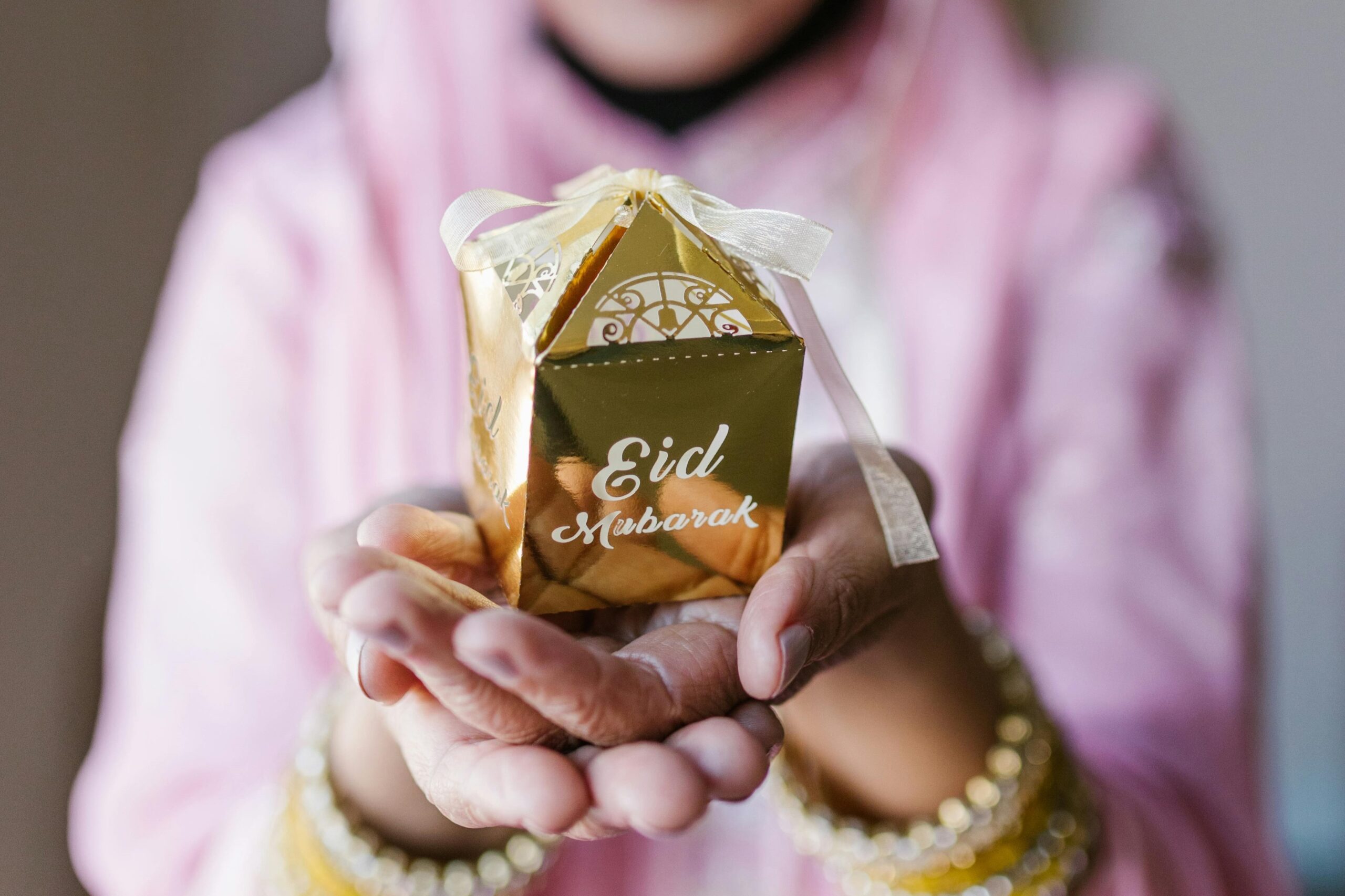
May Allah accept good deeds from us and from you! Eid Mubarak!

Have you paid your Zakat al-Fitr yet?

Multiply your rewards from Allah (SWT) this Eid. Give the gift of happiness and hope to our brothers and sisters in need with Islamic Relief.
03.26.25

Salat Al-Duha: How to Pray It and Its Significance

  Publications

Salat Al-Duha is a Sunnah prayer that holds immense spiritual rewards. It is performed in the morning after the sun has fully risen and before the time for Dhuhr begins.  

Also known as the “Forenoon Prayer” or “Ishraq Prayer” (when prayed earlier), it is a beautiful way to seek Allah’s blessings, forgiveness, and provision for the day ahead. 

In this guide, we’ll walk you through the significance, timing, and step-by-step method of performing Salat Al-Duha so you can incorporate it into your daily worship routine with ease. 

What Is Salat Al-Duha? 

Duha prayer is linguistically defined as the time of sunrise.  It is an optional prayer performed with two raka’at (singular: rak’ah) minimum that the Prophet (ﷺ) prayed frequently and advised his companions to pray. Its time is between sunrise and Dhuhr. 

The Duha prayer is a sunnah mu’akkadah (confirmed Sunnah). This means massive rewards and blessings for those who establish it, but there is no sin on the one who leaves it. 

When To Pray Salat Al-Duha? 

The time for Salat al-Duha extends from after sunrise (approximately 15 min. after sunrise) and ends before midday when the sun reaches its zenith.

man praying, praying salat al-duha is a sunnah

The most preferred time for Duha prayer is at the hottest part of the day, when the sun has reached its zenith (its highest point), and this is approximately halfway between sunrise and Dhuhr prayer. 

As the Prophet (ﷺ) said:  

“It is preferable to offer Duha prayer when the sun’s heat has become so intense that even the young of the camels feel it.” 

Sahih Muslim

How To Pray Salat Al-Duha? 

Duha prayer, like other Sunnah prayers, is offered two raka’at by two. We also pray it the same as we pray Fajr, which is also two raka’at. 

The minimum number of raka’at you can offer in Duha prayer is two raka’at. Abu Dharr reported the Prophet (ﷺ) as saying: 

“In the morning charity is due from every bone in the body of every one of you. Every utterance of Allah’s glorification is an act of charity. Every utterance of praise of Him is an act of charity, every utterance of profession of His Oneness is an act of charity, every utterance of profession of His Greatness is an act of charity, enjoining good is an act of charity, forbidding what is disreputable is an act of charity, and two raka’at which one prays in the forenoon will suffice.”

Sahih Muslim

This hadith also provides the example of four raka’at:

Allah’s Messenger (ﷺ) narrated that Allah, Blessed and Most High said: “Son of Adam: Perform four raka’at for Me in the beginning of the day it will suffice you for the latter part of it.” 

Jami` at-Tirmidhi

What Is The Maximum Number Of Raka’at For Duha Prayer? 

There is no maximum number of raka’at for Duha prayer. As there is no clear report that indicates a restriction on the number of raka’at for Duha prayer.

However, the Prophet (ﷺ) typically prayed Duha with four raka’at. He also offered more than that at times.

When Mu’adha asked ‘A’isha (RA) how many raka’at Allah’s Messenger (ﷺ) prayed at the forenoon prayer. She replied: Four raka’at, but sometimes more as he pleased (Sahih Muslim). 

The Prophet (ﷺ) also prayed eight raka’at on the day of the conquest of Makkah. As narrated by Abu Murra:

“I went to the Messenger of Allah (ﷺ) on the day of the Conquest of Mecca and found him taking a bath, and Fatimah, his daughter, had provided him privacy with the help of a cloth…When he had completed the bath, he stood up and observed eight raka’at (for the forenoon prayer) wrapped up in one cloth.” (Sahih Muslim)

Benefits Of Praying Salat Al-Duha 

Fulling Charity

As stated previously, in hadith, it fulfils morning charity for every joint in your body. For two raka’at of Duha which is sufficient as a charity on behalf of every joint in the body, and a sign of genuine gratitude to Allah S.W.T. (Sahih Muslim)

Becoming One of the Oft-Repentant

The Prophet (ﷺ) said: 

“None is diligent in establishing Duha prayer except one who is oft-repentant (awwāb), and it is the prayer of the oft-repentant.” (Al-Albani)

The term “Salat al-Awwabeen” comes from this narration. Here, the Messenger ﷺ emphasises that only the oft-repentant are persistent in praying Duha prayer habitually.

One of the signs of true repentance is returning to Allah (SWT) not only by cutting off a major sin, but striving to increase in one’s voluntary good deeds, such as nafl prayers (like Salat Al-Duha). 

Following a Sunnah

This advice of the Prophet (ﷺ) to Abu Hurayrah indicates the virtues and great rewards of fulfiling Duha prayer.

Abu Huraira narrated: “My friend (the Prophet ﷺ) advised me to observe three things: (1) to fast three days a month; (2) to pray two raka’at of Duha prayer (forenoon prayer); and (3) to pray witr before sleeping.” (Sahih al-Bukhari)

Immense Rewards from Allah (SWT)

Under certain conditions, the reward for praying Salat Al-Duha can be equivalent to a complete Hajj and ʿUmrah. 

Anas bin Malik narrated that the Messenger of Allah (ﷺ) said:

“Whoever prays Fajr in congregation, then sits remembering Allah until the sun has risen, then he prays two raka’at, then for him is the reward like that of a Hajj and Umrah.” He said: “The Messenger of Allah said: ‘Complete, complete, complete.'” 

Jami` at-Tirmidhi

(Note: This doesn’t fulfil the requirement to perform Hajj) 

Forgiveness of One’s Sins by Allah (SWT)

Abu Hurairah narrated that Allah’s Messenger (ﷺ) said: “Whoever continuously performs the two raka’at of Ad-Duha his sins will be forgiven, even if they be like the foam of the sea.” (Tirmidhi)  

Embrace the Blessings of Salat Al-Duha

Salat Al-Duha is more than just a Sunnah prayer—it is a powerful act of worship that brings immense rewards, spiritual peace, and a stronger connection to Allah (SWT).

The Prophet (ﷺ) himself advised his companions to observe this prayer regularly. Thus, by making the Duha prayer a part of your daily routine, you are following in the footsteps of the Prophet (ﷺ) and earning rewards that extend beyond the present moment.

Take the opportunity to incorporate this beautiful prayer into your mornings, and may Allah (SWT) reward you greatly for your efforts!

03.26.25

Du’as for Those Who Have Passed Away

  Publications

Losing a loved one is one of the hardest things we face in life, and may leave us feeling overwhelmed with grief, hurt, and confusion.

As such, we can make various du’as for the deceased as a way of comfort for ourselves, and to ask Allah (SWT) to provide our loved ones with ease as they depart this Dunya and begin their journey after death.

At Islamic Relief, we recommend seeking support from a professional if your bereavement has left you feeling unable to cope or if you need someone to talk to. 

There are, however, a few du’as for those who have passed away.

Du’a on receiving news of death/loss

In Surah Baqarah, the second chapter of the Qur’an, Allah says that when struck by disaster, you should say:

Inna li-llahi wa Inna ilayhi Raaji’un.

إِنَّا لِلَّهِ وَإِنَّآ إِلَيْهِ رَٰجِعُونَ

Verily we belong to Allah, and verily to Him do we return. 

Qur’an | Surah Al Baqarah | 2:156

Typically, a Muslim would recite this du’a upon hearing the news of someone passing away or when losing something. It’s not just recited as a du’a for the person, but as a reminder to ourselves that we will return to Allah on the day of Judgement. 

Du’a at the time of closing the eyes of the deceased

Umm Salama reported that the Prophet (peace be upon him) came to Abu Salama, one of his companions, (as he died). His eyes were fixedly open. He closed them, and then said: “When the soul is taken away the sight follows it.” Some of the people of his family wept and wailed. So he said:

He then said: “O Allah, forgive Abu Salama, raise his degree among those who are rightly guided, grant him a successor in his descendants who will remain. Forgive us and him, O Lord of the Universe, and make his grave spacious, and grant him light in it.” [Hadith | Muslim]

You can recite this particular du’a for your loved one:

Allaahummaghfir li (name of the person) warfa’ darajatahu fil-mahdiyyeena, wakhlufhu fee ‘aqibihi fil-ghaabireena , waghfir-lanaa wa lahu yaa Rabbal-‘aalameena, wafsah lahu fee qabrihi wa nawwir lahu feehi.

اللَّهُ أَكْبَرُ، اللَّهُ أَكْبَرُ، اللَّهُ أَكْبَرُ سُبْحَانَ الَّذِي سَخَّرَ لَنَا هَذَا وَمَا كُنَّا لَهُ مُقْرِنِينَ وَإِنَّا إِلَى رَبِّنَا لَمُنْقَلِبُونَ، اللَّهُمَّ إِنَّا نَسْأَلُكَ فِي سَفْرِنَا هَذَا الْبِرَّ وَالتَّقْوَى ، وَمِنَ الْعَمَلِ مَا تَرْضَى ، اللَّهُمَّ هَوِّنْ عَلَيْنَا سَفَرَنَا هَذَا وَاطْوِ عَّنَّا بُعْدَهُ ، اللَّهُمَّ أَنْتَ الصَّاحِبُ فِي السَّفَرِ، وَالْخَلِيفَةُ فِي الأَهْلِ، اللَّهُمَّ إِنِّي أَعُوْذُ بِكَ مِنْ وَعْثَاءِ السَّفَرِ، وَكآبَةِ الْمَنْظَرِ وَسُوءِ المُنْقَلَبِ فِي الْمَالِ وَالأَهْلِ

O Allah, forgive (name of the person) and elevate his station among those who are guided. Send him along the path of those who came before, and forgive us and him, O Lord of the worlds. Enlarge for him his grave and shed light upon him in it. 

Hadith | Muslim 2-634

Du’a for the deceased at the time of the funeral

The following du’a is known as the du’a for the deceased at the time of the funeral, although it is a du’a that can be recited at any time for the deceased.

Allāhumma’ghfir lahu warḥamh, wa `āfihi, wa`fu `anh, wa akrim nuzulah, wa wassi` mudkhalah, wagh’silhu bi ‘lmā’i wath-thalji walbarad, wa naqqihi mina ‘l-khaṭāyā kamā naqqaytath-thawba ‘l-abyaḍa minad-danas, wa abdilhu dāran khayran min dārih, wa ahlan khayran min ahlih, wa zawjan khayran min zawjih, wa adkhilhu ‘l-jannah, wa a`idhhu min `adhābi ‘l-qabri [wa `adhābin-nār].

اللهُـمِّ اغْفِـرْ لَهُ وَارْحَمْـه ، وَعافِهِ وَاعْفُ عَنْـه ، وَأَكْـرِمْ نُزُلَـه ، وَوَسِّـعْ مُدْخَـلَه ، وَاغْسِلْـهُ بِالْمـاءِ وَالثَّـلْجِ وَالْبَـرَدْ ، وَنَقِّـهِ مِنَ الْخطـايا كَما نَـقّيْتَ الـثَّوْبَ الأَبْيَـضَ مِنَ الدَّنَـسْ ، وَأَبْـدِلْهُ داراً خَـيْراً مِنْ دارِه ، وَأَهْلاً خَـيْراً مِنْ أَهْلِـه ، وَزَوْجَـاً خَـيْراً مِنْ زَوْجِه ، وَأَدْخِـلْهُ الْجَـنَّة ، وَأَعِـذْهُ مِنْ عَذابِ القَـبْر [وَعَذابِ النّـار]

O Allah, forgive him and have mercy on him, and give him strength and pardon him. Be generous to him, and enlarge his entrance (to his abode), and wash him with water and snow and hail. Cleanse him of his transgressions as white cloth is cleansed of stains. Give him an abode better than his home, and a family better than his family, and a wife better than his wife. Take him into Paradise, and protect him from the punishment of the grave [and from the punishment of Hell-fire]. 

Muslim 3-598

Du’a for the deceased during Salatul Janazah (Funeral prayer)

 Allahumma abduka wabnu amatika ihtaaja ila rahmatik wa anta ghaniyyun ‘an ‘adhaabih, in kaana muhsinan fazid fee hasanaatih, wa in kaana musee-an, fatajaawaz ‘anhu.

اللَّهُمَّ عَبْدُكَ وَابْنُ أَمَتِكَ احْتَاجَ إِلَى رَحْمَتِكَ، وَأَنْتَ غَنِيٌّ عَنْ عَذَابِهِ، إِنْ كَانَ مُحْسِناً فَزِدْ فِي حَسَنَاتِهِ، وَإِنْ كَانَ مُسِيئاً فَتَجَاوَزْ عَنْهُ

Oh Allah, this son of a servant of yours is now in need of Your mercy and You are not in need of punishing that person. If he was pious then increase his rewards, and if he was a transgressor then pardon him. 

Hadith | Al-Hakim

Du’a for the deceased after the burial

Allaahum-maghfir lahu Allaahumma thabbithu

اللَّهُمَّ اغْفِرْ لَهُ الَّلهُمَّ ثَبِّتْهُ

O Allah, forgive him. O Allah, strengthen him.

Hadith | Abu Dawud

May Allah grant us and our loved ones the highest of Jannahs, Ameen!  Explore our du’a hub and find out more about essential du’as here.

03.26.25

Du’as for Pregnancy and New Parents

  Publications

Pregnancy is a life-changing journey for expectant parents. It is a time filled with hope, love and sometimes anxiety.

Welcoming a child into the world is a blessing, and as such, new parents feel a range of emotions – from love, gratitude, or even worry – during this momentous time. 

father and baby, there many du'as new parents can make

Here are a few du’as that expectant or new parents can make, or du’as for babies that we can all recite to show gratitude to Allah (SWT) for this gift of life.

Du’as for Protection

During pregnancy, there are a few du’as you can make to ask for protection during this time. These include for protection against harm and general health.

Protection from harm

It is said that the Prophet (ﷺ) used to seek refuge with Allah for his grandsons Al-Hasan and Al-Hussain. He said:

During pregnancy, you can recite this du’a for protection from harm:

A’udhu bi kalimaat-illaahit-taammah min kulli shaytaanin, wa haammah, wa min kulli ‛aynin laammah.

أَعُوذُ بِكَلِمَاتِ اللَّهِ التَّامَّةِ مِنْ كُلِّ شَيْطَانٍ وَهَامَّةٍ، وَمِنْ كُلِّ عَيْنٍ لاَمَّةٍ ‏”‏‏.

O Allah, I seek Refuge with Your Perfect Words from every devil and from poisonous pests and from every evil, harmful, envious eye.

Hadith | Bukhari

Three Quls

It is Sunnah to read the 3 Quls (Surahs Al-Ikhlas, Al-Falaq and An-Nas) three times in the morning and evening, three times before going to sleep, once after every Salāh, and when you are sick, for protection.

Al-Mu’awwidhatayn (المعوذتين), “The verses of Refuge”, is an Arabic term referring to the last two (chapters) of the Qur’an, Surah Al-Falaq, and Surah Al-Nas. 

Narrated ‘Aisha:

Say Bismillah before each surah and recite the following:

Surah Al-Ikhlas

Qul Huwa-llāhu Aḥad. Allāhu-ṣ-Ṣamad. Lam yalid wa lam yūlad. Wa lam yakul-lahū kufuwan aḥad.

قُلْ هُوَ اللّٰهُ أَحَدٌ ، اَللّٰهُ الصَّمَدُ ، لَمْ يَلِدْ وَلَمْ يُوْلَدْ ، وَلَمْ يَكُنْ لَّهُ كُفُوًا أَحَدٌ

Say, He is Allah, the One, the Self-Sufficient Master, Who has not given birth and was not born, and to Whom no one is equal.

Surah al-Falaq

Qul aʿūdhu bi-Rabbi-l-falaq. Min sharri mā khalaq. Wa min sharri ghāsiqin idhā waqab. Wa min sharri-n-naffāthāti fi-l-ʿuqad. Wa min sharri ḥāsidin idhā ḥasad.

قُلْ أَعُوْذُ بِرَبِّ الْفَلَقِ ، مِنْ شَرِّ مَا خَلَقَ ، وَمِنْ شَرِّ غَاسِقٍ إِذَا وَقَبَ ، وَمِنْ شَرِّ النَّفَّاثَاتِ فِي الْعُقَدِ ، وَمِنْ شَرِّ حَاسِدٍ إِذَا حَسَدَ

Say, I seek protection of the Lord of the daybreak, from the evil of what He has created, and from the evil of the darkening night when it settles, and from the evil of the blowers in knots, and from the evil of the envier when he envies.

Surah an-Nas

Qul aʿūdhu bi-Rabbi-n-nās. Maliki-n-nās. Ilāh-hin-nās. Min sharri-l-waswāsi-l-khannās. Al-ladhī yuwaswisu fī ṣudūri-n-nās. Mina-l-jinnati wa-n-nās.

قُلْ أَعُوْذُ بِرَبِّ النَّاسِ ، مَلِكِ النَّاسِ ، إِلٰهِ النَّاسِ ، مِنْ شَرِّ الْوَسْوَاسِ الْخَنَّاسِ ، اَلَّذِيْ يُوَسْوِسُ فِيْ صُدُوْرِ النَّاسِ ، مِنَ الْجِنَّةِ وَالنَّاسِ

Say, I seek protection of the Lord of mankind, the King of mankind, the God of mankind, from the evil of the whisperer who withdraws, who whispers in the heart

Surah Fatihah

Surah Al-Fatihah is recommended as a form of ruqyah (healing through Qur’an).

If you’d like to recite this verse as a form of ruqyah during your pregnancy, say Bismillah and recite the following:

 Arabic:

الْحَمْدُ لِلَّهِ رَبِّ الْعَالَمِينَ

 الرَّحْمَٰنِ الرَّحِيمِ

 مَالِكِ يَوْمِ الدِّينِ

 إِيَّاكَ نَعْبُدُ وَإِيَّاكَ نَسْتَعِينُ

 اهْدِنَا الصِّرَاطَ الْمُسْتَقِيمَ

 صِرَاطَ الَّذِينَ أَنْعَمْتَ عَلَيْهِمْ غَيْرِ الْمَغْضُوبِ عَلَيْهِمْ وَلَا الضَّالِّينَ

Transliteration:

Alhamdu lillaahi Rabbil ‘aalameen

Ar-Rahmaanir-Raheem

Maaliki Yawmid-Deen

Iyyaaka na’budu wa lyyaaka nasta’een

Ihdinas-Siraatal-Mustaqeem

Siraatal-lazeena an’amta ‘alaihim ghayril-maghdoobi ‘alaihim wa lad-daaalleen

Translation:

In the Name of Allah — the Most Compassionate, Most Merciful.

All praise is for Allah — Lord of all worlds,

the Most Compassionate, Most Merciful,

Master of the Day of Judgment.

You alone we worship and You alone we ask for help.

Guide us along the Straight Path,

the Path of those You have blessed—not those You are displeased with, or those who are astray.

Du’a for New Baby

The following du’a can be recited for healthy children, pregnancy and for a good/healthy marriage:

Rabbana hab lana min azwajina wadhurriyatina qurrata a’yunin wa-jalna lil-muttaqina imama

رَبَّنَا هَبْ لَنَا مِنْ أَزْوَاجِنَا وَذُرِّيَّاتِنَا قُرَّةَ أَعْيُنٍ وَاجْعَلْنَا لِلْمُتَّقِينَ إِمَامًا

Our Lord, grant us from among our spouses and offspring comfort to our eyes and make us an example for the righteous.

Qur’an | Surah Al-Furqan | 25:74

This dua reminds us to seek Allah’s help in building resilience and steadfastness during tough times.

Du’a for Righteous and Pious Children

Prophet Ibrahim (AS) made this du’a, asking Allah to bless him with righteous offspring. You can recite this du’a for your children as follows:

Rabbi hab lii minas-solihiin.

رَبِّ هَبْ لِي مِنَ الصَّالِحِينَ

My Lord! Bless me with righteous offspring.

Qur’an | Surah As-Saffat | 37:100

In addition, there is a du’a in Surah Ibrahim that we can recite for ourselves and our children to be steadfast in prayers:

Rabbij-’alni muqimas-solati wa min zurriyyati, Rabbana wa taqabbal du’aa.

رَبِّ اجْعَلْنِي مُقِيمَ الصَّلَاةِ وَمِنْ ذُرِّيَّتِي ۚ رَبَّنَا وَتَقَبَّلْ دُعَاءِ

My Lord, make me an establisher of prayer, and from my descendants. Our Lord, and accept my supplication.

Qur’an | Surah Ibrahim | 14:40

Another heartfelt dua we can recite when seeking a pious and healthy child is one Prophet Zakariya made, as stated in the Qur’an.

In Surah Ali-Imran, we learn about the heart-wrenching story of Prophet Zakariya’s longing for a child. 

Like his ancestor Ibrahim AS, he had always wanted a child to continue the legacy of prophethood, but his wife was unable to have children, and he had reached old age.

With utmost conviction, he recited the following du’a to Allah:

Rabbi hab lee mil ladunka d’urriyyatan t’ayyibah innaka samee-u’d du-a’aa

 رَبِّ هَبْ لِي مِن لَّدُنكَ ذُرِّيَّةً طَيِّبَةً ۖ إِنَّكَ سَمِيعُ الدُّعَاء

My Lord, grant me from Yourself a good offspring. Indeed, You are the Hearer of supplication.

Qur’an | Surah Al-Imran | 3:38

Allah answered his call and gave him Yahya (AS), who became a prophet.

Du’a during childbirth

The following du’a is used to ask for mercy from Allah and ask Him for guidance. It can be beneficial to recite this during or before childbirth:

Allahumma rahmataka arju, fala takilni ila nafsi tarfata ‘ayn, wa as-lih li sha’ni kul-lahu, la illaha il-la anta.

اللّهُـمَّ رَحْمَتَـكَ أَرْجـوفَلا تَكِلـني إِلى نَفْـسي طَـرْفَةَ عَـيْن، وَأَصْلِـحْ لي شَأْنـي كُلَّـه لَا إِلَهَ إِلَّا أنْـت

O Allah, I hope for Your mercy. Do not leave me to myself even for the blinking of an eye (i.e. a moment). Correct all of my affairs for me. There is none worthy of worship but You. 

Hadith | Abu Dawud

Du’a for Congratulating New Parents

Some scholars advise that you can recite the following du’a when congratulating new parents:

Bārakallāhu laka fi ‘l-mawhūbi lak, wa shakarta ‘l-wāhib, wa balagha ashuddah, wa ruziqta birrah.

بَارَكَ اللَّهُ لَكَ فِي الـمَوْهُوبِ لَكَ، وَشَكَرْتَ الوَاهِبَ، وبَلَغَ أشُدَّهُ، وَرُزِقْتَ بِرَّهُ

 May Allah bless you in His gift to you, may you give thanks to the giver of this gift, may the child reach the maturity of years, and may you be granted its righteousness.

Du’a for the safeguarding of the entire family

The following du’a can be recited for pregnancy, for healthy children and for a good/healthy marriage:

Rabbana hab lana min azwajina wadhurriyatina qurrata a’yunin wa-jalna lil-muttaqina imama.

رَبَّنَا هَبْ لَنَا مِنْ أَزْوَاجِنَا وَذُرِّيَّاتِنَا قُرَّةَ أَعْيُنٍ وَاجْعَلْنَا لِلْمُتَّقِينَ إِمَامًا

Our Lord, grant us from among our spouses and offspring comfort to our eyes and make us an example for the righteous.

Qur’an | Surah Al-Furqan | 25:74

May Allah grant us all pious children, and protect our families from harm, Ameen! Explore our du’a hub and find out more about essential du’as here.


STAY INFORMED

  • This field is for validation purposes and should be left unchanged.

Quick Donate